| |
|
Scroll
down to browse through some archived SWIMMING POOL
questions and answers. Please click the Pool
Problems Link, on top of every page, to access a complete
listing of Pool Problem subjects, an alphabetized
Website Table of Contents, Pool Equipment Information,
About Alan Biographic Material and a Pool Glossary. Use
the other links to access additional subject
information. More information about some new and unique
products, for pools and spas, can be found by visiting
The Website Store.
You'll never know what you'll find and that's always
fun. Be better prepared and avoid costly problems!
|
|
 |
Shipping is FREE* . . . within
the Continental U.S.
A $9.99
handling charge will apply
to Continental U.S. Orders,
under $75.00. Orders
outside of the Continental
U.S. may require some
additional charge, based on
quantity and destination.
Most products can be
shipped World-Wide. International
and orders outside of
Continental U.S. - see
comments on the ordering
pages. |
|
 |

Major
Credit Cards and PayPal are accepted. |
|
On-line
shopping since 2002 - Safe and Secure!!! |
|
Using an ozonator, to improve pool water
quality!!! |
|
Ozone
generators can be very useful in
maintaining pool water quality, but they
cannot be the only product being used to
sanitize and maintain the pool.
Ozone leaves the water very quickly,
once the ozonator is turned off.
This requires that a persistent
sanitizer, such as chlorine or bromine
be present.
Chlorine
is the most popular pool water
sanitizers.
Sanitizing is a must, for proper pool
water management.
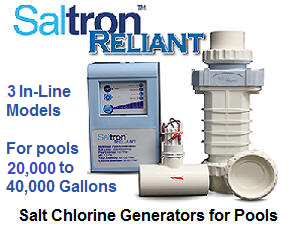
Salt Chlorine generators are a
better way to utilize chlorine, producing
more controllable results. They
eliminate the need to handle, measure or
store chlorine products, while reducing
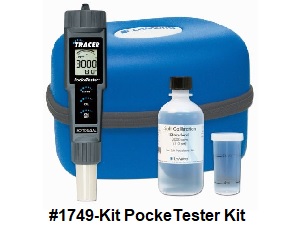
buildup problems. An
Electronic
PockeTester Kit is a convenient
way to monitor the salt level. |
|
Salt Chlorine Generators - 3
models |
Testing The Salt Level |
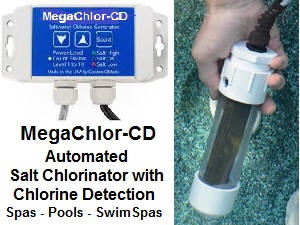
Salt Chlorine Generator - No
Installation |
 |
 |
 |
|
Product and Ordering Information |
Product and Ordering Information |
Product and Ordering Information |
If you have a pool or spa water
testing need, we should have the
product.
►
Scroll down to read through some
Question & Answer information.
◄
|
|
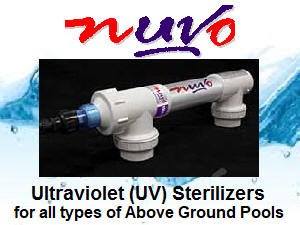
An
Ultraviolet Pool Sterilizer
kills 99.9% of the
microorganisms, passing through
the cell. It can kill
sanitizer-resistant pathogens
and is typically used with
chlorine or bromine. A
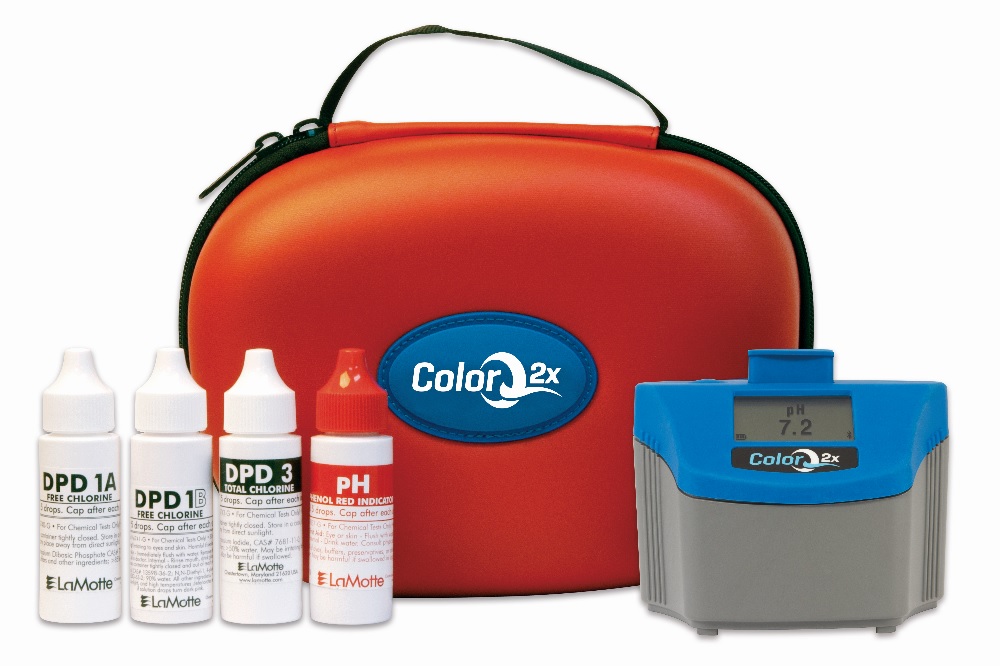
ColorQ All-Digital Water Tester
provides the reliable testing,
required to proper water
chemistry and sanitizer
efficiency.
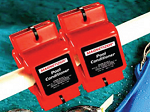
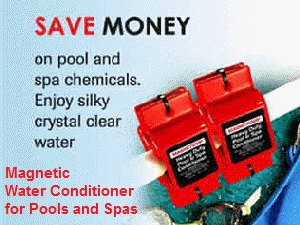
Magnetic Water Conditioners
help solve scaling problems, due
to high levels of calcium
hardness and are available in 4
models. |
|
Above-Ground UV Sterilizer |
ColorQ All-Digital Water Testers |
Magnetic Water Conditioners |
 |
 |
 |
|
Product and Ordering Information |
Product and Ordering Information |
|
If you have a pool or spa water
testing need, we should have the
product.
►
Scroll down to read through some
Question & Answer information.
◄ |
|
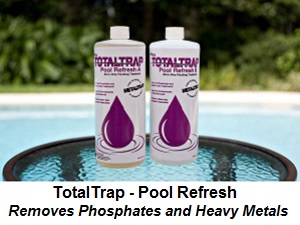
Total
Trap-Pool Refresh is the
easy way to remove phosphates,
which will, otherwise, promote
algae growth and sanitizing
issues.
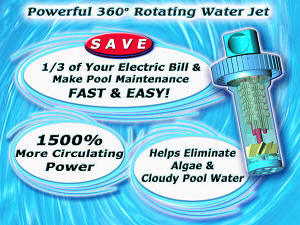
The Circulator is a
replacement return jet fitting,
that dramatically improves
circulation, by creating a
spiral return flow. Better
circulation helps sanitizers
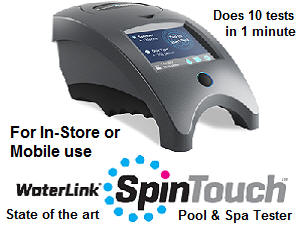
work more effectively. The
WaterLink SpinTouch Labs
are the ultimate tester, doing
up to 10 different water test
factors, in just 1 minute.
Voted product of the year. |
|
How to eliminate phosphates |
Circulation Boosting Return Jet
Fittings |
WaterLink SpinTouch Labs |
 |
 |
 |
|
Product and Ordering Information |
Product and Ordering Information |
Product and Ordering Information |
If you have a pool or spa water
testing need, we should have the
product.
►
Scroll down to read through some
Question & Answer information.
◄
|
|
|
How to use Ozone, to help sanitize and
maintain a pool? |
Ozone (O3)
is a form of Oxygen (O2)
and is a powerful oxidizing agent that can
control microorganisms, destroy organic
contamination, byproduct build ups, dead algae
and organic debris. It is not a complete
sanitizer in the truest sense, because it does
not remain in the water for long periods of
time. In a swimming pool, there must be a backup
sanitizer such as, chlorine or bromine, usually
at about 1/2 the normal level. Because the
ozonator does most of the oxidizing, far less
chlorine or bromine will be required to maintain
any given level. Ozonators, also known as Ozone
Generators, can greatly reduce the quantity of
the backup sanitizer that would, otherwise, be
required. This is especially important in larger
pools, heavy bather usage situations and
commercial pools. The devices that generate
Ozone fall into two categories: UV or Corona
discharge. Commercial pools, larger residential
pools or heavy bather load pools should utilize
a corona-discharge unit, as it is capable of
producing larger amounts of ozone. With
ozonation, the water chemistry should be
maintained in the typical manner. Ozone
generators can be even more effective, when used
together with a
salt
chlorine generator. If problems
arise, refer to the
Pool Problems
Page, as a source of problem-solving
information, broken down into various
categories. Scroll down the page and click on the linked
keywords,
catch phrases
or images, in the archived answers below, to access additional information, on that topic or product.
 |
Join our E-Letter Mailing List.
You'll receive 1-3 E-Letters a
month, featuring helpful pool
and spa advice, new product
information and sale
announcements. All we
require is your e-mail address
and you can opt out anytime you
wish.
Your information
will never be shared or sold. |
|
▼
Helpful,
Problem-Solving Information, in a question and
answer format.
▼ |
►
Bubbles In The Return Flow?
Hello, I have a new in ground pool
and we have the o-zone generator
installed. We have intermittent
bubbling while the pump is working
at the pool corner where is the
return line located. Does the O-zone
system produce that intermittent
(every 2-3 seconds) bubbling? Thank
you.
Joseph G., 12/18/2018
A
bubble stream is normal. Ozone is
introduced, into the water, by air
being sucked into the return flow.
This effect is called a venturi. If
you don't see bubbles, in the return
flow, that indicates something is
wrong. However, the presence of
bubbles does not mean ozone is being
produced. An ozonator is not a stand alone
sanitizing system. It needs back up.
It provides oxidation, without the
addition of chemicals that lead to
chemistry changes or buildup.
Chlorine or salt chlorine generators
can be used in conjunction with
ozone, which makes it a complete
sanitizing-oxidation system. Shock
is only required, if the water water
is deteriorating or, possibly, after
heavy bather usage. Any kind of
shock can be used. It is hard to
completely eliminate chlorine. It is
better to try and reduce the amount
required and an ozonator should help
you do that. When chlorine is
being used in a back up role to
ozonation, it is common to maintain
the chlorine at about 1/2 the usual
level. A
salt chlorine generator would be
a good choice, as it provides better
control and results. Chlorine should
be protected, by adding a one-time
addition of cyanuric acid, usually
around 50 PPM. The offensive odors,
sometimes associated with chlorine,
should be eliminated by the
ozonator. Ozone leaves the
water very quickly. You might
consider adding
THE
CIRCULATOR. This easy to install
device will create a spiraling
return flow, that helps keep the
ozone in the water, for a longer
period of time. Helps to better
distribute heat and chemicals and
reduce filtration time. I hope
that I have been helpful. If so,
please tell your friends and dealers
about the website.
ozonator is not a stand alone
sanitizing system. It needs back up.
It provides oxidation, without the
addition of chemicals that lead to
chemistry changes or buildup.
Chlorine or salt chlorine generators
can be used in conjunction with
ozone, which makes it a complete
sanitizing-oxidation system. Shock
is only required, if the water water
is deteriorating or, possibly, after
heavy bather usage. Any kind of
shock can be used. It is hard to
completely eliminate chlorine. It is
better to try and reduce the amount
required and an ozonator should help
you do that. When chlorine is
being used in a back up role to
ozonation, it is common to maintain
the chlorine at about 1/2 the usual
level. A
salt chlorine generator would be
a good choice, as it provides better
control and results. Chlorine should
be protected, by adding a one-time
addition of cyanuric acid, usually
around 50 PPM. The offensive odors,
sometimes associated with chlorine,
should be eliminated by the
ozonator. Ozone leaves the
water very quickly. You might
consider adding
THE
CIRCULATOR. This easy to install
device will create a spiraling
return flow, that helps keep the
ozone in the water, for a longer
period of time. Helps to better
distribute heat and chemicals and
reduce filtration time. I hope
that I have been helpful. If so,
please tell your friends and dealers
about the website.
Sincerely. Alan Schuster,
12/19/2018
►
Ozone Doing It Well?
I've read through your ozone area
and you've probably answered this, I
am just not getting it completely
(apologies.)
I have a fiberglass 15K gallon pool
(approximately)- in ground, just put
in this summer. We have an Ozonator, 2 speed pump and an
auto chlorinator (inline) that uses
chlorine pucks. Additionally I have
an inline mineral purifier.
Everything was great, but the inline
chlorinator seemed to be allowing
the chlorine to get too high (5+) so
I basically turned it off. Then I
forgot for a week and the chlorine
dropped to 0 or 1, so I turned it
back on. During this time we had
landscaping being finished so lots
of dust was getting into the pool.
We have a pool robot, and I kept it
clean and going, but I began to see
green stuff on the shadow side of
the wall of the pool. I shocked the
pool and now the chlorine is okay (3
or so) but the pH and stabilizer are
really high. Should I try to
correct it with more chemicals?
Thanks for any advice
Shawna R., Hendersonville, TN,
8/26/2020
Because the
ozonator is doing much of the
oxidation, less chlorine is being
used up and that causes the level to
build up. Cut back
o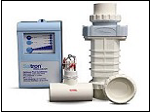 n the number of
tablets being used,
as you do want the ozone to continue
to do as much of the oxidation as
possible. You can lower the
pH, by adding acid.
Lowering the CYA
is another matter. It is rising,
because of the use of trichlor
tablets. At 150 PPM, you should
replace water, in order to drop it
under 75 PPM. High levels will make
the chlorine less effective and make
algae more likely. Adding a
salt chlorine generator will
allow you to use chlorine, without
adding to the buildup of cyanuric
acid. Having a mineral
purifier also helps you cut back on
chlorine usage and is another reason
to cut back on the number of
tablets.
The
Pool Circulator will help you achieve
dramatically better circulation,
which is important, in order to
better disperse the sanitizing
chemicals and ozone. I hope that the information
provided was helpful. n the number of
tablets being used,
as you do want the ozone to continue
to do as much of the oxidation as
possible. You can lower the
pH, by adding acid.
Lowering the CYA
is another matter. It is rising,
because of the use of trichlor
tablets. At 150 PPM, you should
replace water, in order to drop it
under 75 PPM. High levels will make
the chlorine less effective and make
algae more likely. Adding a
salt chlorine generator will
allow you to use chlorine, without
adding to the buildup of cyanuric
acid. Having a mineral
purifier also helps you cut back on
chlorine usage and is another reason
to cut back on the number of
tablets.
The
Pool Circulator will help you achieve
dramatically better circulation,
which is important, in order to
better disperse the sanitizing
chemicals and ozone. I hope that the information
provided was helpful.
Sincerely. Alan Schuster,
8/26/2020
► Ozone, Chlorine
And ORP?
I have a system with an ozone
generator and a controller for pH and ORP on my swimming
pool. I keep my pH at 7.5 and my ORP at 700. The one thing I
have always been confused about is how long to run my filter
pump. And what should the Chlorine level be? I've been told
I can use almost no chlorine, if I run my system 24 hours a
day. Presently I am maintaining a chlorine level of about
0.4 - 0.6 ppm and run my filter for 10 - 12 hours a day,
usually for 12 hours during summer and when the pool is
heated. I'd like to minimize chlorine usage. As I see it,
it's a trade off between chemical usage, electricity for the
pump and how much chlorine in the water I'm willing to deal
with. Is my practice an acceptable one, or would you suggest
otherwise? Thank you.
Ken C., 4/23/2018
You're right. It is a trade off. I suggest that you continue
as you are doing. It is not a good idea to give up on the
chlorine, as its presence acts as confirmation that proper
sanitation exists. With the ozone
generator, it will take little chlorine to maintain this
lower than normal level. The big negative, about chlorine,
is formation of odorous and irritating chloramines. In your
pool, this is not a problem because the ozone destroys the
chloramines. Chlorine acts as a persistent sanitizer and
helps backup the ozone. You seem to have things well in
hand. All I can suggest is that you operate the filter and
ozonator for two sessions per day, by dividing the current
running times in half. That way the pool will be without
ozone being produced for fewer hours at a time. Better
circulation will improve the chances
of success.
The
Pool Circulator will help you achieve
dramatically better circulation,
which will significantly, better
disperse the sanitizing chemicals
and ozone. I hope that I have
been helpful. confirmation that proper
sanitation exists. With the ozone
generator, it will take little chlorine to maintain this
lower than normal level. The big negative, about chlorine,
is formation of odorous and irritating chloramines. In your
pool, this is not a problem because the ozone destroys the
chloramines. Chlorine acts as a persistent sanitizer and
helps backup the ozone. You seem to have things well in
hand. All I can suggest is that you operate the filter and
ozonator for two sessions per day, by dividing the current
running times in half. That way the pool will be without
ozone being produced for fewer hours at a time. Better
circulation will improve the chances
of success.
The
Pool Circulator will help you achieve
dramatically better circulation,
which will significantly, better
disperse the sanitizing chemicals
and ozone. I hope that I have
been helpful.
Sincerely. Alan Schuster, 4/24/2018
►
Too Much Ozone?
I have a 26K gallon (100
cubic meter) pool, and currently installed is an Ozone
Generator, which can produce
4 grams/hour ozone. I run my pool pump 8 hours per day and,
yesterday, I measured the Ozone levels in my pool (right
at the return line) with an Ozone Meter
(quite
a sophisticated and
expensive Ozone meter using vials to break and vacuum
and put in the test equipment) and
the readings are astonishingly high at 2.8 to 3.1 ppm
levels.
At this point am I endangering the health
of my family and the guests? Can you please help
and let me know what product would be better to install,
from your site, and what is the actual Ozone readings I
should have from the pool water?
Thanks for your prompt
reply.
Vasko R., 5/3/2017
It is entirely
normal for the ozone readings to be high, right
at the return. It drops very quickly. as the
water mixes with pool w ater. At the other end
of the pool, you will probably find zero. Ozone
leaves the water very quickly, once the pump is
off. To help the ozone disperse better and
reach more of the pool, I suggest adding
The Pool Circulator.
Instead of having just a stream moving straight
ahead, it will create a spiraling return flow,
that will better disperse the ozone and allow it
to reach more of the pool and perform better, as
well. Still, ozone alone is not enough, to
assure proper sanitizing, as it leaves the water
too quickly. For this reason adding a
salt
chlorine generator can add persistent
sanitizing, while using a much lower level of
free chlorine to achieve optimum results.
There should be little or no odor of chlorine,
because of the ozone. I hope that this information will prove
helpful. ater. At the other end
of the pool, you will probably find zero. Ozone
leaves the water very quickly, once the pump is
off. To help the ozone disperse better and
reach more of the pool, I suggest adding
The Pool Circulator.
Instead of having just a stream moving straight
ahead, it will create a spiraling return flow,
that will better disperse the ozone and allow it
to reach more of the pool and perform better, as
well. Still, ozone alone is not enough, to
assure proper sanitizing, as it leaves the water
too quickly. For this reason adding a
salt
chlorine generator can add persistent
sanitizing, while using a much lower level of
free chlorine to achieve optimum results.
There should be little or no odor of chlorine,
because of the ozone. I hope that this information will prove
helpful.
Sincerely, Alan Schuster, 5/3/2017
► Ozone: how
does it work?
How do pool Ozonators work? Will other
chemicals and chlorine still be required? Thanks for the
help. Sincerely.
Jason H., Reading, PA, 7/24/2012
There are two common methods of generating ozone in a pool.
Most units pass air over a UV light source, that converts
oxygen into ozone. Others units use corona discharge
(electric sparking similar to lightning) to convert oxygen
into ozone. The corona discharge units can produce highe r
quantities of ozone, but can
generate unwanted nitrous oxides. In
a swimming pool, the ozone can
destroy organic matter, including
algae and bacteria. An Ozonator generates very high
levels of ozone, using a much safer
UV light source. The
Ozone Generator is usually operated in conjunction with the
timer and the filter. Once the Ozonator is shut off, all
production of ozone ceases and the ozone in the water
quickly leaves - there is no residual effect. At this point,
the pool is subject to microbial growth, especially on the
walls and in the corners. Because of this limitation of
ozone, there must be a backup sanitizer, most often chlorine
or bromine. However, the Ozonator will very dramatically reduce the amount of
chlorine or bromine required, to a fraction of what it would
be, otherwise. You can use a
salt chlorine generator to
produce any chlorine, that might be
needed, to maintain this lower than
normal level. So far as the overall water chemistry is
concerned, it must be maintained in consideration of water
clarity and quality, bather comfort and corrosiveness. I
hope that I have been of assistance. r
quantities of ozone, but can
generate unwanted nitrous oxides. In
a swimming pool, the ozone can
destroy organic matter, including
algae and bacteria. An Ozonator generates very high
levels of ozone, using a much safer
UV light source. The
Ozone Generator is usually operated in conjunction with the
timer and the filter. Once the Ozonator is shut off, all
production of ozone ceases and the ozone in the water
quickly leaves - there is no residual effect. At this point,
the pool is subject to microbial growth, especially on the
walls and in the corners. Because of this limitation of
ozone, there must be a backup sanitizer, most often chlorine
or bromine. However, the Ozonator will very dramatically reduce the amount of
chlorine or bromine required, to a fraction of what it would
be, otherwise. You can use a
salt chlorine generator to
produce any chlorine, that might be
needed, to maintain this lower than
normal level. So far as the overall water chemistry is
concerned, it must be maintained in consideration of water
clarity and quality, bather comfort and corrosiveness. I
hope that I have been of assistance.
Sincerely. Alan Schuster, 7/24/2012
► High
Chlorine Levels?
Alan-we have a new indoor pool and are
having trouble keeping the chlorine level down. The pool is
used primarily by one swimmer, and is covered around 23
hours per day. We’ve been using a dichlor shock treatment
once a week per instructions. I’ve shut our chlorinator
(which uses 3” tablets) off entirely. With the chlorinator
off for more than one week now, and with a shock per above
one day ago, our readings are total chlorine (between 3 and
10), free chlorine (10+), with pH, total alkalinity, and
stabilizer at normal levels. When the cover comes off,
there is a definite chlorine odor. The pool has an ozone
generator and a floating mineral sanitizer. I suspect
that with no sunshine burn off, and limited bather use,
there is limited consumption of chlorine. Is the solution to
not shock and dribble in very little chlorine, or shock
using less shock product? We’re literally itching for an
answer! Thanks!
Stephen R., Alaska, 11/30/2014
I can see from your email address why the pool is indoors. I
do have an answer for you, but it may not, entirely, be the
one you expect. Stop adding all chlorine: either in the form
of tablets or shock! Your pool is equipped with an ozonator
and a Mineral Sanitizer, is located indoors, is covered most
of the time and not subject to high bather loads. This means
that the ozonator and the
mineral sanitizer should be more than capable of meeting
most of your pool's sanitizer
requirements. The chlorine levels
are building up because there is
little for them to react with - just as you might
have suspected. The recommendations for chlorination and
shocking were probably made based on the pool NOT being
equipped with an ozonator and mineral sanitizer. The only
time you will ever need to shock the pool is at the first
sign of a loss of water quality or after periods of heavy
bather usage. Under these circumstances use a full strength
chlorine or non-chlorine shock. The equipment that you have
is what I frequently recommend to pool owners that are
sensitive to either chlorine or bromine. I hope that this
will solve the problem.
Sincerely. Alan Schuster, 12/1/2014
► Why Aren't
Ozonators More Popular?
Ozonators sound like a good idea. So
why are they not very popular? Is it good for a lazy pool
owner?
John W., 6/24/2005
They may not be as popular as chlorine, but their popularity
is increasing in all types of residential and commercial
pools. The use of ozone generators has been widespread in
spas for many years. Ozonators are not complete stand alone
pool sanitizers. A backup system, usually chlorine or
bromine must be used. A
salt chlorine generator can be used
in conjunction with an ozonator and will provide additional
benefits. Mineral sanitizers and ionizers can also be used
in conjunction with ozone and chlorine, to provide backup
sanitizing and reduce the chlorine usage. In addition, all
of the important water chemistry parameters must be
maintained, as in a chlorine-maintained pool. Yes, it is
convenient. Yes, it will reduce the overall requirements for
sanitizer and will simplify chemical balancing. Yes, it is
good for "lazy" pool owners. There are other choices that
might be worthy of your consideration. Salt chlorine
generators can completely eliminate the need for any
chlorine and there is no need for a backup. Still the water
chemistry must be maintained. But isn't that what pool
service companies are for? I hope that I have been of
assistance.
Sincerely. Alan Schuster, 6/24/2005
► Ozone Is
Not Always Enough?
I have a 40000 liter above ground
therapy pool. This means it is kept at 94 deg. at all times
and that only 2 people are in the water at a time. The pool
is lined with a thick PVC liner, n a closed enclosure and
covered during the night. The filter is a 3/4 HP with
zeolite filter. It runs 24/7circulating all the water every3
hours. Sanitation is ozone only- a GDS process with a
side stream injection and contact tank. Ozone generator is
controlled by an inline ORP controller, measuring water
returning from the pool and keeping them at 680-780 mv. Pool
pH is kept around 7.3. 6 months ago I enlarged my pool (took
it apart and added new segments. All above data is post
op.) Ever since then, the walls of the new segments, lined
with the same kind of liner, are becoming slimy slippery. I
have been scrubbing it off every week and it just keeps
coming back. I have tried super-chlorinating, which seems to
keep it clean for 3-4 days, but then its back .if I let it
be it eventually spreads to the 'old' parts of the pool.
Could it have something to do with ozone-zeolite reaction?
Could ozone be sucking plasticizers out of the liner( and
still doing it after 6 month's). I will be glad to add any
more info you need to speculate this. Tnx.
Nir Z., 12/7/2008
There is no mystery here!!! Ozone generators are good
additions to any pool, spa or therapy pool. While they do a
great job at reducing the biological loads and waste
products, they cannot be used alone and achieve proper
results. Ozone does not remain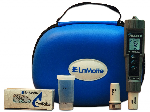 in the water very long and
will be unable to prevent the growth of algal or bacterial
slimes on the walls or in the corners. To keep all of the
underwater surfaces free of
microorganism growth, it is
mandatory to use a sanitizer such as chlorine or bromine.
Because the ozone generator will be doing most of the
oxidation, the amount of chlorine required, to maintain any
given level, will be greatly reduced. In other words, you
still should be maintaining at least a low level of chlorine
or bromine and, to do so, it will require less chemical,
than if the ozone generator was not present. Chlorine and
bromine are persistent sanitizers and
having the ozonator present, allows their use to focus on
sanitizing. When the ozone generator is off, the
chlorine or bromine will still be present to sanitize and
oxidize. No
mention of chlorine use was mentioned in your letter, except
to help clean up the microorganism growth. If you were not
directed to add and maintain a chlorine or bromine level,
you were ill-informed or mislead. Just an
ORP Test is not enough.
If you add a salt chlorine generator, it will provide backup
sanitation, while using less chlorine, than a pool without
an ozonator. Zeolite has to be regenerated
periodically, with the addition of a salt solution, to the
filter tank. Having a
salt chlorine
generator completely eliminates the need to regenerate,
because of the salt content of the pool water. The high operating temperature only adds to the problem. The
zeolite is not part of this problem. At this point, you need
to shock the pool and get a stable free chlorine level and
all traces of slime removed. From this point forward, try to
maintain a free chlorine level of 1-2 PPM or a bromine level
of 2-4 PPM, while operating the ozone generator for as much
time, as practical. I hope that this information will be
helpful. in the water very long and
will be unable to prevent the growth of algal or bacterial
slimes on the walls or in the corners. To keep all of the
underwater surfaces free of
microorganism growth, it is
mandatory to use a sanitizer such as chlorine or bromine.
Because the ozone generator will be doing most of the
oxidation, the amount of chlorine required, to maintain any
given level, will be greatly reduced. In other words, you
still should be maintaining at least a low level of chlorine
or bromine and, to do so, it will require less chemical,
than if the ozone generator was not present. Chlorine and
bromine are persistent sanitizers and
having the ozonator present, allows their use to focus on
sanitizing. When the ozone generator is off, the
chlorine or bromine will still be present to sanitize and
oxidize. No
mention of chlorine use was mentioned in your letter, except
to help clean up the microorganism growth. If you were not
directed to add and maintain a chlorine or bromine level,
you were ill-informed or mislead. Just an
ORP Test is not enough.
If you add a salt chlorine generator, it will provide backup
sanitation, while using less chlorine, than a pool without
an ozonator. Zeolite has to be regenerated
periodically, with the addition of a salt solution, to the
filter tank. Having a
salt chlorine
generator completely eliminates the need to regenerate,
because of the salt content of the pool water. The high operating temperature only adds to the problem. The
zeolite is not part of this problem. At this point, you need
to shock the pool and get a stable free chlorine level and
all traces of slime removed. From this point forward, try to
maintain a free chlorine level of 1-2 PPM or a bromine level
of 2-4 PPM, while operating the ozone generator for as much
time, as practical. I hope that this information will be
helpful.
Sincerely. Alan Schuster, 12/8/2008
► Minimizing
Chemicals?
After reading more of your advise to
others, I am wondering if we could get away with using NO
chlorine by using an ozonator along with a mineral pac or an
ionizer. We are getting a small (3,600 gals.) fiberglass
pool which will be covered with a 4" spa cover, and will
also be under a patio cover, used by 2 adults. We plan to
keep the pool at 87-90 degrees. What would you recommend?
Would our filter (sand) have to run longer if we do not use
chlorine or a salt chlorinator? What other
additives/tests would we need to use, and would we have to
be extra careful to add fresh water, because of the pool
being covered all the time? Is it smarter to just go with a
salt chlorinator? Our pool installer is discouraging us from
use the salt chlorinator, and if indeed we can get by with
no chlorine, that would be ideal. However, we want to keep
things simple as well as clean, and safe. I'm obviously in
the dark about pool chemistry and appreciate any insight
that you can offer. Thanks.
Patty, Tucson, AZ, 10/20/2010
What you are proposing will work. Just make sure that the
ozonator is properly sized for your pool. The combination of
an ozone generator and a
mineral sanitizer might work, even at higher temperatures, as this combination is
popular in spas. For
 the sake of bather comfort and water
quality, the overall pool water chemistry must be maintained
in the typical manner. This combination should not
require
filtration practices that are different from typical pools
of the same size and configuration. By adding
The Pool Circulator, you will
dramatically improve circulation and eliminate dead zones.
This makes it possible to send ozone to the four corners of
the pool, achieving optimum performance. Another means of
minimizing chemical usage is with ultraviolet sanitizing.
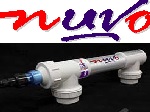
Adding an
Ultraviolet Sterilizer will allow you to use as
much as 70% less chlorine or bromine, killing virtually all
of the microorganisms, as the water flows through the unit.
I would still advise the use of a low level of chlorine, as
it confirm that proper conditions exist. All it should take
is a 0.5-1.5 PPM level. There is be little sensation of
chlorine and the amount used, to maintain this level, will
be much less. You may not eliminate chlorine, but you will
come close. I hope that this information will prove to be
helpful. Please tell your friends and dealers about the
website. the sake of bather comfort and water
quality, the overall pool water chemistry must be maintained
in the typical manner. This combination should not
require
filtration practices that are different from typical pools
of the same size and configuration. By adding
The Pool Circulator, you will
dramatically improve circulation and eliminate dead zones.
This makes it possible to send ozone to the four corners of
the pool, achieving optimum performance. Another means of
minimizing chemical usage is with ultraviolet sanitizing.
Adding an
Ultraviolet Sterilizer will allow you to use as
much as 70% less chlorine or bromine, killing virtually all
of the microorganisms, as the water flows through the unit.
I would still advise the use of a low level of chlorine, as
it confirm that proper conditions exist. All it should take
is a 0.5-1.5 PPM level. There is be little sensation of
chlorine and the amount used, to maintain this level, will
be much less. You may not eliminate chlorine, but you will
come close. I hope that this information will prove to be
helpful. Please tell your friends and dealers about the
website.
Sincerely. Alan Schuster, 10/20/2010
► Bromine
Usage and Ozone?
I have a 25K gallon in ground pool
that uses bromine for sanitation. We have had the pool for 9
years and it is 15 years old currently. It has been
relatively easy to maintain. My question is that with
bromine, we have to shock the pool almost every other day in
the peak of summer when it is used a lot and the water temp
is up around 80. I am assuming that this is because bromine
is un-stabilized and degrades quickly from the Sun. So the
real question is what type of auto generating systems can
we add to this pool to ease the high volume of shocking?
Looking at Ozonators, Salt Generators, etc, but find very
little info when it comes to supporting a bromine system.
Thanks for your help.
Scott R., 4/2/2008
This is a good question and you are wise to ask it. Even if
you stop using bromine, bromide ions will remain. Adding
chlorine will convert the bromides to bromine and the
process keeps recycling. If you add a
salt chlorine
generator, it will have to be set at a higher
than normal setting and this will shorten the life of the
cell and create more of a pH rise. Many salt chlorine
generator manufacturers do not recommend having bromides
present. An ozone generator is not a stand alone sanitizing
system. It needs back up. It provides oxidation without the
addition of chemicals that lead to chemistry changes or
buildup. If you use an ozone generator, it will carry the
burden of the oxidations or wastes and organic byproducts.
That leaves the bromine for sanitizing and backup. Under
these circumstances, you will need far less bromine and
should be able to set the goal at a lower 1-2 PPM level.
Because bromides are present, you can use the less expensive
chlorine to maintain the low bromine level, as it will be
converted. I hope that this
information will prove to be helpful.
Sincerely. Alan Schuster, 4/3/2008
► Ozone And A
Salt Chlorinator?
I live in Venezuela and we live in the
mountains where is cool and we have a pool of about 41,000
gallons that is currently heated to about 90 degrees and
this is forcing us to increase our chemical usage. The kids
eyes are being affected. I would like to move towards using
less chemicals and would like to get a ozone generator
and/or combination of a salt chlorinator. Could you
recommend something?
Luis R., Venezuela, 2/13/2007
The
combination of a salt chlorine generator and an
ozone
generator should be a great improvement. While a combination
unit does exist, I would not recommend it. Your pool is
quite large and the temperature will be on the high end. You
should have full sized or even oversized units. For a salt
chlorine generator that will do the job properly, I suggest
an in-line model. The ozonator will provide backup oxidation and
help minimize the amount of chlorine required. This will
create more pleasant conditions and help the extend the life
of the salt cell. I hope that this information proves
helpful.
Sincerely. Alan Schuster, 2/13/2007
► How Long Do
Ozonators Last?
I have an ozonator on my pool and use
trichlor, as well. It has made a major improvement and has
decreased the chlorine needed to maintain a satisfactory. I
know eventually I will have to replace a part, but how will
I know? Thanks.
Eric B., San Diego, VA 1/4/2010
The ozone generator will require a replacement part of bulb,
depending upon the type of unit. You should get 2-3 years,
before needing a replacement part. There are
ORP PockeTesters, that you can use, right at the return, to
confirm the presence of a proper ORP. If you ever notice a decrease
in water quality, while maintaining proper chlorine
readings, or if the amount of chlorine needed to maintain a
satisfactory has become much higher, it suggests a
replacement item is needed. I am glad to see that you
appreciate the benefits of using ozone and chlorine
together. Using less trichlor slows up the rise in the
cyanuric acid concentration and makes the pH more stable,
for longer periods of time. I hope that this information id
helpful.
Sincerely. Alan Schuster, 1/5/2010
► Hydrogen
Peroxide As A Backup?
I read some of the information on your
website regarding using ozone in a pool with a sanitizer
like chlorine, bromine, ionizers, or mineral sanitizers, but
I was wondering couldn't you also use hydrogen peroxide as a
residual sanitizer? Any additional information you could
provide on this would be greatly appreciated. Thanks.
Vince, 6/11/2010
Hydrogen peroxide is not used as a pool water sanitizer. It
is used only as an oxidizer, primarily with biguanide
maintained pools. Biguanide acts as a
sanitizer and hydrogen
peroxide acts as an oxidizer and not as a sanitizer. With an
ozonator, you don't need an additional oxidizer, as ozone
amply
fills that need. What you do need is a permanent
backup sanitizer and, in this role, chlorine, bromine or
salt chlorine
generators can be used. This
way, if ozone is not being produced, for a short period of
time, there will still be some sanitizer present. I hope
that this information proves helpful.
Sincerely. Alan Schuster, 6/11/2010
► Protecting
The Vinyl Liner?
I have been investigating ozone
systems and it I have read that ozone bubbles that get in
the pool may cause vinyl liner color fading If the water
flow at the return nozzles are directed straight out into
the pool, do you think there will still be a problem with
liner fading in your experience? I have been talking to a
leading manufacturer about this, but I don't think they want
to commit to whether or not I will have a problem.
Leon H., 10/22/2014
 | |
Not wanting to answer the question would hardly instill
confidence in me. WHAT FADES VINYL LINERS IS DIRECT CONTACT
OF CHLORINE PRODUCTS OR VERY HIGH LEVELS, OVER A LONG PERIOD
OF TIME. Ozone does not remain in the water for very long.
In truth, most of the ozonation benefit happens in the
return pipes of shortly thereafter. That is why it is
suggested that chlorine or bromine be used in conjunction
with ozone, in order to provide persistent sanitation and
oxidation. It will help you get by with less chlorine or
bromine, to maintain any given level and that will help
preserve the liner's appearance. Adding The
Pool Circulator will help
to better distribute the ozone, by boosting circulation and
improving distribution. I hope that this information will
prove helpful.
Sincerely. Alan Schuster, 10/22/2014
|
Visit The Website Stores . . . for
better informed shopping!!! |
|
|
Shipping is FREE* . . . within
the Continental U.S.
A $9.99
handling charge will apply
to Continental U.S. Orders,
under $75.00. Orders
outside of the Continental
U.S. may require some
additional charge, based on
quantity and destination.
Most products can be
shipped World-Wide. International
and orders outside of
Continental U.S. - see
comments on the ordering
pages. |
|
|
Major
Credit Cards and PayPal are accepted. |
|
▲
Return To Top Of Page
▲
Aqualab Systems, LLC does not
make any warranty or
representation, either expressed
or implied, regarding the
accuracy or completeness of the
information provided by this
website; nor does Aqualab
Systems., LLC. assume any
liability of any kind whatsoever
related to, or resulting from,
any use or reliance on this
information. The content of this
website should not be used, if
it is conflict with any
applicable federal, state or
local regulations or guidelines.
© Aqualab Systems, LLC. All
rights reserved
|
|