Cart
Sub-Total: $0.00
We have an above ground pool: 15′ diameter X 4′ deep. I have been told that the amount of chlorine, that a pool requires, is more dependent upon the bather usage that it is upon the actual gallons. Is that true and what do you suggest? Thanks.
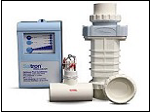
Answer: 06/29/2020It is true that the amount of bather wastes is not just dependent upon pool size. A small above ground pool will require less chlorine than a big inground pool. The chlorine requirements, of a pool, are not strictly based upon the water volume. Actual pool usage must be fac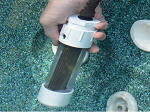 tored into the maintenance procedures. Smaller pools can be depleted of chlorine more quickly than larger pools, if the bather usage is similar. In order to maintain a more uniform chlorine level, a chlorine feeder is a worthwhile consideration. Smaller pools can get by with a floating feeder, although there is a risk of vinyl liner damage, if the floating chlorinator remains in prolonged contact with the pool walls. An inline chlorinator is always a better choice. To regulate the amount of chlorine, it is important to test for Free Chlorine on a daily basis and even more often during periods of high bather usage. In addition, it may be necessary to supplement a chlorinator with periodic additions of a quick dissolving chlorine or shock, during or after periods of high bather demand. In short, small pools do require more diligent attention, if problems are to be avoided. New and affordably priced ways to chlorinate a pool include the Reliant Salt Chlorine Generators or MegaChlor Salt Chlorine Generator. They works well in most above ground pools, installation is minimally simple and no plumbing is required. It can make all the chlorine your pool requires, without handling or storing chlorine. I hope that I have been of assistance.
I have a saltwater vinyl pool around 24k gallons. The past 3 years when I open, I have had chlorine lock and gave to shock with 6 gallons of liquid chlorine. And, repeat if needed. Any suggestions on how to break the lock a better way? Thanks,
Answer: 04/14/2018
“Chlorine Lock” is a mythical term. All it means is that the demand, for chlorine is so high, that a large amount of chlorine is required, to establish a persistent free chlorine level and destroy the combined chlorine. This is typical at pool opening time. The salt chlorine generator, simply cannot produce enough chlorine, fast enough to catch up. Adding supplemental chlorine, as you have done, is the right thing to do. Once there is a free chlorine level and the water clears, the salt chlorine generator should be better able to maintain a suitable level. We hope that the information provided was helpful. If we were helpful, please return the favor and tell your pool or spa owning friends, about our website.
How does the circulator powered? Electric a pool pump etc I can’t find anything on the website Thank you.
Answer: 07/10/2020
 The Circulator does not require any power hookups. Standard return jet fittings send the water straight ahead, The Circulator replaces the standard fittings and creates a spiraling return flow, that reaches throughout the pool. This helps avoid “dead zones” that promote algae growth. Better circulation means better filtration, improved sanitation and better water clarity. All this is gained, by simply replacing the standard fittings with The Circulator. Please visit our website store to browse through a large selection pool and spa water testers, as well as many different, useful and interesting pool and spa products.
Help!! Our in ground gunite plaster pool. It is 9 years old. It is using the salt water system which we love. Work great water is always up to par we check it daily and then once a week take to the local pool store. The one we take the water to is a respectable pool place. But have a question for you. We will not have any one in the pool, for a week or so. Then we will get in and the is white dust thick on bottom. Not quite sure what this is. Thank you for listening please get back with us, as soon as possible with some answers for our problem. Thank you and may God Bless you for helping others, all of our level are perfect. Thank you.
Answer: 08/01/2020
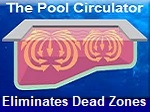 It is called silt and is a combination of wind-blown dust and debris and, possibly some dead algae and plaster dust. When the pool is in use, all this gets stirred up and is mostly filtered out. It doesn’t have a chance to accumulate. If the pool is not used, for a week, it tends to accumulate and cloud the water after it is agitated by swimmers. Vacuuming, first thing in the AM, should help. Adding The Pool Circulators will dramatically improve circulation and help reduce the volume of sediments. I hope that the information provided was helpful.
Will excessive cyanuric acid corrode the tubes in a pool heaters heat exchanger?
Answer: 05/04/2020A pH lower than 7.0, with chlorine or bromine present, will corrode heaters. The lower the pH, the faster it will proceed. That is one of the reasons the pH should be maintained at 7/2-7.8. High levels of cyanuric acid will impede the effectiveness of chlorine. The latest industry research suggests that 50 PPM is the maximum, that should be maintained. If you want to use chlorine and avoid the buildup of cyanuric acid, you should consider a salt chlorine generator. It is the better way to use chlorine.
We just recently opened our pool and began testing chlorine levels with our ColorQ test kit purchased a few years ago, from your company. I have since noticed that the test drops DPD-1A and DPD-1B, purchased this year, appear to be defective. When testing the water the DPD 1-B drops turn a red color for only a short moment (3 to 4 sec) then they go nearly clear indicating a need to add chlorine. I know I have a more than adequate level of chlorinator in the water from a test strip test. I do not see any issues with the pH drops, the total alkalinity drops and calcium drops however I have nothing to compare them against as I already disposed of our remaining test drops from last year. Could these drops be bad also? Please let me know what the problem might be and when you can rectify it.
Answer: 05/28/2019It would appear that the free chlorine level is so high, that it is destroying the test chemicals. Take a sample of pool water and mix it with 2 parts of tap water. Test the mixture. If you get a test reading, multiply it by 3. It won’t necessarily be an accurate answer, but could confirm the presence of a very high level. Most testers only read chlorine, to 10 PPM. You don’t need to add more chlorine, as you probably have far too much. The reagents are not defective. It is a very high level of chlorine, probably over 20 PPM, that is caused the quick fading. Let me know what happens.
I had a dealer run a series of tests and the cyanuric acid tested out at 150 PPM Too high. I learned, from your website, that theSmarterSpa Salt Chlorine Generator for Spas. level became too high, because of my long term use of 3″ trichlor tablets. I knew that I would have to replace 1/2 of the water and did not want to have to keep doing this, because of the trichlor tablets. So. I decided to go with a SmarterSpa Salt Chlorine Generator, that I saw, on your site. Now, I have a salt water pool and there should be no more problems, with cyanuric acid buildups. I had the cyanuric retested and expected to see a reading of about 75 PPM. Instead, I was told it was 105 PPM. That doesn’t make sense, unless one of the tests was wrong. Do you have an explanation? Loving the convenience of the salt chlorine generator. Thank you.
Answer: 05/14/2021Of all the common tests, cyanuric acid is the least reliable and reproducible. Most testers only read to 150 PPM, maximum. So ge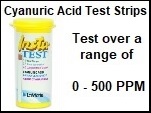 tting a reading of 150 PPM, does not preclude the probability, that the true reading was in the neighborhood of 210 PPM. That would explain why the level only dropped to 105 PPM, after half the water was replaced. For your pool, 50 PPM is good, as a maximum, based on the latest thinking. Higher levels will mean that you will have to maintain a higher free chlorine level, in order to assure proper sanitation. Instead of 1-3 PPM of free chlorine, you might need 2-4 PPM. It would be in your long term interest to drop the level closer to 50 PPM, as it should help the salt cell last longer. LaMotte has come out with a new Cyanuric Acid Test Strip, that measures from 0-500 PPM. This is something that a dealer should have available and should use to retest all readings over 100 PPM. I hope that this information is helpful.
I’ve noticed a white hard deposit along the water line on the tiles. Our guess is that it may be calcium deposits. If that’s the case, what would be an appropriate way to get rid of the deposits and to prevent it from happening again? In one of your answers we read your suggestion about using Mineral Treatment and lowering the overall pH (to 7.2 or so). Would this be advisable to do in our case as well? Are there any specific recommended brands for the Mineral Treatment and how do you use it? Thanks!
Answer: 04/12/2018Most likely the deposits are calcium scale. This pool problem is most likely due to the water reaching the saturation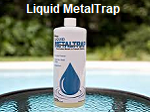 point, so far as calcium hardness is concerned. These deposits can removed using a strong muriatic acid solution. Apply with a sponge and make sure to wear rubber gloves and eye protection. First, test in a small area to see how it will affect the deposits and the tile. If your calcium hardness level is above 400 PPM, you will have to add a quality, phosphate-free mineral treatment, such as Liquid MetalTrap – possibly several times the suggested dose – in order to try and avoid a recurrence. Your local pool professional should be able to suggest a product. Keeping the pH closer to 7.2 and the total alkalinity closer will, also, help reducing the scaling tendencies of the pool water. For more information on the topic, refer to the “Langelier Index” page. The addition of a Magnetic Water Conditioner might be able to help resolve some of the scaling issues. I hope that this recommendation works out for you.
I use a Color 2X PRO 7, and the LaMotte WaterLink HOME Solutions APP, to test my water on a daily basis. What is the difference between Alkalinity and Adjusted Alkalinity measurements? Should I use the alkalinity number or the adjusted alkalinity number, to maintain the correct alkalinity level in my pool? My current numbers are 142ppm alkalinity and 100ppm adjusted alkalinity with pH at 7.3ppm. The report indicates my alkalinity is high. Thank you.
Answer: 07/14/2022First let me make a point, regarding pH and TA. pH is ALWAYS the more important of these two parameters. It may not be always possible to get both in range, at the same time. If that is the case and the pH is in range, there is no compelling need to lower the TA, if it is high, providing that the water is clear and there are no signs of scaling. Accepting this will spare you the endless raising of the pH, which results in the TA rising too much. Raising or lowering one always affects the other, in the same direction.
Traditionally TA is based on bicarbonate-carbonate alkalinity, but other dissolved salts, such as cyanuric acid, can affect the TA. For this reason subtracting 30% of the CYA reading, from the TA reading, will give a better estimate of the bicarbonate-carbonate alkalinity.
Based on the data provided, the difference between the two TA readings can be accounted for by a CYA reading of about 140 PPM, which you did not provide. In your case, the available alkalinity is within the typical 80-120 PPM range and the pH is within 7.2-7.6, as well. Relying on the unadjusted TA, would lead you to think that an addition of acid, to lower the TA, would be beneficial. The addition of acid will lower the pH and force you to add soda ash to raise it back to 7.2-7.6. This will raise the TA and bring you back to the same place you were, before the acid was added. Avoiding this unnecessary up and down is the point of what is stated, in the first paragraph. I would rely on the adjusted TA reading and not add anything to alter the TA. I hope that this is helpful.
We have a 16,000 gallon gunite pool colored with light grey plaster. It is 3 years old and we are located near San Antonio, TX. Last winter we got some black mold in shade areas. We bought a black mold chemical online. It worked great but left lots of white or bleached out specs discoloring the service. It is not scale but discoloration. They are small in size such as 1/4″ but sadly there are lots of them. Any suggestions? Thank you.
Answer: 09/15/2018It sounds like you added trichlor granules, which are about 90% chlorine, acidic and slow to dissolve. Your description suggests that the surface was etched and that the gray colorant was destroyed. If this is the case, it is not reversible. Most likely the mold/algae grew in that area, because circulation was poor and sanitizing chemicals were not being delivered, to that area. Dead zones promote growth of algae or mold. Improving circulation is an important step, in help prevent a recurrence. The Pool Circulator replaces standard return jet fittings and turns the return flow into a spiraling pattern, which reaches areas throughout the pool. This delivers sanitizing chemicals and makes algae/mold growth less likely, by improving chemical distribution. Acid washing the pool, MIGHT soften the color differences. I hope that this information will be helpful.