Cart
Sub-Total: $0.00
We have a 16,000 gallon gunite pool colored with light grey plaster. It is 3 years old and we are located near San Antonio, TX. Last winter we got some black mold in shade areas. We bought a black mold chemical online. It worked great but left lots of white or bleached out specs discoloring the service. It is not scale but discoloration. They are small in size such as 1/4″ but sadly there are lots of them. Any suggestions? Thank you.
Answer: 09/15/2018 It sounds like you added trichlor granules, which are about 90% chlorine, acidic and slow to dissolve. Your description suggests that the surface was etched and that the gray colorant was destroyed. If this is the case, it is not reversible. Most likely the mold/algae grew in that area, because circulation was poor and sanitizing chemicals were not being delivered, to that area. Dead zones promote growth of algae or mold. Improving circulation is an important step, in help prevent a recurrence. The Pool Circulator replaces standard return jet fittings and turns the return flow into a spiraling pattern, which reaches areas throughout the pool. This delivers sanitizing chemicals and makes algae/mold growth less likely, by improving chemical distribution. Acid washing the pool, MIGHT soften the color differences. I hope that this information will be helpful.
There is some pink, slimy looking, slippery-feeling, growth in the hopper end of the pool – vinyl, built-in, chlorine maintained, 20000 gallons, heated and not looking so great. If it wasn’t for the color, I’d think that it was algae. What do you think and how do I handle it?
Answer: 06/23/2018What you think might be “pink” algae is really not algae at all. It is a bacterial slime problem and can be controlled. Make sure that your pH is 7.0-7.2, in order to make the chlorine more effective. Add a quick acting shock at the rate of 2 pounds per 5000 gallons, in order to boost the Free Chlorine Test reading to 5-10 PPM. Use a Free Chlorine Test Kit – this is important! Operate the filter continuously and try to maximize circulation in the deep end. Retest the Free Chlorine every few hours and add more shock, as might be necessary. Brush any areas with deposits. Add either a Silver or Polymer Formula Algaecide: these products have effectiveness against many types of algae and bacteria. As an alternative to these algaecides, or even in addition, add one of those “Yellow” Sodium Bromide Products. This will generate bromine in the water, which is especially effective against “pink” algae or slime. If after an overnight period, the Free Chlorine level is at 1-3 PPM, marked improvement should be seen. If the water is cloudy, it is likely from dead algae and organic debris: use a liquid clarifier to help remove these materials. Once sodium bromide is added chlorine usage will increase for some indeterminate length of time. However, if it solves the problem, it is worth doing. Restore the pH to optimum and resume normal filtration and chlorination. I hope that I have been of assistance.
First, let me say that you and your website are AWESOME! I have had my pool for 10 years now, and have gained most of my knowledge through your website, so thank you very much. In the 10 years, thankfully, I have not had many problems because I am meticulous with my pool and keep my chemistry perfectly balanced and circulation is great. I have a slight problem that I know you have the answer to, and here it is: My pool is a free form gunite pool with plaster, 35,000-40,000 gallons with a DE filter and salt chlorinator. I was experiencing “Pink Algae” and tried to use algaecide (as you recommended) with a lot of shock, and spending countless hours in the pool brushing every bit of the pink blooms. It got rid of it for about a week and it came back. Frustrated, I used 4 pounds of United Chemical’s “Pink Treat” and followed their instructions (the bottle and website say that it can be used in chlorine pools as well as salt generator pools). “Pink Treat” is sodium bromide 88.8%. The pink algae is definitely gone, however, even by following the directions on the bottle, I cannot get any reading for chlorine, no matter how high I turn up the chlorinator (salt generator) and now I’m worried that I converted my pool to a BROMINE pool. I’ve read all of your answers about this topic, and even others on the web, and I’m really concerned that I will have to drain my pool to start over if I want to get rid of the bromine. I’ve also read that by “making chlorine” that I am continually “assisting making more bromine.” Is this also true. Please help and let me know what I can do to get my pool back to chlorine generation from my cell, and/or get rid of the bromine. Right now my chlorine level is ZERO. However, all of my other levels seem good. Thank you for your prompt reply, and the great website. Warmest Regards,
Answer: 08/26/2017This is something that they don’t tell you. and causes confusion. The type of algae, that you had, was evidently resistant to normal level of chlorine. When you added the sodium bromide, the chlorine converted the bromide to bromine. In essence, you now have a bromi ne pool. So long as you keep generating chlorine, it will convert the bromide to bromine. It will be a closed system, so it will keep on cycling. The down side is that bromine cannot be protected, from the SUN’s UV rays, as can chlorine. Therefore, it will be best if you run the system, after the Sun has gone down. This will allow the bromine level to rise and persist and give you a reading the following morning. You could run the filter, for as few hours during daylight to promote circulation. To dramatically improve circulation, you could replace the existing return jet fittings with The Circulator. Better circulation cures a whole host of problems. The possible downside for trying to run the salt cell 24/7 is that you will shorten its cell life. This may not be exactly what you wanted to hear, but it did solve the resistant algae problem. Adding a 60% polymer can help provide some algae protection, during the daylight hours. If this website was helpful, in answering your question, please consider joining our E-Letter Mailing List. You’ll receive E-Letters, with helpful information, new product updates, suggestions and sale announcements. I hope that this recommendation works out for you.
I have never used an algaecide in my new above ground pool and have had no problems to date. My friends with pools, all seem to use phosphate eliminators, algaecides and chlorine. Is it a good idea to use algaecide? Just wondering.
Answer: 08/01/2020The best way to use an algaecide is to add it before you have a problem! That way, it can help you avoid a problem. Chlorine levels rise and fall during the course of the day, depending upon chemical additions and bather usage. When the sanitizer levels drops too low, algae can begin to grow. If an algaecide is present, it just might keep the algae under control, until an adequate sanitizer level is restored. Both above ground and inground pools can use algaecides. Your above ground pool does not have a main drain and means the water circulation is not very good across the bottom. Consider adding The Pool Circulator, which is a simple way to improve pool water circulation and eliminate dead zones, that promote algae growth. Adding a phosphate eliminator is an effective way to control algae, by denying algae a vital nutrient. A simple phosphate test will determine, if there is a need for this product addition. As long as you’re planning on using chlorine, why not use it in a better and more controllable way? A salt chlorine generator is a better way to do chlorine, providing more control, fewer problems and better results. If this website was helpful, in answering your question, please consider joining our E-Letter Mailing List. You’ll receive E-Letters, with helpful information, new product updates, suggestions and sale announcements. I hope that this recommendation works out for you.
I am sure that I have mustard algae. It is a yellowish-green color and does brush off the walls easily. I can get rid of it by shocking heavily. A couple of weeks go by and there it is again. I have heard the copper algaecide will work, but I have a aggregate finished pool and would rather not use copper. Any other suggestions.
Answer: 05/02/2018Your description can be that of mustard algae. It can be treated with other than copper algaecides. You might have a two-fold problem. One part is that your sanitizer level, chlorine I assume, is probably not being maintained adequately at all times. Make sure that you maintain a 1-3 PPM level of Free Chlorine, at all times. Do this and it is unlikely that you will see the mustard algae return. If the problems starts in certain areas, redirect the return flow to improve the water flow, in that area. Adding a circulation booster, such as “The Pool Circulator“, will improve the dispersal of chemicals and dramatically improve circulation. It’s simple to install. For more information, please click here. One of the best products to use for mustard algae is one of those “Yellow” Products containing sodium bromide. Used in conjunction with a shock treatment, it will generate bromine, which seems to be especially effective against mustard algae. It’s important to test for Free Chlorine, when shocking a pool. Make sure that you add enough product and it is added frequently enough to boost the Free Chlorine to 5-10 PPM. You want at least 1-3 PPM persisting through the over night period. Do that and there should a major reduction in the mustard algae, by the morning. Keep the filter operating continuously, until the problem is controlled. You didn’t mention if you have a robotic pool cleaner. They are very effective at cleaning and improving the water circulation on the bottom and can help remove some of the powdery mustard algae. Improving circulation, in the corners, will help prevent a recurrence. If this website was helpful, in solving your problem, please consider joining our E-Letter Mailing List. You’ll receive E-Letters, with helpful information, new product updates, suggestions and sale announcements. I hope that I have provided the solution.
My inground pool has a marcite finish that is a few years old and is in very good condition. However, there are a few blackish colored spots on the bottom, in the corners and near the ladder. I have tried using a Siphoning Device on the end of a vacuum pole with some acid solution, but nothing has happened. I can’t rub the spots off. Can this still be algae? Thanks.
Answer: 06/13/2020The fact that the acid solution had no effect increases the likelihood that it is algae. Black algae, in particular, can be difficult. Fortunately you only have some spots and that can make treatment easier. Your Marcite finish allows for more direct treatment. You have several options. Brush the surface to help expose the algae. Place a 3″ trichlor tablet on top of a spot and allow to remain in place for at least a few hours. The tablets can affect some masonry finishes, so either test it on an inconspicuous spot or verify treatment suitability with the finish contractor. If improvement is seen, repeat elsewhere, as necessary. Another option is the use of a Granular Trichlor to sprinkle onto the spots. Shut off the filter first, so that the granules sink straight down. Use a brush to do the positioning. Another method is to attach a 3″ trichlor tablet to a gadget (available in pool stores) on the end of a vacuum pole. This can be used to rub the trichlor onto the spots. NONE OF THESE OPTIONS ARE SUITABLE FOR OTHER THAN MASONRY FINISH POOLS – DO NOT PERFORM ON VINYL LINED OR FIBERGLASS POOLS. In order to help keep the algae from returning, you should consider the use of a Polymer Algaecide. This product is effective against many resistant types of algae, doesn’t foam and is non-metallic. To better assure proper overall pool water chemistry, visit a pool store that has a very reliable, professional lab such as a WaterLink SpinTouch Lab, rather than a less accurate test kit or strip reader. If this website was helpful, in answering your question, please consider joining our E-Letter Mailing List. I hope that this recommendation works out for you.
Alan, great web site! Keep up the good work. My problem is with recurring green algae in my filter. I have a 14,000 gallon above ground, sand filter, a timer, a chlorinator and very good city supplied water. I had this problem at the end of last season, and it came back mid-season this year requiring me to change the sand in the filter it was so bad. The water prior to the problem was perfect, and when I open the pool it’s always crystal clear. I routinely check pH, chlorine, and alkalinity. My chlorine is easy, the chlorinate and timer keep that right where I want it. The pH tends to drop after rain or heavy use, so I add soda ash when needed to boost it back to 7.4-7.6. Alkalinity usually runs a bit high, up to 180. Normally this is all it takes. Then the water started to slowly get cloudy despite my efforts to keep it clean. Over a period of two weeks it went from just noticeable, to almost cannot see the bottom. Based on an hunch I opened the filter and sure enough the sand had so much green algae that several washings with clean tap wouldn’t clean it (in a wheel barrow, stirring with a rake). So I changed out the sand, added shock and algae preventative, and now it’s crystal clear. When I back-washed, naturally the sight glass was quite green for about 90 seconds, then went clear.
My question is why is this happening and how do I prevent it? Should I add shock and /or algaecide down the filter basket as a preventative? I admit I don’t shock the water often because my chlorine always looks so good. I think I should shock more often, agreed? Will the algae the filter picked up contaminate the filter again?
Answer: 07/20/2017There’s nothing in your letter that jumps out and says fix me! There is always algae present in the filter and in the environs of the pool. When conditions are right, the algae will grow. There are two bits of information missing from your letter and that can be the clue to 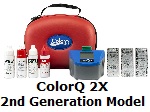 the problem. You did not state how you are testing for chlorine or if you are testing for Free Chlorine. If you are using OTO, you may be giving yourself a false sense of security. OTO measures total chlorine and is not the germicidal form of chlorine. You should be testing for Free Chlorine, which is the active and algae-controlling form of chlorine. Keep the level at 1-3 PPM. The total chlorine reading should not be more that 1 PPM higher. If it is you should shock to break down the combined chlorine. You also failed to mention the chlorine stabilizer level. If your level is higher that 150 PPM, it can reduce the effectiveness of the chlorine. If that is the case, you should exchange a foot or two of water, weekly, until a more suitable level has been reached. The right pool water tester can spare you a lot of problems. The ColorQ PRO 7 is an all-digital tester than eliminates the guesswork and all the color-matching. It would be my first choice. You might want to consider adding algaecide on a regular basis. My first choice would be a polymer formula. It can help with both the algae and the filtration. Sand filter can be very inefficient. You can boost efficiency, by replacing the sand with a zeolite sand replacement media. I hope that I have been helpful. Good luck and enjoy the summer.
I have a problem with what looks like a blue-green algae bloom in my pool. It is a vinyl, inground. I use a built-in chlorinator, with big tablets. I have had algae and green water problems before – I think it is because of the kids and you know what. Shocking usually does the trick. I haven’t been using algaecides. Should I and which would you suggest? Thanks much.
Answer: 07/11/2020In dealing with the blue-green algae, almost any algaecide can be used. It is not resistant to treatment. My choice would be a Chelated Copper Algaecide: it is effective, cost-efficient, does not foam and because it is chelated (stabilized) it should not cause staining. Just make sure that you use it as directed by the label, don’t add more, as most people do. Tell the kids that you bought a new product that detects the presence of urine – only problem is that the product doesn’t exist. Algaecide alone will not be enough, to prevent a recurrence, of the problem. You need better and more reliable sanitation and a salt chlorine generator is just about the best way to accomplish that. You can dial up the chlorine output, based on usage and the seasons. You will not longer have to store, measure or handle chlorine products and you’ll avoid the relentless buildup of cyanuric acid. Hope that I’ve helped. Enjoy the summer.
This is our first year of pool ownership. The pool is an 18′ round, above ground pool. We seem to have developed some algae on one side of the pool and the water has a green tint. I use a chlorine floating feeder, with 3″ tablets and have been very careful about the pH, alkalinity and stabilizer. I clean the cartridge filter weekly and run it for 8 hours a day. What went wrong? Please help because I won’t let the kids in the water.
Answer: 07/14/2019You have the most common type of swimming pool algae: the type that causes green water problems. It does sound like you are taking good care of the pool. Still, bad things can happen to good pools! This is really not that bad, just an inconvenience. Algae is always present in swimming pool water. If the conditions are right, it will begin to grow, resulting in visible signs of algae or problems with green water. That means, if the chlorine level has bottomed out because there wasn’t enough in the water or the demands of the bathers was just too high, algae can start to grow. From your letter, I cannot determine the actual cause, but I can make an educated, insightful guess. The chlorine floater may not always be able to supply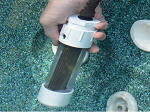 all the chlorine that the pool requires, because the tablets are slow dissolving. Floaters are popular with above ground pools, but are not necessarily the best way to add chlorine. It may be necessary to supplement the chlorine floater, by the addition of a quick dissolving product: sodium dichlor, liquid chlorine, lithium hypochlorite, non-chlorine, shock, etc. Or, you might consider a salt chlorine generator, instead of the floater or additions of shock. It will provide better control and can be used to give the chlorine a quick boost during those periods of high bather usage: like when all the kids are in the water for hours at a time. You are in control, by selecting the level of chlorine output, Test the water for Free Chlorine, several times a day, to gauge the requirements of your pool, during these periods of peak activity. I suggest that you use an algaecide to help prevent the growth of algae. To get rid of the algae, add 2 pounds of shock, per 5000 gallons of water. Circulate continuously. Test the water for Free Chlorine and keep the level at 2-3 PPM or higher, until the algae is gone. Thereafter, resume normal chlorination and filtration. Because the algae formed on one side of the pool, try and direct more water to that area. Swimming can resume, when normal chlorine levels return. Most above ground pools do not have main drains and this can result in poor water circulation on the bottom and in the corners. Adding a robotic pool cleaner will not only help keep the pool clean, it will improve water circulation and reduce the possibility of algae growth. I hope that this information will help to get the kids back into the water. Glad to be of assistance.
Do I want to add an algaecide while I’m shocking the pool to get rid of green water? I have received differing opinions.
Answer: 03/20/2015Sounds like a pool opening? The problem of green pool water is usually cause by the growth of algae. If this is the case, make sure that you vacuum out any debris, as soon as possible. It will help reduce the amount of shock needed to clear up the water. Always allow each chemical to dissolve in turn. Never mix different chemicals together. Algaecides are commonly added before or after shocking. To get rid of the algae it is important to maintain a Free Chlorine reading of at least 1-3 PPM, after an overnight period. It may be necessary to add more than 1 dose of shocking, depending upon the condition of the pool. Test the water a few hours after addition and add more shock, if required. The best product would be a 60% polymer algaecide, which is non-staining and non-foaming. I hope that I have been helpful.