| |
|
Scroll
down to browse through some archived SWIMMING POOL
questions and answers. Please click the Pool
Problems Link, on top of every page, to access a complete
listing of Pool Problem subjects, an alphabetized
Website Table of Contents, Pool Equipment Information,
About Alan Biographic Material and a Pool Glossary. Use
the other links to access additional subject
information. More information about some new and unique
products, for pools and spas, can be found by visiting
The Website Store.
You'll never know what you'll find and that's always
fun. Be better prepared and avoid costly problems!
|
|
 |
Shipping is FREE* . . . within
the Continental U.S.
A $9.99
handling charge will apply
to Continental U.S. Orders,
under $75.00. Orders
outside of the Continental
U.S. may require some
additional charge, based on
quantity and destination.
Most products can be
shipped World-Wide. International
and orders outside of
Continental U.S. - see
comments on the ordering
pages. |
|
 |

Major
Credit Cards and PayPal are accepted. |
|
On-line
shopping since 2002 - Safe and Secure!!! |
|
Caring for vinyl liner pools. |
|
A vinyl
liner requires proper care, in order to
preserve its appearance and extend its
life. Water testing helps avoid
harsh conditions that might damage the
liner.
A
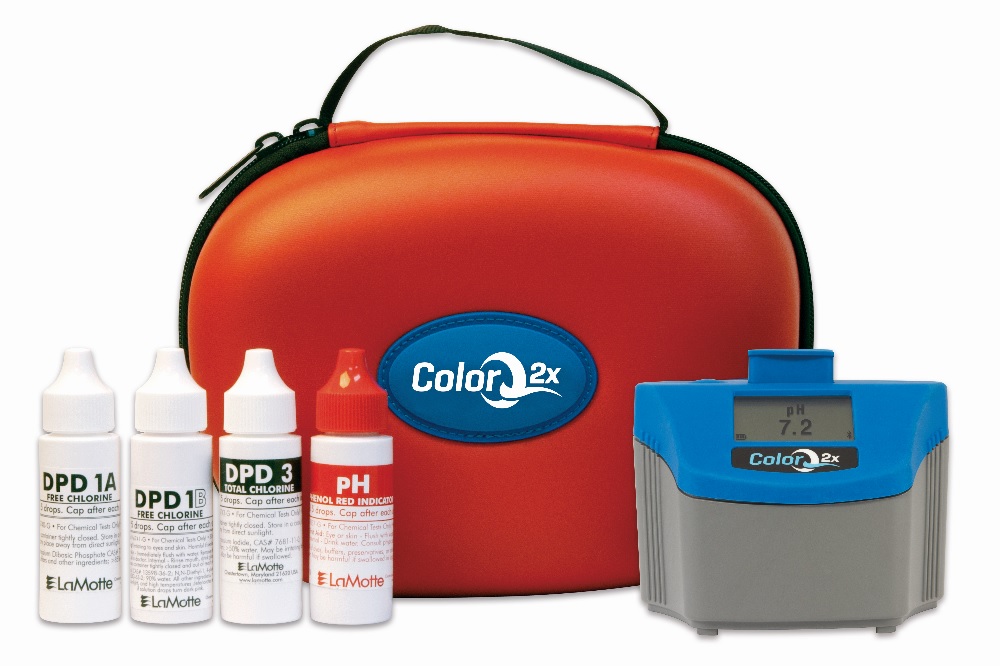
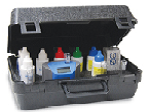
ColorQ 2X is a 2nd generation,
Bluetooth, Waterproof, all-digital tester,
that can
measure all the common test factors. There is a model, for every sanitizing
need.
If the liner ever needs a repair,
Boxer Adhesives products,
produced by
Union Laboratories are the place to
start. A
salt chlorine generator is a better
way to do chlorine, providing more
control and helping to avoid the harsh
conditions, that might hasten the fading the liner. |
|
|
If you have a pool or spa water
testing need, we should have the
product.
►
Scroll down to read through some
Question & Answer information.
◄
|
|
How to care for a vinyl liners and
solve common
problems? |
Vinyl liners
are used in virtually all of the above-ground
pools and most of the non-masonry, inground
pools. Liners, depending upon their gauge and
quality, can last for 10-20 years, if proper
care is taken. Chlorine and other oxidizers
should not be allowed to remain in prolonged
contact with vinyl liners or bleaching of the
color may result. Liners come in a variety of
colors and patterns. If a vinyl liner pool is
being emptied out, because of some necessity,
care should be taken to keep the liner wet, so
as to avoid possible shrinkage. Sharp or
abrasive objects should be avoided. If
problems arise, refer to the
Pool Problems
Page, as a source of problem-solving
information, broken down into various
categories. Scroll down the page and click on the linked
keywords,
catch phrases
or images, in the archived answers below, to access additional information, on that topic or product.
 |
Join our E-Letter Mailing List.
You'll receive 1-3 E-Letters a
month, featuring helpful pool
and spa advice, new product
information and sale
announcements. All we
require is your e-mail address
and you can opt out anytime you
wish.
Your information
will never be shared or sold. |
|
▼
Helpful,
Problem-Solving Information, in a question and
answer format.
▼ |
► Well Water
Caused Staining And Discoloration?
We had a 18' x 36' vinyl inground pool
installed. We had the water tested and had a list of
chemicals to add. I probably should have told the store that
I used well water, but I did not realize it was that
important. Now I know better. The water turned into a tea
colored solution, after I added some pH booster and
chlorine. There may be some brown stains, the deep end. What
should I do to make this right.
Mike K., 6/5/2011
It seems apparent that the water contained iron and other
metals. Dealers don't always run these tests and metals
don't always show up. Pools that turn amber to rusty, brown
or blackish, after addition of chlorine or pH raising
chemicals, usually have iron and other heavy metals present.
This is especially true, when well water is used. If you had
filtered the well water, used to fill the pool, through a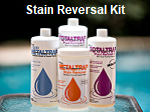 METALTRAP Filter, the heavy metals would have been
permanently removed. When the pool needed to be topped off,
all the new well water could have been passed through the
METALTRAP Filter, to prevent new additions of metals.
Removing metals, as the pool fills is the best insurance
against future problems. There are chemicals means to treat
metal problems and/or remove the stains they cause. Not all
of these chemicals are equally effective, some are
ineffective at higher pH levels and others contain
phosphates, which can lead to other problems. I suggest
adding Liquid METALTRAP: it is phosphate free and works over
the full pool pH range and beyond. Adding this chemical can
help avoid more staining and/or discoloration. If staining
has occurred, it can be removed with METALTRAP Stain
Remover. This concentrated product helps to reduce
and solubilize heavy metals, so that Liquid METALTRAP can
keep them in solution in a chelated state, which is less
colored and more stable. Following up with a recirculating
treatment, using the METALTRAP Filter can permanently
eliminate the metals. All you need is a garden hose and a
small pump to do the recirculation. Once you get the water
looking right, make sure that you run all new water through
the METALTRAP FILTER. Good luck and I hope that I've been
helpful.
METALTRAP Filter, the heavy metals would have been
permanently removed. When the pool needed to be topped off,
all the new well water could have been passed through the
METALTRAP Filter, to prevent new additions of metals.
Removing metals, as the pool fills is the best insurance
against future problems. There are chemicals means to treat
metal problems and/or remove the stains they cause. Not all
of these chemicals are equally effective, some are
ineffective at higher pH levels and others contain
phosphates, which can lead to other problems. I suggest
adding Liquid METALTRAP: it is phosphate free and works over
the full pool pH range and beyond. Adding this chemical can
help avoid more staining and/or discoloration. If staining
has occurred, it can be removed with METALTRAP Stain
Remover. This concentrated product helps to reduce
and solubilize heavy metals, so that Liquid METALTRAP can
keep them in solution in a chelated state, which is less
colored and more stable. Following up with a recirculating
treatment, using the METALTRAP Filter can permanently
eliminate the metals. All you need is a garden hose and a
small pump to do the recirculation. Once you get the water
looking right, make sure that you run all new water through
the METALTRAP FILTER. Good luck and I hope that I've been
helpful.
Sincerely. Alan Schuster, 6/5/2011
►
Vinyl Liner Patches?
I need to remove and a replace some old patches from
last season. I used
Boxer Adhesives #100 vinyl adhesive. Should I
use acetone to remove the old residue or can you
recommend something better?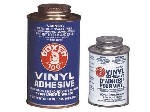
Brian L.,
6/24/2018
The manufacturer
always recommends (MEK) Methyl Ethyl Ketone as the
#1 go to.
However, they never recommend taking a patch off,
due to the additional damage, that could happen, to
the liner. They always recommends a larger patch,
over the old patch. I hope this is helpful.
Sincerely. Alan Schuster, 6/25/2018
► Adding A
Vinyl Liner To A Wooden Hot Tub?
I have a wooden hot tub and it is
beginning to show its age. There is some leaking and some
rough spots. Would it be possible to get a liner made to fit
this tub? Thanks in advance for the help.
Jeff. N., 3/2/2009
Getting a liner made to fit your hot tub is no problem, but
you will have to find a company that makes custom liners.
In the industry's buyer's guide, there are lots of
pool liner manufacturers listed, but none listed
under hot tub liners. They do exist, but you
will have to do some googling. I used to
have a name, but they have been lost, through
industry consolidation. Good luck and I hope that I have been helpful.
Sincerely. Alan Schuster, 3/2/2009
► Hot Tub Needs A
Vinyl Liner?
We have a 3 1/2 year old wooden hot
tub which is used twice a week or less. We have maintained
it with chlorine granules, non-chlorine shock, sodium
bicarbonate, and "enzyme". There is a copper ionizer in the
system, as well. In the past year, we have noted that the
wood surface is deteriorating, with lignin building up on
the surface and floating in the water. Additionally, purple
crystals have appeared and will not go away. They coat the
surfaces and stick to the filter. Having read that the
purple crystals are probably copper cyanurate, I turned off
the copper ionizer, but it didn't change anything. I have
not measured cyanuric acid level. We needed a water pump
replacement, so have drained the spa. The surface of the
wood cannot be scraped clean, and sanding doesn't work on
damp wood. I am planning to let it dry a few days, then sand
it, clean the filter and flush the lines, then refill and
start over. Dry wooden tubs tend to leak, so I don't want it
all dry. How can I avoid these problems in the future? Thank
you very much.

Jack S., Berkeley, CA, 10/24/2016
I think that the time has come for you to add a vinyl liner
to your hot tub. It will stop the leaks, make control of the
chemistry easier and add years of life to the tub. It may
not have the look you want, but it would be the right thing
to do. It will probably have to be custom made. On the plus
side, you will find the water chemistry easier to maintain.
It is important to monitor the copper content. There are
many models of the ColorQ Digital Water Analyzer and several
are designed, for use with ionized pools, spa or hot tubs. I
hope the advice helps.
Sincerely. Alan Schuster,
10/25/2016
►
Drainage Problem?
Alan, I am contemplating putting an
in-ground liner pool in my backyard. My backyard is
relatively level at the rear and then slopes down toward the
back of my house and levels out again. I want to install the
pool in the lower level but I am worried about drainage from
the higher ground. Do you have any suggestions?
Leslie D., 2/20/2017
Your question is really out of my area of expertise, but I
can relate some things to look into. I lived on Long Island
for many years and the Specialty Pool and Spa Chemical
Manufacturing company that I co-founded was based there, as
well. I knew many of the local builders and got to hear
stories about the "tough" jobs. It was not uncommon to
actually put a vinyl-lined, inground pool into the water
table: this was especially true on the south shore.
Appropriately enough, they called this type of pool a "water
job" and not every company had the expertise to build, under
these circumstances. It did require some pool construction
know-how and the right materials. You should discuss this
problem with some of the local builders. You don't want
water running across the lawn and into the pool. Some swales
(ground contours) can be used to divert the water around the
pool. I am sure that your problem is not unique. It is a
matter of having the right builder and the right pool
construction. You need to do your homework on this one!
Good luck. I hope that I have been helpful.
Sincerely. Alan Schuster, 2/20/2017
► Dark Liners
Keep Water Warm?
I am going to have to replace my
inground pool liner next season. I have looked at some
patterns and have narrowed down the choices. I am leaning
towards a dark blue-black patterned liner. Is there an
advantage in the dark color in helping to keep the pool
water warm, as compared to the lighter blue colors. My
thinking is that dark colors are better at heat absorption.
Is this the case?
J. H., 9/23/2013
Good question. I had a tie-dyed black liner in a pool. There
didn't seem to be an obvious difference in heat retention
between this liner and my previous blue liner pool. In any
case, these were different pools, at different times, at
different locations and it would have been difficult to
measure or quantify any warming effect. However, logic tells
me that there should be some positive difference. My advice
is that you choose the vinyl liner on its looks and let any
warming effect be a bonus. Good luck with your choice.
Sincerely. Alan Schuster, 9/23/2013
►
Reinstalling A Liner?
Hello, My name is Daniel F. and I am
an American currently residing in Lyon France. When we came
over here, we bought an out of ground pool that we put in
the container. We installed it (this was six years ago), and
everything was fine. We moved though, and are now trying to
re-install it. Our ordered liner has not yet arrived and we
were trying to put he old one (which was in pretty good
shape) back into the pool. We got the two holes lined up
(skimmer and water jet thing), and that went fine. But we
were unable to fit the rest of the liner on (very
frustrating), so, I was wondering if there is some reason
that you can't install previously used liners? Are there any
tricks of way to put it on? It seems that the whole liner
shrunk! I would be VERY grateful for any advice you can give
me! Sincerely.
Daniel F., Lyon, France, 4/22/2016
Just yesterday I discussed something very similar with vinyl
liner manufacturer. The problem is that the vinyl liner was
stretched to some extent, when it was first installed. After
removal from the pool, the liner may have shrunk and the
cutouts for the skimmers and returns may not line up
properly or may result in severe wrinkling. I doubt that
there is anything that you can do about this problem.
Reinstalling a used liner, even in the same pool, is
difficult at best and most likely not doable. That was the
subject of the question, I asked yesterday. I hope that I
explained the mystery. Bon jour.
Sincerely. Alan Schuster, 4/22/2016
► Floating
Vinyl Pool Liner?
My liner on the deep end has floated
out some and the liner is pulled out a small amount from the
coping. I can definitely see water behind it. We have had a
lot of rain this year! The rest of the pool looks just fine.
Any solutions on repairing this and suctioning the liner
back?
Nancy W., 3/29/2013
The recent heavy rains raised the water table to uncommon
heights. Fill the pool to the proper height, as this will
equalize the hydrostatic pressure. Use a pump to remove the
water from behind the walls. The liner should be able to be
re-attached, by tugging it back into the track. As the water
in the surrounding area recedes the liner should stop
floating. Improving drainage in the immediate pool area
might help prevent future problems. Good luck and I hope
that this information proves useful.
Sincerely. Alan Schuster, 3/29/2013
► Covered
Over The Main Drain?
Hi Alan. We recently purchased a home
with an inground pool. We know nothing about it, the size,
make or even if it is working properly. The home was
foreclosed on by the previous owners and was bought by a
construction co. The whole inside of the home has been
completely remodeled. Unfortunately, the pool area is a
mess. The construction company put in a new liner but it
looks like they covered over the main drain in the bottom of
the pool. I'm foreseeing major problems with this. Why would
they do that? We asked them to close the pool, before we
bought the home, and they lowered the level of the water and
covered it. We don't know if they even blew out the lines.
Hopefully, if there is a problem it will be the
responsibility of the construction company We live in the
western New York area and it's gets very cold up here.
Thanks for your time.
Denise F., New York, 3/5/2014
I had a vinyl pool on Long Island and it lost all of the
water. The information provided seemed to point to the leak
being in the main drain or main drain line. I opted to have
a new liner installed (the original was over 10 years old)
and had the main drain filled in. This was done, rather than
tearing up the hard bottom trying to find the leak. A main
drain helps improve circulation across the bottom and helps
maintain uniform pool water conditions. In order to maintain
proper pool water conditions, I utilized a robotic pool
cleaner, at least several times a week. This acted as a
moving main drain and kept the pool interior clean. The
point is that you can live without a main drain, provided
that you make the necessary allowances. Installing The
Circulator is every return fitting can dramatically improve
circulation, by creating a spiraling return flow. There's
not much you can do, at this point, about how the pool was
winterized. In the spring, make sure that the main drain
line has been capped off at the multi-port valve. In
addition, check to see if any governmental codes and/or
regulations require that inground pools have main drains.
Are you certain that the pool did, in fact, have a main
drain? Once the pool pump and filter are re-connected, you
will be able to access the possibility of damage and
determine responsibility. Good luck and I hope that I have
been helpful.
Sincerely. Alan Schuster, 3/5/2014
► Water And
Stones A Behind Vinyl Liner?
My pool company had to remove, the
shallow end, my liner of my inground pool, because there was
a small sharp rock. After the liner was picked up, water
started seeping in by the steps. After they pumped out the
water, we noticed water seeping by the bottom step. They put
the liner up and after filling the pool with about 3-4
inches of water, we noticed water in between liner and floor
and more sharp rocks appeared on the same spot, low end of
the shallow part. The floor is not even. Again they drained
the pool and removed rocks, now after they again are filling
the pool now, I noticed a big water bubble in the shallow
end between the liner and floor, also water on edges of pool
in between liner and wall. I also notice more sharp rocks
coming between the liner and floor. They came early this
morning removed the air pumps, finished closing up the pool
with the water bubble and the sharp rocks. My pool is
filling up now. What damage can be done to the pool and
should they have closed the pool with the water in between
the floor and liner. Who is responsible? I just had the pool
installed in the fall of 2011 - not even a year. Should I
stop filling the pool or wait to see what happens. I am in
NE Pa and we got lots of rain and floods. I am in Scranton,
Pa and did not get flooded. Who is responsible for fixing
this?
Rose P., Scranton, PA, 9/15/2011
It is hard to assign blame, if stones appear under a liner.
Possibly, the builder did not use a good quality, screened
sand, vermiculite or pool base and a stone or stones were
present, but this is unprofessional and unlikely, especially
with an experienced builder. I, too, have read the reports
of the severe weather events, of this pool season. The
ground is water logged, based on your description. Anytime
the ground water level is higher than the pool water level,
water will flow in towards the sides and/or bottom of the
pool. The temporary creation of a stream, below the liner,
could have washed sand away or carried in stones and debris.
Being a relatively new pool, it seems obvious that the
present water table is far higher that it was, when the pool
was built. If water is puddling, under the liner, you
should raise the water height to the maximum. The
hydrostatic pressure could push the water out. Use a
squeegee to push the water towards the sides. Unless the
pool is kept full, there is a risk of collapse. Perhaps, by
next spring the water table will have dropped and a proper
repair can be made. Tropical storms, hurricanes and extreme
amounts of rainfall can create problems. Read your warranty
and try to work with the builder. Check with your home
owner's insurance. Hopefully, this will be solved.
Sincerely. Alan Schuster, 9/15/2011
► A Stone
Under The Vinyl Liner?
I discovered a pointed stone under the
shallow end on my vinyl inground pool, which is just a few
months old. The builder is coming back to remedy the
problem. Why did this happen?
Martin B., Charlotte, NC, 7/11/2011
It is hard to pinpoint the cause, if a stone appears under a
liner. Possibly, the builder did not use a good quality,
screened sand, vermiculite or pool base and a stone or
stones were present. Or one could have fallen in from the
excavated debris. Or the base was not deep enough. These
could be attributed to the builder, but an experienced
builder should not make these mistakes. However, a recent
heavy rainfall could have created an underground stream of
water, beneath the liner, and that washed the sand away,
exposing a stone or more. It would be hard to fault the
builder, for this cause. If ground water problems were a
consideration, a hard bottom might have solved the problem.
In this case, dry cement would have been mixed in with the
sand, prior to forming the hopper and for floor. A light
misting with water, would have caused the base to harden and
be less likely to be eroded, by ground water. Still, ground
water erosion can overwhelm even this approach, when dealing
with extreme weather events. I hope that this information
will prove useful.
Sincerely. Alan Schuster, 7/11/2011
|
A Great Decorative Option |
|
 |
|
Use a Premium Pool Graphic
Mosaic Mat
to decorate your pool floor.
The image appears to be
tiled on your pool floor,
but that's just an illusion.
Actually, you simply set one
of these colorful graphics
on the water and push it to
the bottom, with a pool
brush. Its weight keeps it
there. Choose from 9
attractive designs, plus a
custom monogram model.
Most are available in 3
sizes: 47" diameter,
23" diameter or 10.5"
diameter. No adhesives needed
and installation is just
that simple. To remove or
place elsewhere, just lift
it off. |
|
Click
Here For Product and
Ordering Information |
► Chlorine
Bleached A Spot?
I am not exactly sure how it happened,
but a 3" trichlor chlorine tablet ended up in the middle of
the shallow end of the pool. It was there for at least
several hours and bleached the color out, in the immediate
area. The liner is fairly new and I hate to look at this
eyesore. Can it be re-colored? Any suggestions would be
appreciated.
Howard B., Wilmington, NC, 3/23/2010
So far as I know, there is no way to color it over and it
would never be a match. What you can do is use an underwater
Premium Graphic Mosaic Mat and position it over the
bleached area. These products can be used underwater, so
draining will be unnecessary. There are lots of choices, in
terms of size and depiction. It would be an easy and
attractive solution. It will even help strengthen the
affected area, in case any damage was done. I hope the
suggestion is helpful.
Sincerely. Alan Schuster, 3/23/2010
► Adding A
Mosaic?
I would like to add some color and
interest to the bottom of my vinyl pool. It a solid blue
color. Any suggestions? I am afraid that gluing something in
place might damage the liner.

Jerry S., Panama City Florida, 1/10/2011
You can do just what you want with
Premium Pool Graphic Mosaic Mats.
This Pool Art is simply positioned where you want it. No
adhesive is required. Its own weight keeps it in place.
There are lots of aquatic graphic option and even some
college logos, to choose from. I hope this create the look
you want.
Sincerely. Alan Schuster. 1/11/2011
► Liner
Popped Out Of The Track?
Dear Alan, I have followed your site
ever since we got our pool a few years ago and had the
problems with biguanide and water mold pink slime etc. I
decided to order the LaMotte ColorQ PRO 7 from your site.
The only problem was no order confirmation page came up,,
but, no worries. Two days later, a ring of the door bell and
there was the test kit. Now, if only the jerks who sold me
the 50,000 gallon pool had service like you I'd be a happy
camper. I opened the pool and low and behold the vinyl
liner, a whole 4 years old, has separated from the bead area
in about 3 places of about 5 feet in length, but only in the
deep area. Since I have no red "S" on my light blue shirt I
cannot for the life of me pull the liner up enough to stick
the bead back in.. Too make matters worse what was a
perfectly smooth bottom is now wrinkled to heck in the
shallow end. The pool company keeps saying they will be out.
Still waiting and waiting. Can there be any lasting damage
if this goes on for much longer. If they ever do show up and
if they do get it in and smoothed out again, is there anyway
to prevent this from happening again? I know winter is rough
on vinyl pools. Thanks.
Tom, 5/8/2009
You should be able to tug the liner back into the track. You
might need to warm the liner with some hot water or use a
hair dryer. Be careful and use a GFI protected outlet - no
one should be in the pool! To prevent a recurrence, there is
a product called bead lock, that you can use to help secure
the liner in place. Otherwise use window screen spline (the
rubber material that holds the screening in place). This is
a fairly common problem. So far as the wrinkles, you might
use a toilet plunger and tug them a bit. Sometimes ground
water and drainage issues cause the wrinkles. Hopefully, it
will all work out. Thanks for ordering the tester.
Sincerely. Alan Schuster, 5/8/2009
► Repair
Above The Waterline?
I have a horizontal tear in my vinyl liner about 10 inches
long. It's above the water line, close to the bead. I need
something heavy duty to repair it, not just a patch kit. Can
you suggest something?
Barry, 11/1/2007

Sounds like the area was subjected to stretching. I would
glue a vinyl strip over the length of the tear. It will be
more durable than a patch and should relieve the stretching
pressure.
Boxer Adhesives has the adhesives and materials
you need. Good luck and I
hope that this suggestion is helpful.
Sincerely. Alan Schuster, 11/1/2007
► Bugged?
Hi Alan. We purchased a 27' Round pool
about 2 years ago. Last year in the middle of winter, we
noticed we had no water in the pool. Well because it was
still under warranty. The pool company replaced the liner in
the spring. Well, we just lost all the water in our pool and
couldn't figure out where the leak was. The pool company
came to inspect the liner and told us that we have a bug
problem. They seem to think there are bugs eating the liner
since there were many small holes. Have you ever heard of
such a thing? Would these bugs be termites? Ants?
Denise G. in Massachusetts, 8/29/2009
I checked into this and was told that such instances are
highly remote, but are possible. Short of saying that it
can't happen, it is very rare and may depend on the
existence of drought conditions. Insects do not eat vinyl.
Possibly, under extreme conditions, they can chew through
the liner, in search for water. Unless you have some
concrete visible evidence of such insect activity, it is far
more likely that the holes are the result of a poor quality
pool base. The base under the pool should be free of pointed
or sharp objects and the ground must be level and topped off
with a layer of vermiculite pool base or fine sand. In those
rare instances, where there is insect involvement, the area
under and around the pool should be treated by an
exterminator and the area covered with a resistant plastic
barrier and pool base. I hope that I have been of help.
Sincerely. Alan Schuster, 8/29/2009
Editors note: I checked with a expert and the
conclusion is that it is very, very rare. Unfortunately,
that is little consolation. Here are a few suggestions. If
you want to use an insecticide, one that is not solvent
based or is a dry material would be preferred. Insects or
termites do not eat vermiculite. It has been reported that
DE can act as a deterrent against insects. It would be
worthwhile mixing DE in with the vermiculite or clean sand.
Adding a dry insecticide would be another plus. Once the
pool has been refilled, you might want to treat the pool
perimeter (the ground around the pool - not the water) with
an insecticide. This could be repeated periodically. Vinyl
liners are petro-chemical products and contain no cellulose
or other materials normally associated with termites or
insects.
► Vinyl Liner
Repair?
I have a small hole in the liner near
the water line. Can a vinyl repair patch work underwater?
Thanx.
Barry H., Easton, PA, 6/13/2006
Boxer Adhesives makes a complete line of repair kits,
patches and adhesives. The patches can even be used
underwater, on the walls or bottoms of above ground or
inground pools. There are several different types available.
Pick one and follow the directions. The sooner you repair
the hole - the less likely it is that the vinyl liner will
tear. Good luck and I hope that I was helpful.
Sincerely. Alan Schuster, 6/13/2006
► Tablets In
The Skimmer?
We had an 18X36 vinyl inground pool
installed this season. I have been using the "hockey puck"
tablets in the skimmer. I was familiar with the method
because of how my parents maintained their pool. A friend
mentioned that this is not a good method and suggested that
I get a chlorinator. Is that the case? Thank you.
Billy, 6/12/2007
It does sound like a case of like father like son! There are
a host of reasons that you should not be following this
practice. Some fil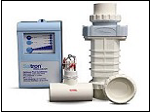 ter manufacturers will frown on this
chlorination method. If you have a heater, it can lead to
heater damage. At the very least you are exposing
your vinyl
liner to fading. Picture this: after the pump shuts off the
chlorine tablets continue their slow dissolution and raise
the chlorine level in the skimmer. Convection and currents
can carry this higher chlorine content water out of the
skimmer and into contact with the liner. Given enough time,
there can be a degree of liner fading, especially in the
areas surrounding the skimmer containing the chlorine
tablets. If you add an automatic chlorinator, I'm sure that
you will find that your use of chlorine will decrease
because it is not being consumed in your filter and that you
will have more control over the chlorine level. And of
course your liner's appearance may be saved. An even better
choice would be a salt
chlorine generator. No product to contact a vinyl
surface and more control. I hope that I have been helpful and
convincing. ter manufacturers will frown on this
chlorination method. If you have a heater, it can lead to
heater damage. At the very least you are exposing
your vinyl
liner to fading. Picture this: after the pump shuts off the
chlorine tablets continue their slow dissolution and raise
the chlorine level in the skimmer. Convection and currents
can carry this higher chlorine content water out of the
skimmer and into contact with the liner. Given enough time,
there can be a degree of liner fading, especially in the
areas surrounding the skimmer containing the chlorine
tablets. If you add an automatic chlorinator, I'm sure that
you will find that your use of chlorine will decrease
because it is not being consumed in your filter and that you
will have more control over the chlorine level. And of
course your liner's appearance may be saved. An even better
choice would be a salt
chlorine generator. No product to contact a vinyl
surface and more control. I hope that I have been helpful and
convincing.
Sincerely. Alan Schuster, 6/12/2007
► Fungus On
The Reverse Side Of Liner?
My pool has some grayish stains in the
hopper. I have tried everything; shocking, rubbing with a
chlorine tablet and ascorbic acid and nothing has helped. It
seems to start in the spring and spread and darken as time
passes. The dealer says that it a fungus growing on the
reverse side of the liner and I'll have to live with it. Is
there any suggestion that might help? Thank you.
Mike T., 6/11/2009
Information on this topic is very sketchy. The only person I
had a conversion with, in depth, does not want to have his
name made public. He is not in the liner business and,
therefore, does not want to handle the inquiries. It is not
a common problem. But if you have the problem that is no
consolation.
Some types of bacteria and/or fungi, found in the soil, can
actually appear to penetrate a vinyl liner and cause stains
to appear on the liner. Usually they will start off as spots
or cloud-like formations on the liner. Chemicals used to
elimination algae and other microorganisms have little or no
effect, on these types of stains, since it doesn't get to
the source of the microorganisms in the soil.
If a pool is thought to have a problem with microorganisms,
mold or fungus staining reverse-side of the liner, the
ground underneath the liner should be replaced with fresh
sand, vermiculite or pool base. Afterwards, treat with a
solution of one-part liquid pool chlorine and three-parts
tap water. Apply with a garden sprayer several times. Wait a
few hours, before prior dropping the liner into place. If it
is not a new liner, please bear in mind that the liner could
shrink and become useless, if allowed to dry out completely.
An alternative to the chlorine/water spray would be use a
non-solvent based herbicide on fresh sand, vermiculite or
pool base.
If the liner has been recently replaced, one method which
has been discovered that may provide a solution. The
application of Ferrous Sulfate (FeSO4), to the perimeter
around the outside of the pool can change the pH and the
soil chemistry. This chemical is a reducing agent and
exhibits acidic properties. This technique seems be
effective in retarding and/or killing the troublesome
bacteria, mold or fungus. This stems from a method used to
protect the vinyl liners used under some landfills. This may
not a guaranteed cure, but has been met with some success.
It can be tried without having to drain the pool and
replace the liner. For an typical inground pool, you might
require twelve to fifteen pounds of this chemical. Sprinkle
it on the ground, around the outside pool perimeter, near
the pool patio or deck, on as much of the pool perimeter, as
possible. Afterwards, turn a lawn sprinkler on the area, for
two or three days: long enough to get the ground around the
pool thoroughly saturated with water. The intent is to get
the ferrous sulfate to soak deep into the ground. Hopefully,
it will change the pH and soil chemistry enough and kill off
or retard the growth of these troublesome microorganisms.
Results may not be seen for a few weeks, depending upon the
nature of the soil's chemistry and drainage properties.
Direct application of chemicals can damage some plants or
grasses, so abundant watering and drainage is important.
Ferrous sulfate is used with plants such as: Rhododendrons,
Azaleas, Blueberries, Mountain Laurel, Holly and Blue
Hydrangea, that thrive best in acidic soil. Do not allow
this chemical to get into the pool, as it will cause water
discoloration and staining of underwater surfaces. An
alternative to the surface distribution would be the digging
of a series small holes around the pool perimeter and
burying some of the ferrous sulfate, in each one. Follow
with a thorough watering down of the area, for the next few
days.
Sincerely. Alan Schuster, 6/11/2009
► Vinyl Liner
Wrinkles?
When my vinyl liner was installed a
few years ago, it nice and smooth. Today, I see some
wrinkles in one area. What's the cause?
Barry D., Cincinnati, OH, 7/9/2011
Two things come to mind. It is possible that the bottom has
undergone some shifting and/or settling over the past few
years and this has led to some wrinkling. Another
possibility is that corrosive, acidic water conditions have
caused the vinyl liner to increase water absorption and this
has led to a stretching of the liner and the wrinkles. Is it
possible that you have been keeping the pH too low? It is
important to maintain the pH in the 7.2-7.6 range for bather
comfort, sanitizer efficiency and to help protect the pool
equipment! Low pH can be quite common with the use of
trichlor tablets in an automatic chlorinator because the
product is acidic and requires regular pH monitoring.
Because the water looks good, many people tend to neglect
the pH. The practice of "dumping" in chemicals and allowing
them to remain on the bottom, for prolonged periods, is not
recommended. Acidic chemicals such as pH decreaser, muriatic
acid or cyanuric acid can create the acidic conditions that
can contribute to this problem. Always take care to
broadcast or distribute all chemicals, so as to avoid local
high concentrations and lessen the likelihood of problems. I
hope that I have been helpful.
Sincerely. Alan Schuster, 7/10/2011
► Vinyl Liner
Expansion?
I have been building vinyl pools for
some time, but in recent years have been finding problems
with the vinyl "growing" under water - sometimes as much as
2" to 3" - causing a "flap" or crease to appear. Asking
around, it seems that a low pH or "pH bounce" caused by low
TA and Hardness could be the reason, so I have been
recommending the following values for my customers with
vinyl liner pools:
1. pH 7.6 - 7.8
2. TA 120 to 160 (no
higher than 160)
3. Cl 1.0 to 2.0 ppm
4. Calcium Hard. 200 to 400 ppm
Would you care to comment? TIA.
Larry O., New Zealand, 4/27/2011
From what I have learned, it is low pH that is responsible
for the growth (expansion) of the liner. The low pH causes
water to be absorbed into the vinyl. The parameters that
you are using are close to the point of scale formation. In
this situation, the pH is the very important. Keep it at
7.2-7.6. Higher readings will decrease the efficiency of
chlorine! In order to help maintain the pH in this range,
it is important to keep the total alkalinity at 80-120 PPM.
Higher TA readings are OK, so long as the water remains
clear and there is no sign of scaling. High TA makes pH
adjustment more difficult. But, high TA is not a problem
and can be a benefit, if the pH is within the proper
range. Calcium hardness should never be raised above 200
PPM. Higher readings will prevent you from maintaining a
high TA reading: such as 200 PPM. The higher TA reading
will make low pH much less likely. In essence, your choice
is higher TA or higher calcium and I would opt for the
higher TA. The chlorine reading is reasonable. One of the
major causes of low pH conditions is the neglectful use of
trichlor in a feeder. Because the water looks great, people
tend to pay less attention to the water chemistry. These
tablets are quite acidic and will drop the pH of the pool,
into decidedly acidic and corrosive ranges, if regular
additions of pH increaser are not made. The net result is a
pool with a very low pH. I hope that I have been helpful.
Sincerely. Alan Schuster, 4/26/2011
Thanks, I will take your advice
seriously. Regards.
Larry O., New Zealand, 4/27/2011
► Doesn't
Look Right?
Dear Alan, thanks for this nice
personal feature on your web-site. We purchased an older
home several months ago, that has an in-ground pool with a
vinyl liner. Before the purchase we had a pool inspection
and everything was satisfactory. The previous home owners
stopped by this week for a visit, and commented that the
pool liner "didn't look right" and he said it appeared to
have suffered damage from the cold. We had a very cold
winter (negative degree temperatures) this year. He looked
at it closely & said 2 liners ago they had to replace the
liner for the same reasons. Having never owned a pool
before, my knowledge is VERY limited on pools. Before I
approach my insurance company I want to know: Have you ever
heard of this? To be honest, we have been adding water
frequently, and I didn't think evaporation would cause this
much water loss. The pool has not been used for swimming
yet, because of busy careers with many overtime hours, so
water loss is not caused from splashing. Due to the
summertime approaching we were about to call a pool
contractor to get it ready to open, but wanted an unbiased
opinion. Your prompt answer would be greatly appreciated.
Thank you.
Kay B., 5/22/2007

Pool liners can easily last 10-20 years. The same liners are
used in Maine as in Georgia. I can't possibly tell what is
wrong from your letter. It could be that things "don't look
right" because of erosion due to heavy rainfall, ground
shifting, structural changes or chemical effects on the
liner. If the pool is losing more than about 1/4" per day,
it could be the sign of a leak and that can lead to erosion
behind the liner. Leaks can be found and liners repaired. I
suggest that you call in an experienced vinyl liner
specialist for a definitive determination of the problem,
if, in fact, there is a problem! Many common types of leaks
can be solved, simply by adding
Fix A Leak, the leak sealant
that has been sealing pool and spa leaks for over 30 years.
Good luck and I hope that I have been helpful.
Sincerely. Alan Schuster, 5/22/2007
► Water Right
Up To The Coping?
I have read through most of the
questions on vinyl liner pools regarding liner "float" and
found them to be extremely helpful. Thanks! While, I can
understand water table surrounding the pool can float the
liner if it is higher than the pool water level, what I
could not find was the effects of heavy rains raising the
water above the liner to the coping, and whether this causes
"float" or not. I live in Dallas, TX, where we sometimes see
heavy rains that can drop 3-5 inches of rain in a matter of
a few hours. A lot of times during these heavy rains, the
water level in my pool will rise up to and above the coping
and I always thought that was what caused "float". Will the
water rising up to and above the coping cause the liner to
float? If so, are you aware of any pool products today that
would help prevent this? I hate to lower the water level of
the pool every time there is a threat of rain or flash
flooding, but am getting tired of dealing with wrinkles
every spring. Thanks.
Larry B., Dallas, TX 4/2/2008
The higher the water level, in the pool, the less likely the
liner will float. In fact, the rising pool water might even
help prevent liner floating. I always disliked pumping water
out, as I had a salt chlorine generator and would have to
replenish the salt. The answer is yes, there is a way to
maintain a proper water level. There are various
auto-levelers that can be installed to remove excess water,
once the level reaches a predetermined point. Sounds like
what you are looking for. Enjoy the season.
Sincerely. Alan Schuster, 4/2/2008
► Chlorine
Floats?
I have an in ground vinyl pool, 16 by
32 with a 6' deep end. I see all sorts of fancy devices for
sanitizing. I use 1" trichlor tablets in floating feeder and
shock the pool weekly. It all seems to work for me. What am
I missing?
Michael N., Penfield, NY, 4/14/2010
I suspect that you are someone that is taking the time to do
all the maintenance. Obviously you are doing a good job.
Unfortunately there are lots of pool owners that don't spend
the time to test the water, add the chemicals, vacuum the
bottom and clean the filter. Basically, you a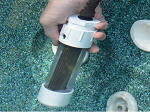 re satisfying
the pools requirement for chlorine. However, there are a few
limitations. The floater gives your less control over the
rate of chlorine additions and probably makes monitoring
more frequent. But, these are things that you can work to
control. However, there is something that you cannot correct
and that is the floater itself. The floater remains in the
water at all times and can be carried by currents or winds
to positions behind pool ladders or into corners. Here it
can remain in prolonged contact with the vinyl liner's
surface and this can result in a bleaching of the vinyl.
Using a floating chlorinator in a vinyl pool can entail a
risk of liner bleaching and can be avoided by using an
inline chlorinator. The inline chlorinator makes chlorine
additions simpler, more controllable, helps avoid liner
damage and takes the chlorine floater out of the pool and
away from the bathers and that is a good thing! However, the
continued use of stabilized chlorine will cause the cyanuric
acid level to rise to a point, where partial water
replacements will become necessary. Adding a
salt chlorine
generator would be an even more convenient way to
chlorinate, without creating any build-up problems. I hope
that I have been helpful. Enjoy the summer. re satisfying
the pools requirement for chlorine. However, there are a few
limitations. The floater gives your less control over the
rate of chlorine additions and probably makes monitoring
more frequent. But, these are things that you can work to
control. However, there is something that you cannot correct
and that is the floater itself. The floater remains in the
water at all times and can be carried by currents or winds
to positions behind pool ladders or into corners. Here it
can remain in prolonged contact with the vinyl liner's
surface and this can result in a bleaching of the vinyl.
Using a floating chlorinator in a vinyl pool can entail a
risk of liner bleaching and can be avoided by using an
inline chlorinator. The inline chlorinator makes chlorine
additions simpler, more controllable, helps avoid liner
damage and takes the chlorine floater out of the pool and
away from the bathers and that is a good thing! However, the
continued use of stabilized chlorine will cause the cyanuric
acid level to rise to a point, where partial water
replacements will become necessary. Adding a
salt chlorine
generator would be an even more convenient way to
chlorinate, without creating any build-up problems. I hope
that I have been helpful. Enjoy the summer.
Sincerely. Alan Schuster, 4/14/2010
► Baptismal
Pool Liner?
We are in need of a new liner for our
Baptistery. We are having difficulty in locating a company
which can supply this product. We would appreciate any help
you could give.
Becky, 2/3/2005
I must admit that this is a new question. I am not familiar
with the your specific application. However, I would hazard
a guess that what you are seeking is a custom-sized vinyl
pool liner I suggest that you contact a local vinyl pool
builder. They must deal with a manufacturer of custom-sized
liners for pools, hot tubs and other applications. Baptismal
Pool Liners are one of those "other applications." I sure
that they will be able to help with your needs. I hope that
I have been of assistance.
Sincerely, Alan Schuster, 2/3/2005
► Not Really
A Bleached Liner?
Read thru all your vinyl stain
question and answers, but don’t think my issue has been
covered. I have a 20 x 45 35,000 gallon vinyl in ground. We
close for cold winters and use a mesh safety pool cover with
tie downs onto the concrete deck. For the past 5 years or so
as I opened up in spring I found bleach marks in the shallow
end only, some the size of baseballs, some in the shape of
the worms that we’d scoop out in the spring vacuuming. This
year those blotchy bleach marks are more prevalent, again
shallow end only. I use liquid chlorine and maintain a good
eye on my water chemistry; however my pool water testing
company does not test for metals. That said, as the problem
is bleaching I assume I don’t have a metals problem UNLESS,
and this seems farfetched to me, the whole pool bottom is
stained. All except the “bleached” areas which aren’t
bleached at all, but rather the original, though perhaps
faded colour of the vinyl. Your advice will be most
appreciated. Thank you.
Steve, Ontario, Canada, 5/5/2006
Nothing in the letter suggests that you added the type of
chemicals that would bleach spots. Try this for starters --
place 6-12 vitamin C tablets on a "bleached area" and
another group on a normal looking area. Shut off the filter
and give it 15-30 minutes. Good luck.
Sincerely. Alan Schuster, 5/5/2006
Bingo! Within minutes the area under
and around the Vitamin C tablets was white, the same colour
as what I thought were “bleached” spots. In fact it would
appear that the dominant colour of the liner bottom is now
“stain dirty” and I hadn’t realized it. I’ve just taken two
samples of water; one from the pool and the other from my
garden hose that tops off the pool as needed. In fact it’s
running right now. I’ll take for testing and ask that it be
tested for metals and minerals as well. From reading your
other Q and A’s it would appear that my problem is dissolved
metals and minerals staining the vinyl. Please comment and
advise how I should proceed to clean the bottom. It doesn’t
brush clean, I’ve tried that.
Steve, Ontario, Canada, 5/6/2006
Not so far fetched after all? Put 1/2 pound of
METALTRAP
Stain Remover in a white sock and drop onto a stain. Slowly
move around with a vacuum pole. Repeat elsewhere, as
necessary. Have the
pool and source water tested for iron and copper. Add a dose
of a phosphate-free, Liquid METALTRAP, for every 0.5 PPM of
metals. At the very least add two doses. If the stained area
is too broad to be treated with the "sock", you may have to
lower the pH of the pool to 6.0, discharge all of the
chlorine and add a few pounds of the oxalic or ascorbic
acids. Thereafter add a dose of Liquid METALTRAP monthly or
prior to adding new water, in order to avoid minimize the
possibility of a recurrence. Hope the information solves the
problem.
Sincerely. Alan Schuster, 5/6/2006
► Fading
Away?
I started to use gas chlorine last
year. Now it seems that my vinyl liner has faded. Are these
related? Thank you.
Don B., 8/2/2008
It is quite likely, in my opinion, there is correlation
between the fading and the gas chlorine. Some fading is
normal, but is should be very slight and not highly
apparent. Using gas chlorine, especially if it is added
weekly, will spike the chlorine level up much higher than
the recommended 1-3 PPM. Levels of 10-15 PPM are probably
quite common. At this high chlorine level, there will be an
accelerated fading of the vinyl liner. Such high levels are
not ideal for bather comfort. If, in addition, to the high
chlorine level, there are low pH conditions, the
aggressiveness of the chlorine increases and that can raises
the probability of problems. If you confirm that the
chlorine levels are indeed being spiked too high, you can
help stabilize the current appearance of the liner by
maintaining a 1-3 PPM, with the use of an alternative form
of chlorine maintenance, such as a salt chlorine generator. High levels, over time, of any
form of chlorine or direct application of chlorine to a
liner surface can result in a fading of the liner. Please
browse through the archives for more on these topics. I hope
that I have been of some assistance. slight and not highly
apparent. Using gas chlorine, especially if it is added
weekly, will spike the chlorine level up much higher than
the recommended 1-3 PPM. Levels of 10-15 PPM are probably
quite common. At this high chlorine level, there will be an
accelerated fading of the vinyl liner. Such high levels are
not ideal for bather comfort. If, in addition, to the high
chlorine level, there are low pH conditions, the
aggressiveness of the chlorine increases and that can raises
the probability of problems. If you confirm that the
chlorine levels are indeed being spiked too high, you can
help stabilize the current appearance of the liner by
maintaining a 1-3 PPM, with the use of an alternative form
of chlorine maintenance, such as a salt chlorine generator. High levels, over time, of any
form of chlorine or direct application of chlorine to a
liner surface can result in a fading of the liner. Please
browse through the archives for more on these topics. I hope
that I have been of some assistance.
Sincerely. Alan Schuster, 8/2/2008
► Unplanned
Draining?
Dear Alan, I live in Pennsylvania and
have an in ground pool that is approx. 50 years old. It has
6 inch concrete sides and a sand bottom and a vinyl liner.
It is 16x32 with a 7.5 ft deep end and 3 ft shallow. It is
December and it developed a leak and drained except for
about 3-4 inches in the shallow end. I will be replacing the
liner in April of next year but am concerned with leaving
the pool empty for 3 months. I keep reading that draining it
is a bad idea but am not sure if that is only if I am going
to try to use the same liner next year. The walls, as I said
are 6 inches of concrete. This liner is only 7 years old but
a couple of years ago developed a blackish discoloration and
seems to have weakened it. We tried everything to clean it
but it appears to have bled through from the other sides.
I've been told that it is caused by an organism. What can
you suggest to prevent it from recurring with the new liner?
So, 2 questions. Can I leave it empty and have you heard of
this blackish discoloration? Thanks.
Malinda H., Pennsylvania, 12/29/2006
One of the main reasons that is not recommended that liner
pools be drained and left empty is that the water helps to
support the walls. Your pool may have 6" concrete walls, but
it is 50 years old and there is no way to be absolutely
certain that damage will not result. It is possible that the
pool will not suffer a collapse, but that is not for me to
say. At the very least have the pool inspected by a
knowledgeable pool builder. The discoloration could have
been caused by a fungus. Have the inside of the
pool thoroughly cleaned out and replaced with fresh sand and
or pool base. Make sure that drainage in the pool area is
adequate. Good luck and best wishes for the new year.
Sincerely. Alan Schuster, 12/29/2006
► Eliminating
The Deep End?
Can the deep end of a pool be filled
in and a new drain and liner be placed into the existing
space ? We would like to make our pool all one depth to play
more games in it.
Nameless, 5/4/2007
Positively, with just one reservation! It is possible to
fill up the hopper and install a new main drain. Having a
liner custom-made is no problem. The only problem relates to
the construction of the walls and their condition. The walls
are partially held in place by the water. Removing the water
could result in an inward movement of the walls or some
shifting. Some pools are so constructed that emptying them
is less uncertain. I suggest that you discuss this matter
with the builder or a qualified contractor. No one would
know better than him, the feasibility of the project. Good
luck. I hope that I have been helpful.
Sincerely. Alan Schuster, 5/4/2007
► When To
Drain?
Alan, I have to replace the liner in
my inground pool. The water is about 2 feet low. Can I go
ahead and drain the pool? I don't know how long it will be
until I can get a new liner. How long could I wait to get a
liner if I drain the pool now? Thanks.
Judy, 3/21/2004
The longer a vinyl lined pool remains empty, the greater the
chance for structural damage and/or ground shifting. Do not
drain the pool, until recommended by the vinyl liner
installer. Good luck and enjoy the new look.
Sincerely. Alan Schuster, 3/21/2004
► Getting A
Vinyl Liner Installed?
We live in So. California, 45 minutes
north of L.A. We know the pool we want to put in, but cannot
find anyone to install it. We are not stuck on any
particular brand, but we are totally stuck on getting it
installed. Can you help us on anyone who installs inground
liner pools? Thanks.
Pricilla T., California, 3/11/2004
I am not personally familiar with vinyl liner pool
installers, in your area. However, if you go to the local
Yellow Pages, you should be able to get the name of vinyl
pool builders, in your area. Try and Google it. Good luck
with the pool. Glad to be of help.
Sincerely. Alan Schuster, 3/11/2004
► Lightened
Up The Bottom?
Alan. What a great website! I have a
20,000 gal in ground pool, and had a new vinyl liner
installed a year ago. It looked great! When it was opened
this spring I noticed that the liner was considerably
lighter in the bottom, where the fellow closing the pool had
throw poorly mixed pool shock last fall. I was going to say
something at the time he was closing it, but I figured he
is the expert, right? I always mix the shock with warm water
to be sure it dissolves. Anyway, I am kind of sick about
this. He tells me it happens all the time and that it could
be something coming up from the bottom. All this sounds
fishy to me. Question is, how could this be fixed? Could a
cosmetic patch be put over the existing liner? It covers
most of the well at the bottom, probably a 10'X12'
semicircle. Would the pool have to be drained to do this?
Would water pressure ruin the liner if it were drained? Can
it be patched underwater with an adhesive (again, only
cosmetic)? Or do I just have to get used to it?
Tom J., 4/27/2011
I am going to post your letter and my reply. I don't usually
make a point of mentioning this and, although the subject is
already covered, I want to make sure that the message gets
through. You pretty much answered your own question.
Something fishy? Nothing is coming up from the bottom! Too
much chlorine was allowed to remain in prolonged contact
with the liner and it lightened the color in the subject
area. Arguing anything else is deflection. Draining a vinyl
liner pool is never a good idea, if avoidable. An aesthetic
patch sounds good, but adhering it without wrinkles, without
weakening the liner by use of an inappropriate adhesive and
without providing a semi-circle of nooks and crannies for
algae to take hold in, is something that is probably not
doable. At least so far as I know. I'll pass the letter on
to someone else, in case there is something that I am
missing. Otherwise, care should be taken to avoid chlorine
products from remaining in prolonged contact with the vinyl
pool liner. Quick dissolving products or liquid chlorine and
avoiding ultra-high chlorine levels could help avoid such
problems. A salt chlorine generator would have been a much
better sanitizing option and would have minimized the fading.
A Premium Pool Graphic Mosaic Mat will
cover and area 47" in diameter and could draw the eyes away,
from the problem. Some users have placed. as many as 3
of this size mats, just because of the way it looks. The
mats are simply dropped into the pool and positioned with a
pool pole. Its weight keeps it in place. I
think in the final analysis it is something that you'll have
to get used to. Sorry that I didn't have a solution.
Sincerely. Alan Schuster, 4/27/2011
► Proper
Liner Care?
I'm putting a new vinyl inground liner
in a week or two. Besides age, the "old" liner has faded out
rather badly. I know that sunlight (UV) plays an unavoidable
part in this. At the same time, I know that some of the
fading is due to the chlorine I've been using. I've heard of
bromine and biguanide, but don't know how switching to one
of these methods would help with the fading. Any thoughts.
for when I start up with the new liner? Thanks in advance.
No Name, 6/16/2005
A really good question! I'm sending a copy to a vinyl liner
company and I'll follow up, if there is additional
information. It is true that high levels of chlorine can
lighten the color of a vinyl liner, over time. I would
expect a similar, but less significant effect to occur with
bromine use, over time. Biguanide, on the other hand, will
not alter the liner color. But, biguanide is used with
hydrogen peroxide, on occasion, and that might have an
effect. I really believe that badly faded liners are the
result of overly aggressive chlorine treatment or are caused
by allowing chlorine products to remain in direct contact. A
salt chlorinator system or an inline chlorinator allows the
use of chlorine, but helps avoid high concentrations and
direct contact. Adding a
UV sanitizer can cut the chlorine
requirement by as much as 70% and that helps to preserve the
liner's appearance. I hope that I have been helpful.
Sincerely. Alan Schuster, 6/16/2005
Manufacturer's Note: Alan, you are right on the
money. Non-chlorine methods of sanitizing pool water are a
good way to cut down on bleaching of liners. I've never
heard of a bromine or biguanide pool getting bleached out
like a chlorine pool. We think the best way to cut back on
bleaching, while still using chlorine is try keep chlorine
levels < 2 ppm, using only non-chlorine shock or adding an
alternative sanitizer to reduce additions of chlorine.
R. K., 6/17/2005
► Vinyl Liner
And Gas Chlorine?
Does chlorine gas (professionally done
weekly) used for pool cleaning reduce the life of the vinyl
liner? Thanking you.
Raj M., 4/13/2008
Gas chlorine certainly can be effective and does not
contribute byproducts, but there is a major downside, in my
opinion. The chlorine level spikes upward, because of how it
is added, and that can compromise bather comfort and bleach
bathing suits. In the case of vinyl pools, the color of the
vinyl liner could fade at an accelerated rate. Any method
that allows a week's worth of chorine to be added all at
once or permits undissolved chlorine products to contact the
liner, is not the best method to use in a vinyl lined pool.
I am a believer in the type of prolonged or slower-release
chlorination that can be obtained by using an automatic
chlorinator or a salt chlorinating system. These methods are
better at keeping the Chlorine level within the 1-3 PPM
range, that is so important for comfortable and worry-free
enjoyment of the pool. I hope that I have been helpful.
Sincerely. Alan Schuster, 4/14/2008
► Found The
Pool Leak?
I was losing about an inch of water
daily and was convinced that I had a leak. The pool is a 18
x 36 vinyl inground that is about 3 years old. After
checking all the fitting, I decided to try a dye solution
and see if that could help locate the leak. To my great
surprise, I located the leak. It was in the shallow end
about 2 feet in front of the steps. I assumed that someone
stepped on a sharp pointed pebble or something. I have
several questions. Can I use a piece of the original vinyl,
which I have, as a patch. Is there anyway to do this without
draining the shallow end, as I don't want to risk damage to
the pool or liner. I appreciate the opportunity to ask these
questions.
Bill M., Freehold, NJ, 7/24/2007
Yes, you can use the original liner material as a patch.
Lucky, that you have a piece.
Boxer Adhesives manufactures a
complete line of vinyl plastic repair products and adhesives
that can even be used underwater. Just use it as directed
and make sure that you trim the corners off the patch, in
order to help prevent them from lifting. Locating the
source of the leak was the hard part. The repair will be the
easy part. Good luck and enjoy the season.
Sincerely. Alan Schuster, 7/24/2007
► Vinyl
Liners And Liquid Chlorine?
Hi Alan! I noticed that you seem to
have no problem recommending liquid chlorine use in vinyl
lined pools. After many years in the above ground pool
business I must tell you that I sell many replacement liners
to customers who use liquid chlorine and/or liquid acid on a
regular basis due to the liner literally tearing at the
water line. It seems to happen after only 3 years or so of
usage. I cannot recall ever selling a replacement liner for
the same problem to customers who stick with using granular
shock, tri-chlor tablets, and granular acid. There are too
many cases I can think of to write this off as coincidental.
What do you think is the cause? Sincerely.
Joann C., 8/24/2010
Too much of a good thing is still too much. Liquid chlorine
is never my first choice. People try and avoid adding
chemicals daily or even frequently. Pool services add liquid
chlorine once a week. By adding a week's worth of liquid
chlorine, all at once, it can create harsh conditions for
vinyl liners It would be better for the liner and the
bathers to spread this same amount over a week. This would
avoid the chlorine levels spiking upward, but it would
require more time. If liquid chlorine is added slowly, with
the filter operating, and in incremental amounts, it should
be as safe as any other form of chlorine. It is certainly
better than having cal hypo granules sitting on the bottom.
Dichlor is very soluble and pH neutral, but continued use
will lead to stabilizer problems. Lithium costs more, but is
very soluble. Both products are popular in vinyl pools. No
matter which product is used the chlorine released will act
the same, based on the other water chemistry factors. The
bottom line is that with liquid chlorine it is just too easy
to add too much. Better for the liner would be the use of
trichlor in a feeder, as the release is slow and
controllable and chlorine levels do not spike upward. Even
better would be bromine, biguanide or other alternative
sanitizers: ozone, ionization, mineral purifiers. The use of
a salt chlorine generator is an excellent way to add
chlorine to a pool in a safe and effective manner. I hope
that this explanation will help.
Sincerely. Alan Schuster, 8/24/2010
► Just In
Case?
Hello. I just had my liner replaced
with a new Liner. The liner is beautiful. I was wondering if
you can use spare pieces of the liner as patches. Can you
use regular patch glue and glue a spare piece on the
original liner? I do not need to patch anything now but you
never know. If so, I was wondering what I would have to do
to get a small piece of the two different patterns on my
liner. Thanks.
Larry M., 2/10/2006
There's nothing like being prepared. The vinyl patch kits
usually contain a piece of a blue vinyl and some glue. There
is no reason that a piece of the original liner pattern
could not be used as a patch. However, it is extremely
unlikely that you will ever need it, but you will have to
request it from the manufacturer. I suspect that they will
be accommodating. Enjoy the new look.
Sincerely. Alan Schuster, 2/10/2006
► Bubbles
Under Liner?
I seem to have formed what appears to
be several air bubble under the liner. Any suggestions of
what to do? Thank you for the assistance. Best regards.
Paul P., Cyprus, 12/21/2009
Gases, from decaying organic matter, may be coming from
below the pool. Using a wide rubber squeegee, try and push
the bubbles to the side of the pool. Hopefully, from there
it will be able to vent upwards. I hope that this
information will solve the problem.
Sincerely. Alan Schuster
► Effect Of
pH On Vinyl Liners?
How does pH affect the vinyl liner of
a pool?
Sean H., 11/1/2010
Apart from corrosion and bather irritation, low pH in a
vinyl pool can cause the liner to absorb excessive amounts
of water and lead to wrinkle formation. In addition, low pH
readings will make the chlorine more aggressive and this, in
turn, could accelerate the bleaching of the color. High pH
readings are less likely to affect vinyl liners, but are
more apt to lead to scaling conditions, cloudy water, loss
of chlorine effectiveness and possible bather irritation.
The recommended range for pH, under most conditions is
7.2-7.6. I hope that I have been helpful.
Sincerely. Alan Schuster, 11/1/2010
► Pool Tar?
Thanks for your response. I have been
advised that the tar is called pool tar AKA pool goo and is
not black algae. After reading the responses on your web
site, most report seeing black spots on the pool bottom,
which I see none. Although, pool goo may just be a nice way
of saying I have black algae. The black spots left on the
sides of the pool from my kids feet kicking off the wall
scrub off fairly easy. The bottom of the pool does feel
sticky when walking on it. I went in the pool today for the
first time this year just to give it a good vacuuming and
cleaning as advised. I have taken your advice and was given
the same advice as you gave me, except to heat my pool with
a heater or solar cover which I have both. However, it seems
counter productive in that the heat would promote more
algae. If you have any advice on pool goo which I was told
is a reaction from plasticity of the new liner I installed?
Let me know if this sounds logical. Thanks for you advice.
Scott, Detroit, MI, 6/26/2004
I did some research on this one and here is what I came up
with. While it is still possible that you have black algae,
there is another very likely explanation. A new vinyl liner
(as is the case in your situation) can, sometimes, exude
plasticizer from the liner, over the course of the winter.
While this plasticizer material is clear, it can act as a
means for dirt and debris to become attached and accumulate.
As the water warms up (hence the reference to a heater) the
plasticizer will reabsorb, eliminating the problem. It is
reported that, if it happens, it only occurs once during the
first years and never again. You do not need a new liner. I
hope that this information will prove helpful.
Sincerely. Alan Schuster, 6/28/2004
► Border Or
No Border?
We are in the process of selecting a
new vinyl liner for a 20 x 40 pool. I am leaning toward one
with no border. Is there an advantage of having a liner with
a border in respect to a fade line? Thanks for your help.
Liz P., Allenwood, NJ. 2/21/2007
Borderless pool liners used to be the norm. However, a
border helps hide the effect of time, oily residues,
chemical effects and the aging difference, above and below
the water line. Vinyl liner pools with borders should look
better and for longer periods of time. I hope that I have
been helpful.
Sincerely. Alan Schuster, 2/22/2007
► Seeing
Vinyl Liner Seams?
I’m noticing a lot of seams in my
brand new liner and was wondering if the liner should have
been ordered in one piece that would have fit the entire
pool. The inground pool is approx. 20 X 44. We had a dark
vinyl liner installed early fall of last year and this year
I’m noticing a lot of seams on the bottom of the pool. I’ve
been searching the web and all I can find is liners in one
piece. This pool company also put up foam walls and I’m
noticing dents in some areas. Please let me know if these
things are normal. I spent an awful lot of money and am
worried that this job was not done properly. Thank you.
Sue D., 7/6/2005
Liners are made with seams. That is how it has to be done.
The current trends of vinyl liner colors are becoming darker
and darker with time. The darker the liner, the more
noticeable the seams. All material used in production of the
floor portion of the vinyl liners is 72" material. No matter
which company is producing the liners. The walls
are produced from 39" material. Many people now are
ordering these new darker colors and for the first time
noticing the seams. A surface defect can simply be due to an
impression in the foam. This is a big surface and it is not
totally unexpected to see some variations. Consider how
liners are installed? There is nothing to indicate that the
job was not done properly. Enjoy the pool.
Sincerely. Alan Schuster, 7/6/2005
► Wayward
Liner?
We have a 12 x 20 pool that is over 16
years old. We have changed the liner once before with no
problems. Last summer our umbrella stand was blown in the
pool by heavy winds and cut a sizable hole in the bottom. We
decided to replace the liner. Problem is that the liner
keeps coming out of the track. Do you have any suggestions -
we are at our wits end! Thank you.
T & J, 5/18/2004
Assuming that the track is not broken, there is something
that you can try. Many dealers carry a product called Bead
Lock, that can be forced into the track, behind the bead, to
secure the liner in place. It is used in much the same
manner as window screen spline which holds window screening
in the frame. I hope the problem is solved.
Sincerely. Alan Schuster, 5/18/2004
► Premature
Vinyl Liner Wrinkles?
My wife totally drained our vinyl
pool, as suggested by our local pool supply business. Now we
have wrinkles up to three inches. I just read on your
website that this was a big mistake; she should have left
some water in the pool to prevent this problem. My question
is what should we do now? The pool has been filled for weeks
and the weight has not pushed out the wrinkles. I tried
unsuccessfully to manually flatten them. Any suggestions?
Thanks.
Steve, Daphne, Alabama, 4/21/2005
Completely draining a vinyl liner pool is never a good idea
and is rarely recommended and only as a last resort. Most
likely the vinyl has stretched and shifted and there is
probably little that can be done to eliminate the wrinkles.
You could try using a toilet plunger to move the liner a
bit. Perhaps, that will help with some of the wrinkles.
Sorry there isn't anything more that I can add. Good luck.
Sincerely. Alan Schuster, 4/21/2005
► Vinyl Liner
In A Concrete Pool?
I HAVE AN OLDER CONCRETE POOL, IS IT
POSSIBLE TO GET A LINER FOR IT?
Cathy H., 2/26/2009
I don't see why not. It is not as simple as dropping in a
new liner of the proper size. The walls will probably have
to be covered with a foam material and something will have
to done with the bottom. The coping will probably need
modification. I am really not an expert on this subject and
I suggest that you speak with a company involved in vinyl
liner installations. Good luck and you'll love the new look.
Sincerely. Alan Schuster, 2/27/2009
► Hanging A
Beaded Liner?
I am replacing a beaded liner. My
question is How do I replace it? Do I need to take off the
top rail to do this? Or is there a way to just slide it out.
Thanks.
Jackie H., 5/6/2004
The bead is shaped like an upside down "J" and should slip
into the mounting bracket. The weight of the water stretches
the liner, securing it in place. I'm sure that the liner
dealer will be able to give you some pointers. Have fun and
enjoy the new look.
Sincerely. Alan Schuster, 5/6/2004
► Floating
Liner?
Hello Alan - HELP! I have an inground
swimming pool approx. 2 years old - when we removed the
cover this month the liner has 'floated' away from the
walls - this is especially bad in the deep end - and the
water level in the pool has dropped quite a bit. Any idea
what caused this and what can be done to correct the
problem. Any preventative measures we can take to keep this
from happening again? Any insight will be most appreciated.
Patti S., Lewisberry, PA. 4/7/2005
It is likely that you have a warranty on a 2 year old pool.
Use that as the starting point. The water level dropped
because there is a leak somewhere in the liner or the main
drain. If the leak is due to a tear in the liner, the water
level would be a the point of the damage. If the main drain
has a leak, the water was in the process of completely
draining out. You need to locate the leak. See if your
warranty cover this type of problem! There are companies
that specialize in leak detection and repair. Allowing your
pool to drain to could risk structural damage and liner
shrinkage and should be avoided. Once the leak has been
repaired and the pool is refilled, it is probable that the
water will push the vinyl liner back into place. Good luck
and I hope that I have been of help.
Sincerely. Alan Schuster, 4/7/2005
► Water
Behind The Liner?
Alan, I have a 20x40 inground swimming
pool. The problem I am having is that with all the rain we
have been getting I am getting water under the liner. The
water lifts the liner and shift it around. After a few dry
days the water dries up and leaves the liner out of place. I
did French drain around the pool with no positive outcome.
I live in an area where there are lots of springs and have
not had any problem like this in 15 years. What can I do?
Christopher, 1/8/2005
This sort of thing can only happen if the water table is
higher than the water level in the pool. A French drain is
intended to help the situation. Other things that you can do
would be to try and improve drainage around the pool area by
creating swales to direct the flow after from the area and
keeping the pool water level as high as possible. In the
past 15 years, there could have been major changes in the
springs and water table. After the water table recedes, you
might use a toilet plunger to try and tug the liner back in
place. Good luck and maybe the rain will go elsewhere?
Sincerely. Alan Schuster, 1/8/2005
► Paint In
Place Of A Liner?
We bought a house with an inground
pool with a vinyl liner that is torn and needs replacing.
There is some kind of concrete like stuff behind the liner,
can we just paint this as one would do to a plaster
pool--instead of putting in another vinyl liner?
Cindi M.,
Youngstown, OH. 3/27/2004
If the pool was built as a vinyl lined pool, it can't
be done. The pool structure consists of walls that are not
water tight and a bottom and hopper area that are contoured
sand. The purpose of the vinyl liner is to make everything
water tight. Short of completely rebuilding the pool, you
will need to replace the liner. Good luck.
Sincerely. Alan Schuster, 3/28/2004
►
Fiberglassing A Vinyl Pool?
A friend of mine removed his liner and
fiber coated it and he said it is beautiful, this is what I
wand to do. My pool is 20' wide X 45' long and 3' on the
shallow end going down to 10' deep. What do I need and how
many gallons? I want fiber glass instead of a liner. Also,
the upper walls are steel, all the way around, and they are
four foot high, the bottom and hopper end and hopper walls.
Thank you.
L. H., 10/26/2007
I am sorry that I took so long in responding, but I was
looking into the question. So far as I know vinyl pools are
not meant to be finished in this manner. While it has been
done, it will most likely void the warranty of the walls.
Depending upon the actual wall construction, the fiber glass
construction may suffer during harsh conditions of weather,
in various parts of the country. Unless you are presented
with actual engineering data and time studies, I would opt
to replace the liner with a new one. Good luck,
Sincerely. Alan Schuster, 10/29/2007
► Not
Touching?
Alan, I have a concern. As the pool is
being refilling I stepped down onto the first step and
noticed the liner does not touch the wall or bottom of the
pool under the step. I thought this morning I would check to
see if the water would push the liner against the wall as it
rises above the step. The water level is just at the edge of
the first step. On both sides of the pool under the steps I
put my hand in the water and pushed the liner down. The
liner still is not against the wall of the pool. Should
there be a distance between the liner and the pool walls or
floor?
Jeff H., Columbus, GA 3/6/2005
This is really out of my area of expertise. I don't know if
you are describing it incorrectly or if I am
misunderstanding you. Vinyl liners must always be supported
by a wall or the sandy bottom. The air trapped behind the
liner has to be removed - this is normally done with vacuum
pumps, as the water is being added. It sounds like air is
being trapped behind the liner and that this is keeping it
away from the wall. Perhaps, as the pool is filled higher
the air will be forced up and out from behind the liner. I
don't know what else to tell you. I am a chemist - not a
pool builder and my knowledge is limited to my own
observations with 2 pool installations. If things are not
to your liking, after the water is to the proper level, you
might want a second opinion. Hopefully, the air will leave
and it will all be academic. Good luck.
Sincerely. Alan Schuster, 3/6/2005
Thanks for the information. The pool
completed filling and it appears that the water level has
pressed the liner under the step. I will look closer after
work today.
Jeff, 3/7/2005
It looks like I hit the nail on the head. I'm glad
everything is turning out alright. Enjoy the pool.
Sincerely. Alan Schuster, 3/7/2005
► Trendy
Liner?
Can you please tell me what the latest
trends are in vinyl pool liners? Are solids in? What color?
Dark blue, light blue? What is the most practical? Is the
stone-look border pattern popular? I would very much
appreciate your response, as I have to replace mine this
year. My deck is grey-beige flagstone. Thanks so much.
Anne, 3/30/2010
Trendy liners? Thirty years ago most liners were solid
colors or a mosaic. Today most liners are made to look like
a tiled plaster pool. And they certainly look great! You
should have no problem finding a liner that goes with the
surroundings and is a pleaser. Ask 10 people and you'll get
14 different opinions. Yours is the one that counts. Go with
the one that will give you the most enjoyment. Enjoy the new
look.
Sincerely. Alan Schuster, 3./30/2010
► Problem
With Tree Roots?
I have tree roots growing underneath
the vinyl lining. Would it be wise to cut them out when
replacing the liner or remove the tree completely? Will
these roots eventually puncture the liner?
M & D, California, 1/12/2005
Just cutting the roots may not end the problem. The
remaining roots may continue to grow, in all directions, and
you will end up with the problem once again. You are much
better off removing the tree. Check with a horticulturalist
for the best way to make sure that new sprouting does not
occur! I understand that some trees, such as live oaks, can
prove troublesome. Good luck with the project.
Sincerely. Alan Schuster, 1/12/2005
► Protecting
The Vinyl Liner?
A friend of mine had a beautiful looking above ground pool,
just a few years ago. Now the liner looks all bleached out.
He adds a granular chlorine to the pool and just dumps it
into the water. I'm not sure, but I think the chlorine is
the problem. Can that be? I am doing some research now
because I plan on getting a pool next spring and I would
like to maintain the appearance. Thanks.
Jason A., Worcester, MA, 6/21/2011
It is normal for a vinyl liner to lose some of the color
over a long period of time. Ideally, it happens on an even,
overall basis and not in blotches. Vinyl liners can last for
10-20 years, depending upon vinyl quality and conditions,
before needing a replacement. The practice of "dumping"
chlorine into the pool is not helping to preserve the
liner's appearance. Granular chlorine should be broadcast
across the surface, to allow for a more gentle addition to
the water. This will avoid clumping on the bottom, which
could result in some bleaching. Chemicals should be added
with the filter operating. If there is an automatic pool
cleaner, it can help avoid products remaining on the bottom,
by improving circulation across the depths of the pool.
Typically, lithium hypochlorite and sodium dichlor are added
to the pool by broadcasting. Calcium hypochlorite is usually
added by forming a slurry and decanting the clear liquid
into the pool: away from the walls and in front of a return
flow. Always use all chlorine products in full accordance
with the label instructions! Built-in chlorinators, that use
solid forms of Trichlor and
Salt Chlorine Generators are
very popular and help avoid liner fading, by applying a more
uniform concentration of chlorine over a period of time.
Good luck with the pool. I hope that I have been helpful.
Sincerely. Alan Schuster, 6/21/2011
|
Visit The Website Stores . . . for
better informed shopping!!! |
|
|
Shipping is FREE* . . . within
the Continental U.S.
A $9.99
handling charge will apply
to Continental U.S. Orders,
under $75.00. Orders
outside of the Continental
U.S. may require some
additional charge, based on
quantity and destination.
Most products can be
shipped World-Wide. International
and orders outside of
Continental U.S. - see
comments on the ordering
pages. |
|
|
Major
Credit Cards and PayPal are accepted. |
|
▲
Return To Top Of Page
▲
Aqualab Systems, LLC does not
make any warranty or
representation, either expressed
or implied, regarding the
accuracy or completeness of the
information provided by this
website; nor does Aqualab
Systems., LLC. assume any
liability of any kind whatsoever
related to, or resulting from,
any use or reliance on this
information. The content of this
website should not be used, if
it is conflict with any
applicable federal, state or
local regulations or guidelines.
© Aqualab Systems, LLC. All
rights reserved
|
|