|
 |
Shipping is FREE* . . . within
the Continental U.S.
A $9.99
handling charge will apply
to Continental U.S. Orders,
under $75.00. Orders
outside of the Continental
U.S. may require some
additional charge, based on
quantity and destination.
Most products can be
shipped World-Wide. International
and orders outside of
Continental U.S. - see
comments on the ordering
pages. |
|
 |

Major
Credit Cards and PayPal are accepted. |
|
On-line
shopping since 2002 - Safe and Secure!!! |
|
Shocking or Super-Chlorinating spa or
swim-spa water!!! |
|
Shocking
or super-chlorination is the application
of quick dissolving chlorine, with the
intention of rapid increasing the spa's
chlorine level. The reasons for
shocking are due to the presence of
microbial growth, cloudy water,
underwater slimes and high levels of
combined chlorine. This is done
with a variety of products such as,
dichlor, lithium hypochlorite, hydrogen
peroxide or non-chlorine shock.
Sanitizing is a must, for proper spa
water management.
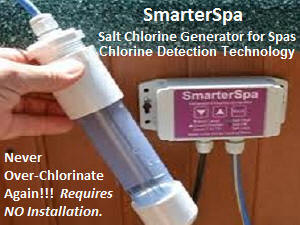
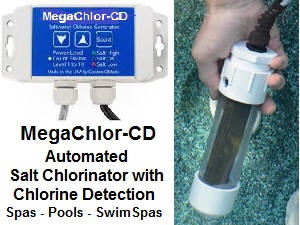
Salt Chlorine generators are a
better way to utilize chlorine, producing
more controllable results. They
eliminate the need to handle, measure or
store chlorine products, while reducing
buildup problems. Shocking can be
a simple as changing the salt chlorine
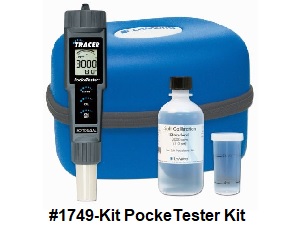
generator output to boost of shock mode. An
Electronic
PockeTester Kit is a convenient
way to monitor the salt level, as well
the overall water chemistry. |
|
Salt Chlorine Generators - 4
Models |
Testing The Salt Level |
Salt Chlorine Generators - 4
Models |
 |
 |
 |
|
Product and Ordering Information |
Product and Ordering Information |
Product and Ordering Information |
If you have a pool or spa water
testing need, we should have the
product.
►
Scroll down to read through some
Question & Answer information.
◄
|
|
A
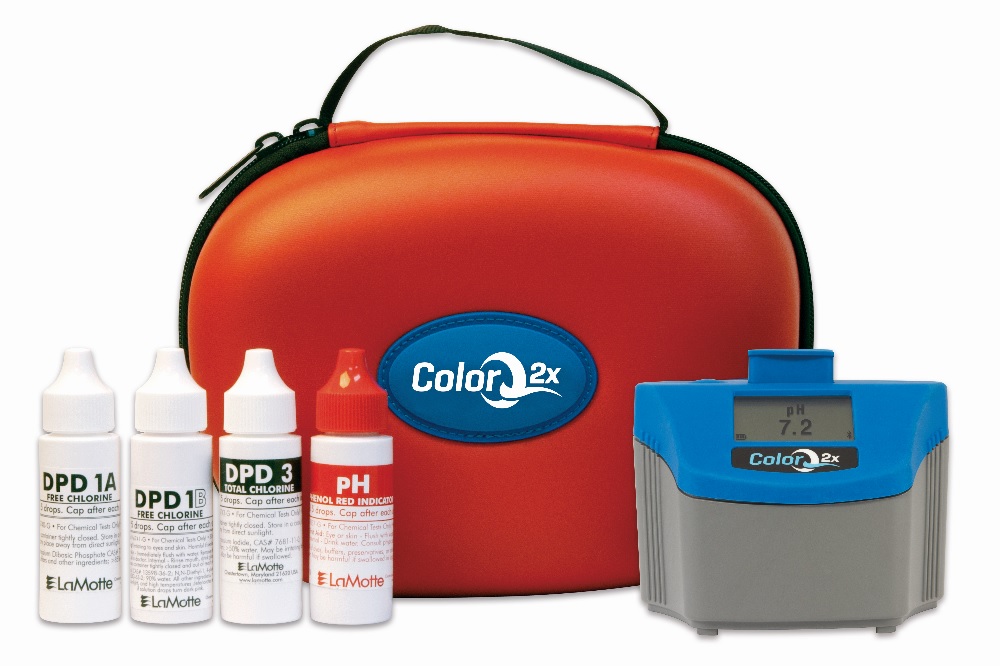
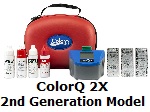
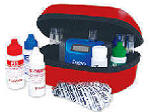
ColorQ 2X is a 2nd generation,
Bluetooth, Waterproof, all-digital tester,
that can
measure all the common test factors. There is a model, for every sanitizing
need.
If you
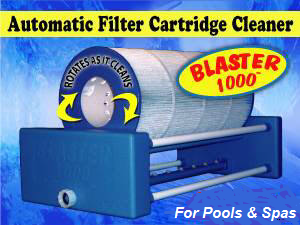
have a cartridge filter,
The Blaster Automatic Filter Cartridge
Cleaner will make that chore
much easier. Fine
particles can pass through many
filters. The
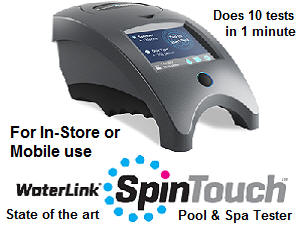
WaterLink SpinTouch Labs
are the ultimate tester, doing
up to 10 different water test
factors, in just 1 minute.
Voted product of the year. |
|
ColorQ All-Digital Water Testers |
Automatic Filter Cartridge
Cleaner |
WaterLink SpinTouch Labs |
 |
 |
 |
|
Product and Ordering Information |
Product
and Ordering Information |
Product and Ordering Information |
If you have a pool or spa water
testing need, we should have the
product.
►
Scroll down to read through some
Question & Answer information.
◄
|
|
|
|
How to shock
treat a spa, swim spa or hot tub? |
Shocking a spa
or hot tub refers to the application of large
quantities of chlorine, non-chlorine shock or
hydrogen peroxide. Typically 5-10 times the
normal dose is used, based upon actual
conditions and needs. The purpose of this large
dose is to break down the combined chlorine,
organic waste and contamination and re-establish
a positive level of sanitizer. Shock treatments
must be repeated, until such time as a stable
sanitizer reading can be achieved, for at least
a few hours. Products such as sodium dichlor,
lithium hypochlorite and
non-chlorine shock are used for this purpose,
with spas utilizing chlorine, bromine, ozone
generators, ultraviolet sanitizers, mineral
sanitizers or ionizers. These products cannot be
used in a biguanide-maintained spa: only
concentrated hydrogen peroxide can be used as
the shock. Spas using a
salt
chlorine generator can dial the output up to
shock mode, to quickly super-chlorinate the spa. A spa should be shocked at the first
signs of algae, mold or slime, after periods of heavy
bather usage and at the onset of a loss of water
clarity or quality. Another common practice is
to shock treat the spa water every week,
typically, after a period of high bather usage.
This will help to re-establish the sanitizer
level, help prevent the growth of resistant
microorganisms and help maintain sparkling,
crystal clear spa water. When using shock, the
label doses are only a guide. Your spa or hot
tub could require more or less, depending upon
the actual water quality. If problems
arise, refer to the
Spa Problems
Page, as a source of problem-solving
information, broken down into various
categories. Scroll down the page and click on the linked
keywords,
catch phrases
or images, in the archived answers below, to access additional information, on that topic or product.
 |
Join our E-Letter Mailing List.
You'll receive 1-3 E-Letters a
month, featuring helpful pool
and spa advice, new product
information and sale
announcements. All we
require is your e-mail address
and you can opt out anytime you
wish.
Your information
will never be shared or sold. |
|
▼
Helpful,
Problem-Solving Information, in a question and
answer format.
▼ |
►
When To Shock And Why?
I
just spent hours pouring through your website and it was so
informative and helpful! I've bookmarked it for reference
and will tell all my friends about it, for sure! I've
read pretty much every answer you gave on the subject but
still wanted some clarification, if you could: We just
bought the "ChlorMaker Salt Chlorine Generator" as a cost effective
replacement for our old Salt Water System Chlorine
Generator, which never worked since we got it. We bought the
tub used from a private owner and the salt system was a
selling point. But, either we have broken wires or a
need to replace the cell. And the Spa Mini is less than $200 instead
of $700. The dealer that specializes in the OLD System told
us, that we'd still need to Shock the tub weekly despite the
generator. Your advice says that we should not need to shock
it at all. That boosting it for high usage should do the
trick. You did allude though that there might be "some times
where you might need to shock it" but did not describe what
those might be. We don't really trust the dealer who is
trying to sell us extra things. So what I really want to
know is, WHEN are the circumstances we would need to use a
Shock treatment? If I need to have some on hand, that's
fine, I just want to be able to recognize the circumstances
we would need to use it and would love to avoid it all
together if it's just something they told us to sell more
products. I know all about balancing the other aspects of
the water. We have already been doing that, while adding
chorine shock once or twice a week, until we decided what to
do about replacing the salt chlorine generator. Plus
all the info on your site informed me EVEN better than I was
before. Thanks for your help!
Becky G., Jackson, MI, 12/31/2017
 You
may never have to shock the spa, with a salt chlorine
generator. BUT!!! There could be times when the bather usage
depletes the free chlorine level.
Salt chlorine
generators do not always play catch up very well, so
adding some shock could avoid a problem. Otherwise, once a
month, even if all is well, raise the free chlorine to 5-10-
PPM. This helps eliminate any microorganisms that might
become resistant to normal levels of chlorine. Any
time you see a loss of water quality is a good time to test
the chemistry and possibly add some shock. The great
thing about salt chlorine generators is that you can simply
dial-up the chlorine output and create the same effect, as a
shock treatment. If you need a quick boost, then a chlorine
shock is the way to go. I hope that the information
provided was helpful. Best wishes for the new year.
You
may never have to shock the spa, with a salt chlorine
generator. BUT!!! There could be times when the bather usage
depletes the free chlorine level.
Salt chlorine
generators do not always play catch up very well, so
adding some shock could avoid a problem. Otherwise, once a
month, even if all is well, raise the free chlorine to 5-10-
PPM. This helps eliminate any microorganisms that might
become resistant to normal levels of chlorine. Any
time you see a loss of water quality is a good time to test
the chemistry and possibly add some shock. The great
thing about salt chlorine generators is that you can simply
dial-up the chlorine output and create the same effect, as a
shock treatment. If you need a quick boost, then a chlorine
shock is the way to go. I hope that the information
provided was helpful. Best wishes for the new year.
Sincerely. Alan Schuster, 12/31/2017
►
How Much Shock To Add?
Hello, I can’t
seem I to get an answer to this question. My hot tub is 72
in x 72 in x 30 in deep. How much shock do I use.
Thanks.
Heather, 12/8/2017
The amount is enough. Every
spa is different and size is not the only consideration.
Read the label and add that amount. Retest in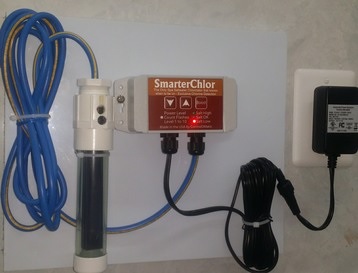 an hour and
add more, if necessary.
Keep adding, until the water clears up, the underwater
surfaces are not slippery and the free chlorine is a stable
1-3 PPM. The total chlorine should not read more than 0.3
PPM. If it does, more chlorine has to be added. Make sure
the pH is 7.2-7.6. A
salt chlorine generator
is a convenient way to add chlorine and eliminate most needs
to shock a spa. You can simply dial-up the chlorine
production, on a temporary basis. The SmarterSpa
model knows when to produce chlorine and when to shut itself
off, preventing over-chlorination. There are no-installation required models,
starting at very affordable prices. It will eliminate the
need to measure, handle and store chlorine and help
eliminate most odors. I hope that I have been helpful.
If so, please tell your friends about the website.
Best wishes for the New Year.
an hour and
add more, if necessary.
Keep adding, until the water clears up, the underwater
surfaces are not slippery and the free chlorine is a stable
1-3 PPM. The total chlorine should not read more than 0.3
PPM. If it does, more chlorine has to be added. Make sure
the pH is 7.2-7.6. A
salt chlorine generator
is a convenient way to add chlorine and eliminate most needs
to shock a spa. You can simply dial-up the chlorine
production, on a temporary basis. The SmarterSpa
model knows when to produce chlorine and when to shut itself
off, preventing over-chlorination. There are no-installation required models,
starting at very affordable prices. It will eliminate the
need to measure, handle and store chlorine and help
eliminate most odors. I hope that I have been helpful.
If so, please tell your friends about the website.
Best wishes for the New Year.
Sincerely. Alan Schuster, 12/8//2017
► Chlorine Shock And
Bromine?
If I am using Bromine, should I use a
non-chlorine shock treatment and would anything negative
happen if I used a chlorine shock? This past summer, I only
used non-chlorine shock and had beautiful water. Last week,
the pool dealership gave me a fast-shock that has chlorine
in it. Is it safe to use with Bromine or not? Thanks.
Christine, 5/13/2013
Using the chlorine shock should not be a problem. When you
add a non-chlorine shock to bromine maintained water it
destroys contamination or converts into bromine. Guess what?
The same thing will happen, if you use chlorine. It all ends
up as bromine. Isn't chemistry great! I assume that the
product is sodium dichlor and it should provide equally good
results. There would not be a problem switching back at any
time. Just get yourself a good, easy-to-use, water analyzer,
such as the ColorQ PRO 7
Digital Water Tester. It eliminates all color-matching
and guesswork. Enjoy the spa.
Sincerely. Alan Schuster, 5/13/2013
► Something
Other Than MPS?
I think I'm allergic to non-chlorine
shock and my wife doesn't want to use chlorine in our indoor
spa because of the odor. Can I use a Bromine system and
shock with something other than mps? Or what else would you
suggest? Thanks.
Hal F., 2/3/2014
If you are maintaining your spa on bromine, excess mps will
convert to bromine. You can shock with chlorine. There
should be little persistent chlorine odor, as it will be
converted into bromine. I am not sure if your are allergic
or not. The problem may be rooted in poor sanitation and not
have anything to do with bromine or mps. I certainly agree
that avoiding chlorine would be best, in terms of the odor.
What I suggest is that you add an ozonator. This will allow
you to avoiding using shock, under normal conditions. In
addition to the ozonator, you should maintain a 1-3 PPM
level of bromine and use a mineral sanitizer, to help
maintain this lower level of bromine. Either way you should
get better water quality with less odor and fewer chemicals
being added. A Salt Chlorine Generator has become a popular
option, as it is the better way to do chlorine.
Affordably-priced models are available, that require no
installation. Simply Plug-n-Play. I hope that
I have been helpful. Good luck and enjoy the spa.
Sincerely. Alan Schuster, 2/3/2014
► How Often
To Shock?
My spa is maintained with granular
dichlor. Do I still have to shock the water?
Henry D., Statesboro, GA, 12/3/2016
Shocking helps to destroy organic byproducts and wastes and
helps prevent the development of resistant microorganisms.
Shock treating the spa water, once a week or at the first
signs of a loss of water quality, is a reasonable minimum.
You could use the same dichlor product to shock: just add a
double or triple dose. I would prefer to use a non-chlorine
shock. This product will help destroy the odorous
chloramines and get you back into the spa even sooner. If
your spa is equipped with an ozonator, the need to shock
treat a spa can be reduced, especially if the ozonator is
run off a separate low-speed pump. I hope that I have been
helpful.
Sincerely. Alan Schuster, 12/3/2016
► To Shock Or
Not To Shock?
Thanks for your web site, I find it
very helpful. I have a spa that is 300 gallons. I run 6 days
a week and get in the hot tub after my run. This obviously
takes its toll on the water chemistry. Do you have any
suggestions as to how often I should shock and how often I
should change the water? Any thing else you think I should
consider?
Hughes J., 6/11/2013
All that
activity is going to add a lot of wastes to the water. A
salt chlorine generator
is a convenient way to add chlorine and eliminate most needs
to shock a spa. You can simply dial-up the chlorine
production, on a temporary basis. The SmarterSpa and
MegaChlor-CD models know when to produce
chlorine and when to shut itself off, preventing
over-chlorination. Both models allow you to set in
boost mode, which super-chlorinates the water. Doing this could help reduce the need frequent
shock treatment. However, a weekly shock treatment is still
useful to rid the water of wastes and help prevent the
development of sanitizer-resistant microorganisms. How often
to change the water can be subjective. The only scientific
way would be to measure the TDS. If it rises 1500 PPM above
the starting point, without a doubt the water should be
changed. Every 3 months is a common guideline, but heavy use
could mean more frequent changes. A lot depends upon the
sanitizer being used. Some methods add a lot to the TDS.
Ozonation does not. The important thing to do is maintain
the water chemistry and clarity and it is the best
indication of water quality. I hope that I have been
helpful.
Sincerely. Alan Schuster, 6/11/2013
► Is Shocking
Necessary?
Why do I need to shock my spa when it
has an ozonator and I add chlorine daily?
Bill G., 2/16/2017
You may not have to. But, that doesn't mean that you
shouldn't! Once in a while it is a good practice to shock
the spa, in order to not only destroy organic contamination,
but to eliminate microorganisms that might have able to
survive more typical chlorine levels. There is no set rule
and every spa is different. If the spa is not going to be
used for a few days, that is always a good time, as it will
not interfere with the use of the spa. You can further
reduce the need to shock, by adding a mineral sanitizer. I hope that this information is
helpful.
Sincerely. Alan Schuster, 2/16/2017
► Choosing A
Spa Shock Treatment?
I'm an owner of a new spa. I've got
the water chemistry all balanced. Everything's cool, but I
was wondering about something. I'm using bromine as a
sanitizer. I buy shock made for the spa which costs about 6
dollars a pound. Is it the same as the 1 pound chlorine
shock bags that I use in my swimming pool? If not, could I
use this as shock for my spa? I'm kind of confused
about whether chlorine is the sanitizer used in spa shock,
or not. Thanks in advance.
Miranda, 4/10/2018
Chlorine could very well be the active ingredient in the spa
shock that you are using. Because you are on bromine, any
chlorine or non-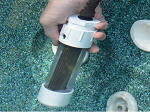 chlorine shock will be converted into
bromine. Isn't chemistry great! The pool shock in a bag is
most likely calcium hypochlorite: you should not use this
product in the spa, as it is slow dissolving, will raise the
pH and contributes calcium to the water. The product that
you are using probably contains sodium dichlor: it is quick
dissolving, essentially pH neutral and well suited for spa
shock treatment. Another good choice would be potassium
peroxymonosulfate: a non-chlorine oxidizer that will quickly
boost the bromine level and is completely soluble. You
could meet all the sanitizing and shock requirements, by
adding a salt
chlorine generator. Shocking can be as simple, as
changing a setting, on the controller. It provides more
consistent and better results. I hope
that I cleared things up for you. Enjoy the spa.
chlorine shock will be converted into
bromine. Isn't chemistry great! The pool shock in a bag is
most likely calcium hypochlorite: you should not use this
product in the spa, as it is slow dissolving, will raise the
pH and contributes calcium to the water. The product that
you are using probably contains sodium dichlor: it is quick
dissolving, essentially pH neutral and well suited for spa
shock treatment. Another good choice would be potassium
peroxymonosulfate: a non-chlorine oxidizer that will quickly
boost the bromine level and is completely soluble. You
could meet all the sanitizing and shock requirements, by
adding a salt
chlorine generator. Shocking can be as simple, as
changing a setting, on the controller. It provides more
consistent and better results. I hope
that I cleared things up for you. Enjoy the spa.
Sincerely. Alan Schuster, 4/10/2018
► Hydrogen
Peroxide?
I have a question about the use of
hydrogen peroxide in spas. Some friends of mine are using
straight hydrogen peroxide in their spas and they say it
works great. They have no way to test how much is required
to do the necessary sanitizing but they say they just add
lots and it won't hurt you. This is obviously bucket
chemistry, but I do not have any knowledge about hydrogen
peroxide to discuss with them. Can you tell me about this
stuff or tell me where I can go to get this information?
Thanks.
Michael G., Canmore, Alberta, Canada, 1/18/2005

The lack of specific information about hydrogen peroxide is
probably due to the fact that the material is not recognized
as a spa sanitizer. It is used as a spa oxidizer, usually in
conjunction with biguanide. There is no doubt that it is an
effective oxidizer. I would not recommend its use in a stand
alone situation. If you want to totally eliminate chlorine
or bromine, hydrogen peroxide can be used in conjunction
with a mineral sanitizer. The mineral sanitizer will help
provide sanitizing action and the hydrogen peroxide will
furnish the necessary oxidizing action. It is possible to
test the peroxide level: LaMotte Company produces a convenient
Peroxide test strip. Have you considered a
salt chlorine
generator? It is a complete sanitizing system,
which can
be used to provide oxidizing action and will avoid handling
the hazardous hydrogen peroxide solution. I hope that this
information proves helpful.
Sincerely. Alan Schuster, 1/19/2005
► Shocking A
Biguanide Spa?
Can a non-chlorine shock be used in a
spa being maintained with biguanide? I use hydrogen peroxide
now, but would like to use something else. Thanks.
Matt, 8/1/2016
Non-chlorine shock is potassium peroxymonosulfate. It cannot
be used with biguanide as a spa shock treatment or for any
other reason. Non-chlorine shock will chemically destroy the
biguanide. Hydrogen peroxide is the product of choice. The
track record on biguanide suggests, that sooner or later,
you will have to switch to another sanitizer, because of the
development of sanitizer resistant mold and bacteria.
A salt chlorine
generator is a complete sanitizing system, that can
provide better and more consistent results, at a lower cost. Enjoy
the spa experience.
Sincerely. Alan Schuster, 8/1/2016
► Using
Chlorine Or Non-Chlorine Shock?
Thank you for your informative
website. I am a new spa owner and have decided to go with
sodium dichlor, as a sanitizer. But, after reading a lot on
the internet, I'm still confused. Should I use a chlorine or
non chlorine shock with this? Why would I choose one over
the other? I guess I just don't get the difference,
especially when using chlorine as the sanitizer. Thank you
for your time.
Evan W., Tucson, AZ, 11/14/2007
You can use either one. The purpose is to maintain a free
chlorine level of 1-3 PPM, with the total chlorine not more
than 0.3 PPM higher. If the total chlorine gets to be too
high, the non-chlorine might do a better job of narrowing
the difference. If you opt to go with a
salt chlorine
generator, you will
have a complete system, which sanitize the water and provide
the opportunity to shock, simply by changing a setting.
We offer several models, that require no installation and
two of the are "smart enough", to only produce chlorine,
when it is actually needed. You'll never
over-chlorinate again. I hope that you will find this information
helpful.
Sincerely, Alan Schuster, 11/14/2007
► When To
Shock?
Hi Alan, I just bought a house with a
hot tub and have many questions about water chemistry. I
have found your web site very helpful and have put it in my
favourites. One quick question. Is there a maximum amount of
shock treatments you can do in a week? Is it dangerous doing
it too often? Are shock treatments harmful to the tub or my
family? I am using bromine and it seems that shock is the
only thing that brings the levels back up. The shock is a
lithium based granule. The questions could keep coming , so
I will go back to your site and wait for your response.
Thanks for your help and your web site info! Sincerely.
Theresa, Ontario, Canada, 10/18/2018
You can shock treat your spa, as often as needed, to
maintain a 3-5 PPM level of bromine. Shock treating merely
refers to the addition of a quick dissolving product that
will provide an instant boost to the bromine level of the
spa water. You can use the current product or sodium dichlor
or a non-chlorine shock for this purpose. The bromine
product is slow dissolving and the easiest way to boost the
level is to add "shock." I hope that I have been helpful.
Sincerely. Alan Schuster, 10/19/2018
► Too Much
Shock?
I shocked my bromine spa last night,
and tested it this morning. My pH is at 8.4 and my bromine
level is way too high! After shocking, are the levels
supposed to go back down to where they were by themselves,
or do I have to re-adjust everything all over again? I had
all my levels perfect, and now they're all too high (except
for the TA - that is still good). Thank you.
Kristin W., 1/19/2016
Not really! An ideal bromine reading should be 3-5 PPM.
Higher levels could be irritating. If the water was
"perfect" adding shock would have boosted the bromine level.
The water being in good condition probably did not have a
lot of wastes and byproducts present that would react with
bromine. It may take a few days for the levels to drop and I
would not recommend bathing, unless you know how high is
high. In the future, remember you can always add more - you
can't take out! Add shock treatment in increments until the
level is 5-10 PPM, instead of adding a fixed amount and,
possibly, overdosing. If you want to lower the level
quickly, many dealers carry a chlorine/bromine neutralizer
product. Follow directions and add it increments. Your pH is
too high and should be lowered to the 7.2-7.8 range. I hope
that the information proves helpful.
Sincerely. Alan Schuster, 1/19/2016
► The
Shocking Facts?
I am using bromine tablets in my hot
tub. I work hard at keep the level in the 3-5 PPM and the
water seems to be in excellent shape. Do I still need to
shock?
Bob, Tiburon, CA, 12/2/2009
Good question! If you add a spa shock treatment, such as a
non-chlorine shock, on a weekly basis or after heavy bather
usage or at the first signs of a loss of water quality, you
will help destroy the buildup of organic byproducts and help
prevent the development of resistant microorganisms. On the
other hand, if you rarely shock the water, you increase the
likelihood of organic byproducts building up and the
development of resistant microorganisms. At the very least,
consider adding some non-chlorine shock after periods of
heavy usage, in order to quickly re-established the bromine
level. A reliable tester can help speed the process. The
ColorQ testers are all-digital and eliminate the color
matching and guesswork. I hope that I have been helpful.
Sincerely. Alan Schuster, 12/2/2009
|
Visit The Website Stores . . . for
better informed shopping!!! |
|
|
Shipping is FREE* . . . within
the Continental U.S.
A $9.99
handling charge will apply
to Continental U.S. Orders,
under $75.00. Orders
outside of the Continental
U.S. may require some
additional charge, based on
quantity and destination.
Most products can be
shipped World-Wide. International
and orders outside of
Continental U.S. - see
comments on the ordering
pages. |
|
|
Major
Credit Cards and PayPal are accepted. |
|
▲
Return To Top Of Page
▲
Aqualab Systems, LLC does not
make any warranty or
representation, either expressed
or implied, regarding the
accuracy or completeness of the
information provided by this
website; nor does Aqualab
Systems., LLC. assume any
liability of any kind whatsoever
related to, or resulting from,
any use or reliance on this
information. The content of this
website should not be used, if
it is conflict with any
applicable federal, state or
local regulations or guidelines.
© Aqualab Systems, LLC. All
rights reserved