|
 |
Shipping is FREE* . . . within
the Continental U.S.
A $9.99
handling charge will apply
to Continental U.S. Orders,
under $75.00. Orders
outside of the Continental
U.S. may require some
additional charge, based on
quantity and destination.
Most products can be
shipped World-Wide. International
and orders outside of
Continental U.S. - see
comments on the ordering
pages. |
|
 |

Major
Credit Cards and PayPal are accepted. |
|
On-line
shopping since 2002 - Safe and Secure!!! |
|
Protecting a heater and improving
performance!!! |
|
Incorrect
use of a sanitizer can result in heater
corrosion.
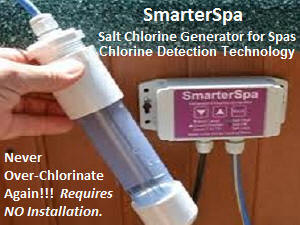
Salt Chlorine generators
tend to create higher pH conditions,
which are not likely to cause corrosion.
A Chlorine
is a popular pool water
sanitizer and sanitizing
is a must, for proper
water management.
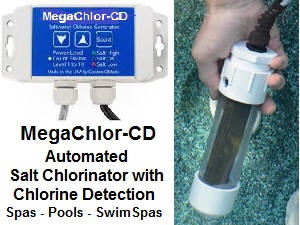
Salt Chlorine generators are a
better way to utilize chlorine, producing
more controllable results. They
eliminate the need to handle, measure or
store chlorine products, while reducing
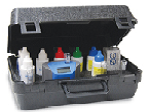
buildup problems. An
Electronic
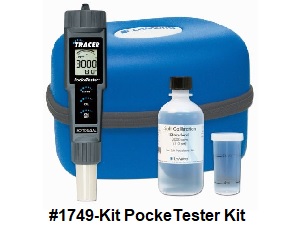
PockeTester Kit is a convenient
way to monitor the salt level.
|
|
Salt Chlorine Generators - 4
Models |
Testing The Salt Level |
Salt Chlorine Generators - 4
Models |
 |
 |
 |
|
Product and Ordering Information |
Product and Ordering Information |
Product and Ordering Information |
If you have a pool or spa water
testing need, we should have the
product.
►
Scroll down to read through some
Question & Answer information.
◄
|
|
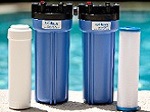
A
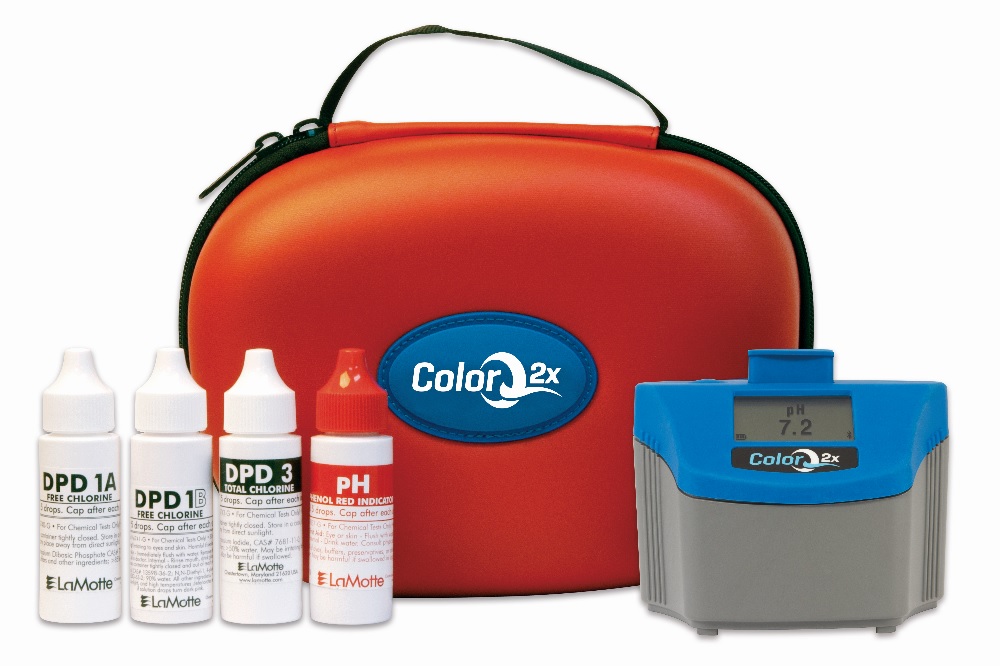
ColorQ 2X is a 2nd generation,
Bluetooth, Waterproof, all-digital tester,
that can
measure all the common test factors. There is a model, for every sanitizing
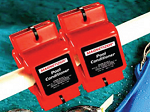
need. A
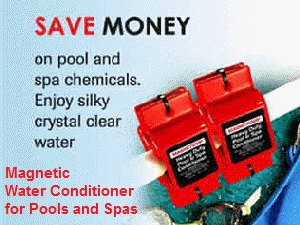
Magnetic Water Conditioner
helps control scaling
tendencies, which can reduce
heater and filter efficiency. The
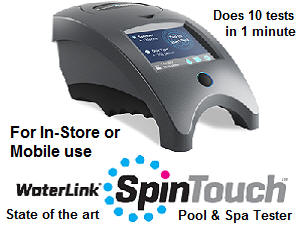
WaterLink SpinTouch Labs
are the ultimate tester, doing
up to 10 different water test
factors, in just 1 minute.
Voted product of the year. |
|
ColorQ All-Digital Water Testers |
Magnetic Water Conditioners |
WaterLink SpinTouch Labs |
 |
 |
 |
|
Product and Ordering Information |
Product and Ordering Information |
Product and Ordering Information |
If you have a pool or spa water
testing need, we should have the
product.
►
Scroll down to read through some
Question & Answer information.
◄
|
|
|
How to solve heater problems and select
the right options? |
Spas and hot
tubs require routine care and periodic
maintenance, in order to preserve and maintain
the good operating condition of the heater and
other equipment. Manufacturers' trouble-shooting
guides should be consulted for maintenance or
replacement instructions. Heater corrosion can
result from poor management of the spa water
chemistry and chemical additions and should be
completely avoidable. If problems arise, refer
to the Spa
Problems Page, as a source of
problem-solving information, broken down into
various categories. Scroll down the page
and click on the linked
keywords,
catch phrases
or images, in the archived answers below, to access additional information, on that topic or product.
 |
Join our E-Letter Mailing List.
You'll receive 1-3 E-Letters a
month, featuring helpful pool
and spa advice, new product
information and sale
announcements. All we
require is your e-mail address
and you can opt out anytime you
wish.
Your information
will never be shared or sold. |
|
▼
Helpful,
Problem-Solving Information, in a question and
answer format.
▼ |
►
Cost OF Heating?
We live in Minnesota and winters are
cold. Really cold. We
are cost about the cost of heating.
Are there any better options, when
selecting a brand? Thank you.
Tom F., 8/9/2018
As the
name implies,
Arctic
Spas were designed, with extreme
temperatures in mind. In other
spas, the shell is covered, with
installation. This helps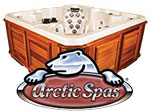 save
heat, but makes servicing difficult.
It also only protects the spa.
In Arctic Spas, the entire inside of
the cabinet is insulated, protecting
all the pipes and equipment and
making servicing easier. Other
spas rest on the cold ground or a
cold slab. Arctic Spas rest in
a raised, insulated platform, made
specifically for its greater
insulating properties. Any
waste heat, from the pump. is used
to help maintain the water
temperature, as it lies within the
insulated cabinet. Even the
thermal covers are thicker, for
better installation and less heat
loss. No matter what the
conditions, an Arctic Spa is built
to withstand extreme climates.
Heating will always cost money, but
better design and superior
insulation, will help to lower the
cost.
I hope that this was informative and
helpful.
save
heat, but makes servicing difficult.
It also only protects the spa.
In Arctic Spas, the entire inside of
the cabinet is insulated, protecting
all the pipes and equipment and
making servicing easier. Other
spas rest on the cold ground or a
cold slab. Arctic Spas rest in
a raised, insulated platform, made
specifically for its greater
insulating properties. Any
waste heat, from the pump. is used
to help maintain the water
temperature, as it lies within the
insulated cabinet. Even the
thermal covers are thicker, for
better installation and less heat
loss. No matter what the
conditions, an Arctic Spa is built
to withstand extreme climates.
Heating will always cost money, but
better design and superior
insulation, will help to lower the
cost.
I hope that this was informative and
helpful.
Sincerely. Alan Schuster,
8/09/2018
►
What Caused Heater Corrosion?
Hi Alan.
Question on spa. I just found out that my heater is bad to
severe internal corrosion. I just had the heater installed a
year ago. Tech states my water must be really bad and asked
what I am using to sanitize. I have been using a salt
chlorinator for the past year and the chlorine level were
always on the low end. What would cause the heater to
corrode so quickly? Is there something I could do to make
water less corrosive? Would high/low pH cause this? Thanks.
Thomas J.,
10/20/2016

Chlorine will only attack copper, if the pH was under 7.0.
The pH needs to be at 7.2 - 7.6. A
salt chlorine generator
should avoid heater corrosion,
unless you overdo the additions of acid, as they tend to
raise the pH. To reduce the probability of future problems,
make sure the pH is optimized, the total alkalinity is at
least 80-120 PPM and that the calcium hardness is not less
than 200 PPM. If the water tests high for copper, I suggest
draining and starting over. I hope that I have been helpful.
If so, please tell your friends and dealers about the
website.
Sincerely. Alan Schuster, 10/20/2017
► Too Hot To Handle?
Our hot tub temperature has really
gotten hot. When we turn it back, nothing happens.
Temperature remains hot. I'm trying to avoid the expense of
calling a professional that lives far away. Any suggestions
or help would be appreciated. Thanks.
Gloria N., 5/13/2015
Your spa needs to be serviced and I am not knowledgeable
enough to be of assistance. Spas are equipped with high
temperature shut off switches and thermostats. It seems that
something has failed. High temperatures, above 104ºF or
40ºC, can be dangerous to the bathers and should be avoided.
If you want the use of the spa, I don't see how you have a
real choice. Sorry that I couldn't be of more help.
Sincerely. Alan Schuster, 5/13/2015
► Economics
Of Shutting On And Off?
Is there a study which compares cost
of maintaining a constant higher temp verses turning spa
down between use to a lower temp then bringing back to temp
each time the spa is used. I can find cost of operating spas
but no study on turning up and down vs. constant temp. Logic
tells me it would be cheaper to maintain a constant temp,
but I have some spa owners who insist that we turn spas down
between use to save money. Thanks for your help, and I
appreciate your advice.
Tim J., 4/18/2012
This gets asked a few times a year. I know of no study on
this subject. Analyzing the physics behind the question
tells you the heat loss to the environment is less, as the
water temperature drops closer to the ambient. Much depends
on how well the spa is insulated and the type and fit of the
cover. Yes, I think you can save money. But, it could be
pennies and you will lose the ability to enjoy the spa
whenever the mood strikes. If there is money to be saved,
this is not a really an effective way. Maintaining good and
consistent water quality and filtration will help minimize
problems and that will really save on operating costs. An
ozonator to destroy wastes and a
Mineral Sanitizer
for persistent backup sanitation are a great way to reduce
chlorine or bromine usage, without sacrificing water
quality. I hope this helps to put things in perspective.
Sincerely. Alan Schuster, 4/19/2012
► Economics?
We have a 1000 gallon spa in operation
outdoors, at a spa resort. Currently, it is being heated by
propane. Being that the spa is not covered, heat loss is
considerable. Would a heat pump make sense, in terms of cost
and temperature recovery time? Thanks.
Bret F., 12/4/2014
There is absolutely no doubt that an heat pump will result in a considerable savings.
Exactly how much will depend on the cost of propane and the
cost of electricity. But, it will be more than enough to
justify the switch. As a bonus, it operates a lot cleaner
too. The size of your spa and the uncovered feature, makes a
heat pump a viable alternative.
Good luck and I hope that I have been helpful.
Sincerely. Alan Schuster, 12/5/2014
► Excessive
Heating Costs?
I recently purchased a house that has
an inground granite spa that sits completely in concrete. I
ran the spa with temp. on 100°F for 30 days and my utility
bill went up $300.00. Original owners say they also had this
problem. My electrician says it is the electric heat and my
pool man says it still shouldn't be that high but doesn't
seem to know what to do to make it efficient. I have had a
large above ground spa before and ran it 24/7 and never even
noticed that it even used electricity. Spa runs on 220.
totally electric, was digital but wasn't running, so pool
man changed to manual on and off. Electrician questions spa
heating element. Pool man doesn't seem to know. Note:
Original home owners say the pool company that installed the
spa have tried to correct the problem but had no success, so
they stopped using it. Please help. Any possible answers to
problem will be greatly appreciated.
JBF, 5/14/2005
The cost of heating electrically is based on power
consumption. Better reduction of evaporation and heat loss
will reduce electrical consumption and costs. Is this spa
covered when not in use? Otherwise, the heat loss will be
considerable. Not only will the heat radiant away, but even
more will be lost through evaporation. Covering can be a
bother, but is will produce big savings. Want covering at
the press of a button? An
automatic safety cover
might be just what you need. Electric resistance heaters are
not very efficient. and this plays a direct role in your
heating costs. You might consider having a heat pump installed, as this type of heating is,
perhaps, the most cost effective means. I hope that this will help find a solution.
Sincerely. Alan Schuster, 5/14/2005
► Heater
Corrosion?
Recently, I had a corrosion problem
with my spa heater. What can I do to avoid a repeat?
Brady, 11/4/2007
Copper/copper alloy heater components can be adversely
affected by low pH, in the presence of chlorine or bromine.
The best way to avoid low pH levels is to maintain a total
alkalinity of 80-120 PPM. Some products such as trichlor
tablets should not be used in a spa. In addition, bromine
tablets are best utilized in a feeder or floating dispenser.
Electric heaters and heat pumps, that utilize a titanium heat
exchanger, are far more resistant to corrosion. Frequent
testing of the spa water is always a good practice. I hope
that I have provided some helpful information.
Sincerely. Alan Schuster, 11/5/2007
► Turned
Blue?
Admittedly, I neglected the spa for
about a two week period. Upon realizing it was not checked
for some time, I checked, and found both chlorine and pH
low. I attempted to raise the pH first, with sodium
carbonate, I believe. I have some pH plus that I never had a
problem with and while adding it a little at a time, the
water turned blue. I raised it to 7.0, shocked the water and
cleaned the filters. I then set the automatic filter cycle
to run continuously, to filter out the blue color that
precipitated out of the water. It has been running for 6
hours now, and is as blue as the Caribbean. Short of
draining, washing, and refilling the tub, can you offer any
advice or assistance? And any advice to prevent a
recurrence? Thanks!
Joe, 10/8/2006
There seems little doubt that this is a copper problem. The
low pH caused copper corrosion to occur in the heater. I
would advise draining and cleaning the spa. Spas should be
drained occasionally and this is a good time to do it. I
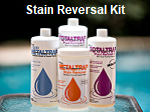
would add a dose or two of a quality metal chelating agent,
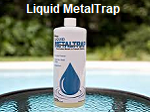
such as Liquid METALTRAP, after the spa is refilled. You
mentioned chlorine - I hope that it was not trichlor
tablets, as it could be part of the problem - too acidic.
Dichlor is what is used most often. Hopefully, the damage to
the heater was not serious, but each instance of low pH will
take its toll. I hope that I have been helpful.
Sincerely. Alan Schuster, 10/9/2006
► No Heat?
Dear Alan, I heard you were the man to
ask about spa trouble. I have a 1996 Spa. It will not heat,
it will cycle but no heat. I have had this trouble for a
month now. I changed the pressure switch and nothing has
changed. I don't know where the thermostat is so I can not
check it. Please if you have any insight let me know.
Desperate, 12/30/2010
While I can usually offer advice on spa water chemistry,
water quality and related maintenance issues, your question
is very product specific. I can point you towards possible
solutions, but it is the manufacturer that should be best
able to offer trouble-shooting information. In most cases,
if the power is interrupted, the thermostat may need to be
reset. Check to see what temperature the spa is set to
maintain. It may be set below the current water temperature
and should be raised to the desired temperature. Look for a
circuit beaker that may be protecting the heater and may
have tripped. Most spas, if not all, are equipped with a
high temperature cutoff switch, which prevents temperatures
from rising above 104°F. This is done for safety reasons, as
higher temperatures can be dangerous to the health of
bathers. Possibly there is a problem with this switch.
Sorry that I can't offer more but I have no access to model
by model information. I hope that this information will
prove to be useful. If this website was helpful in providing
information, please tell your friends and dealers about the
website.
Sincerely. Alan Schuster, 12/30/2010
► The Best
Temperature?
What is the best temperature for a hot
tub? For some reason I am having a hard time finding the
right temp to set it. No one seems to know.
Robert S., 2/15/2016
This is an entirely individual preference. A temperature of
104ºF is the safe maximum. With kids you might want to lower
the maximum. Most people keep the temperature at 100 -
104ºF. In the summer months, many people keep it at a
pool-like temperature. It's what makes you and the family
comfortable. Enjoy the spa.
Sincerely. Alan Schuster, 2/15/2016
► Spa Cooler?
I have a 400 gallon above ground spa
that gets up to 102°F degrees with the cover on! How can I
lower the temp? I don’t like the temperature over 98°F. Is
there a spa cooler of some sort? Thanks.
Bob D., Arizona, 7/27/2005
There is equipment used to cool swimming pools. It should be
possible to do the same with a spa.
Heat
pumps offers a broad choice of products, that heat water, chillers that cool water and units
that do both. Hopefully, this information will help you cool
off.
Sincerely. Alan Schuster, 7/28/2005
► Shutting
Off?
Presently I have an outdoor spa and
the heater isn't working. The spa is set up on a timer and
when it comes on it is supposed to turn on the heater. The
controls are equipped with a manual over ride and when I hit
the button you can hear the motor attempt to run and then it
turns itself off. Would my heater thermostat be bad or is my
motor bad? How do I check either one of these? Thanks for
the help.
Johnny G., 3/13/2004
There are several possibilities: thermostat problem, high
temperature cut-off switch problem, pump problem, controller
problem or a circuit breaker problem. I suggest that you
prefer to a trouble-shooting guide or the spa manufacturer's
website for additional insight, as this is really out of my
field of expertise. Good luck and I hope that I have helped
point you in the right direction. Good luck.
Sincerely. Alan Schuster, 3/14/2004
► Cooling
Off?
I have a spa and the water gets real
hot and then a week later it's only warm. I use it about
once a week. Should there be a timer to set? Or is it run
only from the cold to hot knob. Thanks for your time P.S. my
cover is starting to come apart, Could hot air be seeping
out to cause this problem?
Cold In California, 1/29/2008
Most likely you have a problem with the thermostat or the
controlling devices. Most spas have a thermostat that can be
set at a particular number. The temperature is controlled by
the heating switching on according to the thermostat or a
controller setting. You need to check to make sure that the
settings are correct. It is also possible that a sudden
power outage can alter the thermostat settings, dropping the
setting to the lowest number. This will prevent the heater
from coming on. Check to see what temperature the thermostat
is actually set at. The display may only show the actual
water temperature. With the variety of spas and equipment on
the market, it is impossible for me to be more specific. You
should refer to the trouble-shooting guide in the owner's
manual or contact the manufacturer and/or dealer, if
problems continue. The poor condition of the cover, is not
the cause of the problem. It does, however, cause heat loss
and should require the heater to be used more than
necessary. I hope that I have been of help.
Sincerely. Alan Schuster, 1/29/2008
► Higher Spa
Temperature?
We usually keep the spa water at 104ºF
and use it for about 20 minutes at a time. I don't seem to
be able raise the water temperature above this point. I
would like to try a slightly higher temperature. Is there a
reason this is happening?
Flagstaff, AZ, 12/12/2012
Temperatures above 104ºF can be dangerous. Most, if not all
spas, are equipped with high temperature cutoff switches
that prevent the temperature from rising above this point.
Even at 104°F, bathing time should be limited to about 20
minutes, especially if fully immersed in the water. Special
individual health requirements should be factored into the
spa usage. I hope that I have been helpful.
Sincerely. Alan Schuster, 12/12/2012
►
Intermittent Operation?
My husband and I use our spa every
evening and sometimes in the morning, during the winter-time
in upstate NY (i.e. cold weather). He usually turns the
temperature up an hour or two before use and then turns it
down, under the impression that this will save on heating
costs. I think keeping it at a stable temperature is
probably just as economical. Do you have any idea about
this? Cheers.
S. D., New York, 10/22/2006
In theory, a warmer spa will lose more heat to the
surroundings. Therefore, shutting off the heater could save
money. How much? The savings, depending upon the insulation,
might be trivial, in the overall scheme of things. Heating
isn't 100% cost efficient, so it does cost more to replace
lost heat. Considering how often the spa is used, why give
up the ability to use the spa, anytime you want, for some
pocket change? I hope that this information will be helpful.
Sincerely. Alan Schuster, 10/23/2006
|
Visit The Website Stores . . . for
better informed shopping!!! |
|
|
Shipping is FREE* . . . within
the Continental U.S.
A $9.99
handling charge will apply
to Continental U.S. Orders,
under $75.00. Orders
outside of the Continental
U.S. may require some
additional charge, based on
quantity and destination.
Most products can be
shipped World-Wide. International
and orders outside of
Continental U.S. - see
comments on the ordering
pages. |
|
|
Major
Credit Cards and PayPal are accepted. |
|
▲
Return To Top Of Page
▲
Aqualab Systems, LLC does not
make any warranty or
representation, either expressed
or implied, regarding the
accuracy or completeness of the
information provided by this
website; nor does Aqualab
Systems., LLC. assume any
liability of any kind whatsoever
related to, or resulting from,
any use or reliance on this
information. The content of this
website should not be used, if
it is conflict with any
applicable federal, state or
local regulations or guidelines.
© Aqualab Systems, LLC. All
rights reserved