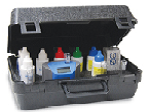
| |
|
Scroll
down to browse through some archived SPA and Hot Tub
questions and answers. Please click the Spa
Problems
Link, on top of every page, to access a complete listing
of Spa and Hot Tub Problem subjects, an alphabetized
Website Table of Contents, Spa and Hot Tub Equipment
Information, About Alan Biographic Material and a Spa
and Hot Tub Glossary. Use
the other links to access additional subject
information. More information about some new and unique
products, for Spas and Hot Tubs, can be found by visiting
The
Website Store.
You'll never know what you'll find and that's always
fun. Be better prepared and avoid costly problems!
|
|
 |
Shipping is FREE* . . . within
the Continental U.S.
A $9.99
handling charge will apply
to Continental U.S. Orders,
under $75.00. Orders
outside of the Continental
U.S. may require some
additional charge, based on
quantity and destination.
Most products can be
shipped World-Wide. International
and orders outside of
Continental U.S. - see
comments on the ordering
pages. |
|
 |

Major
Credit Cards and PayPal are accepted. |
|
On-line
shopping since 2002 - Safe and Secure!!! |
|
Managing the Sanitizer level, of Spa or
Swim-Spa water!!! |
|
Sanitizing is a must, for proper spa
water management.
Salt Chlorine generators are a
better way to utilize chlorine, producing
more controllable results. They
eliminate the need to handle, measure or
store chlorine products, while reducing
buildup problems. An
Electronic
PockeTester Kit is a convenient
way to monitor the salt level. |
|
Salt Chlorine Generators - 4
Models |
Testing The Salt Level |
Salt Chlorine Generators - 4
Models |
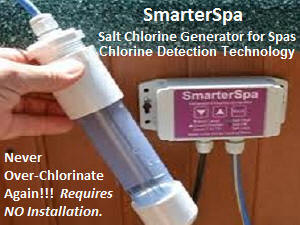 |
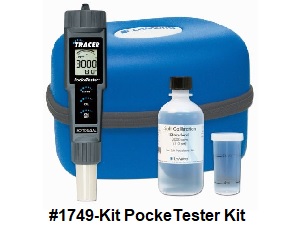 |
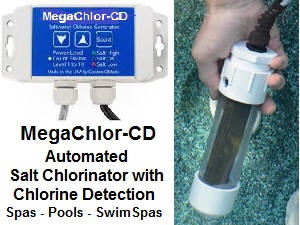 |
|
Product and Ordering Information |
Product and Ordering Information |
Product and Ordering Information |
If you have a pool or spa water
testing need, we should have the
product.
►
Scroll down to read through some
Question & Answer information.
◄ |
|
To achieve better sanitation,
proper water chemistry is
required.
A
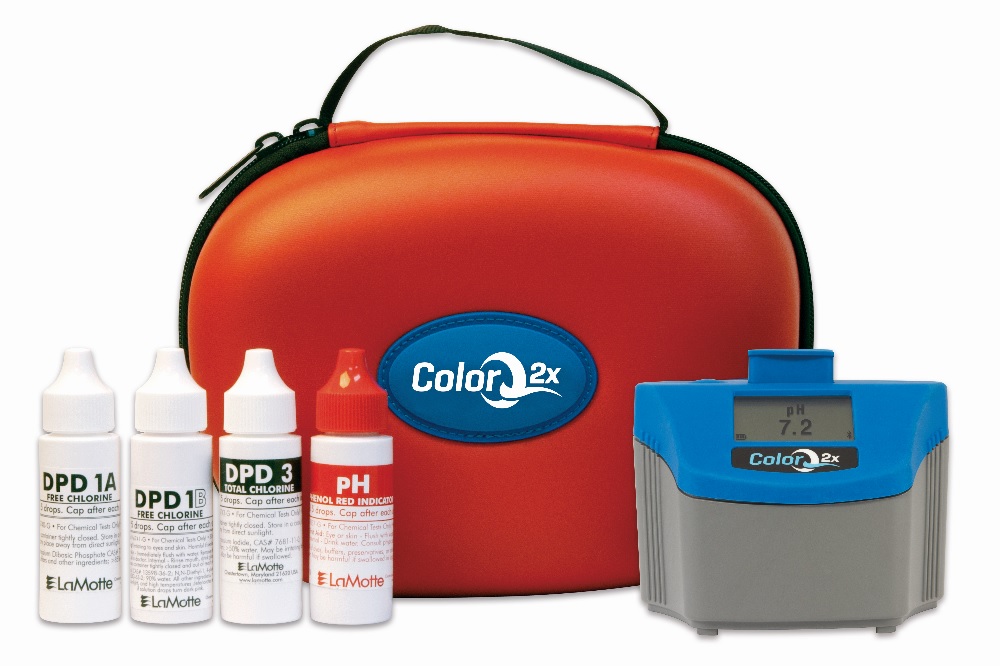
ColorQ 2X is a 2nd generation,
Bluetooth, Waterproof, all-digital tester,
that can
measure all the common test factors. There is a model, for every sanitizing
need.
If
you have a cartridge filter,
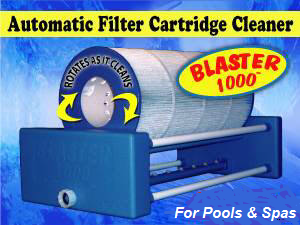
The Blaster Automatic Filter Cartridge
Cleaner will make that chore
much easier. Fine
particles can pass through many
filters. The
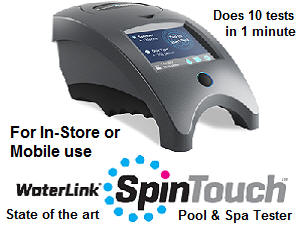
WaterLink SpinTouch Labs
are the ultimate tester, doing
up to 10 different water test
factors, in just 1 minute.
Voted product of the year. |
|
ColorQ All-Digital Water Testers |
Automatic Filter Cartridge
Cleaner |
WaterLink SpinTouch Labs |
 |
 |
 |
|
Product and Ordering Information |
Product and Ordering Information |
Product and Ordering Information |
If you have a pool or spa water
testing need, we should have the
product.
►
Scroll down to read through some
Question & Answer information.
◄
|
|
|
How to control algae, mold and more, in
a spa water? |
Microorganisms
of all types can grow in a poorly treated spa.
Sanitizing is the only thing that keeps spa
water clean, healthy, enjoyable and from
becoming old bath water. Microorganisms
including algae, bacteria, slimes and mold can
present themselves in various ways: cloudy
water, slimy growths or slippery underwater
surfaces. The warm temperature of the spa or hot
tub can accelerate the growth of microorganisms.
Today, there are many more choices of spa water
sanitizers: chlorine, bromine, biguanide, ozone
ultraviolet, mineral purifiers and ionization.
Using a combination of two - one as the primary
and another as a backup - produces consistently
good results and sparkling clear spa water.
Proper spa water treatment has never been easier
or more convenient. Water testing the sanitizer
level has never been easier: there are models of
the
ColorQ digital water analyzers,
for most every need. Eliminates all the color
matching and guesswork. If problems arise, refer to the
Spa Problems
Page, as a source of problem-solving
information, broken down into various
categories. Scroll down the page and click on the linked
keywords,
catch phrases
or images, in the archived answers below, to access additional information, on that topic or product.
 |
Join our E-Letter Mailing List.
You'll receive 1-3 E-Letters a
month, featuring helpful pool
and spa advice, new product
information and sale
announcements. All we
require is your e-mail address
and you can opt out anytime you
wish.
Your information
will never be shared or sold. |
|
▼
Helpful,
Problem-Solving Information, in a question and
answer format.
▼ |
► Failed Again???
I have a spa that is 8 months old. It
was a floor model at the store where we bought it and we
believe they were using bromine as the sanitizer. The first
set of problems occurred only a couple of months into
ownership. We started having scaling issues. The usual
treatment of Defender after draining, scrubbing and
refilling the spa seemed to resolve this issue. I did notice
something a little odd when I would remove the filters to
hose them off, though. Little wisps that looked like broken
down tissue paper under the filters. I tried devising my own
filter net out of a cloth diaper and plastic coated wire
since it’s a tight area where very little can fit. The
pieces were very small and looked like they would go through
a standard pool filter. We refilled the tub, added the same
sanitizer as the first time, an all natural enzyme treatment
that we use in conjunction with chlorine as the shock. A
little over a month, the problem was back with a vengeance.
It looked like a person with a severe, peeling sunburn had
used our hot tub. Really gross! We were told there was
little choice but to drain it, scrub, and refill. Before
draining, we super shocked for about 10 days. To try and
prevent another recurrence, we added chlorine to the tap end
of the hose, let it sit for 10 min, then refilled after
cleaning out the tub yet again. Since we didn’t know the
exact age of the filters, I decided to get a new set (it
uses two 14” long filters) that were supposedly
antimicrobial. I religiously add chlorine shock weekly,
whether we’ve been able to use the tub or not. It doesn’t
see a lot of use, probably 1 or 2 times/week. I even try to
leave it open to the sunlight, if weather permits. Since its
winter, those opportunities are not many. Here we are, less
than one month later and…IT'S BAAACK! Not only is this labor
intensive, its getting expensive. The all natural enzyme
treatment is costly at $35/fill up. Mother Nature isn’t
giving us many opportunities to drain and scrub without
freeze worries either. We chose this enzyme treatment since
I have very sensitive skin and wanted to avoid bromine,
which seems to produce the strongest skin, eye and nose
irritation from other pools we’ve visited. Note: We are on a
well, but use a hose pre-filter and the LaMotte test strips
we’ve been using don’t show anything out of balance. Help,
Help, Help! What now?
Amy, Monument, Colorado, 2/14/2018
A mold problem is usually indicative of the development of a
resistant microorganism and/or inadequate sanitation. It can
show up as s limy deposits or even look like shredded, floating tissue
paper. A spa requires a sanitizer and oxidation, to
prevent it from looking like
old bath water. All sanitizers
must have an EPA
(Environmental Protection Agency) Registration number, in
order to be considered a sanitizer. This is Federal law and
every state has its own, as well. No number = not a
sanitizer! It is certainly not
behaving like it is a sanitizer. It addition to sanitizing,
there must be oxidation, to eliminate organic wastes and
byproducts. The addition of a
salt chlorine
generator is something that you might consider, as it
will make maintenance easier and produce higher quality
water, with more consistent results. It will reduce the
chemical consumption.
Water testing is not an assurance of proper sanitizing - you
need both proper chemistry and sanitizer levels. I
suggest that you add a gallon or two of laundry bleach and
recirculate for an hour. If there is still chlorine present,
you can drain and clean Start with a clean slate and use a
recognized spa sanitizer. I hope that I have been helpful. limy deposits or even look like shredded, floating tissue
paper. A spa requires a sanitizer and oxidation, to
prevent it from looking like
old bath water. All sanitizers
must have an EPA
(Environmental Protection Agency) Registration number, in
order to be considered a sanitizer. This is Federal law and
every state has its own, as well. No number = not a
sanitizer! It is certainly not
behaving like it is a sanitizer. It addition to sanitizing,
there must be oxidation, to eliminate organic wastes and
byproducts. The addition of a
salt chlorine
generator is something that you might consider, as it
will make maintenance easier and produce higher quality
water, with more consistent results. It will reduce the
chemical consumption.
Water testing is not an assurance of proper sanitizing - you
need both proper chemistry and sanitizer levels. I
suggest that you add a gallon or two of laundry bleach and
recirculate for an hour. If there is still chlorine present,
you can drain and clean Start with a clean slate and use a
recognized spa sanitizer. I hope that I have been helpful.
Sincerely. Alan Schuster, 2/14/2018
► Black
Growth?
Alan, I have a hot tub and I use a
product that doesn't contain chlorine or bromine, instead of
chemicals. I am getting a black growth that neither the tub
dealer nor the treatment manufacturer can identify. I have
treated, drained & cleaned the tub twice, and the problem
returns. I have not treated with a chlorine type shock yet.
On advice from the tub dealer, just the treatment's brand of
shock. Have you ever heard of a black type of growth? Do
you know of a lab where I can get it tested to identify it?
Should I use a chlorine (or other chemical) based shock to
completely get rid of the growth (how much and how long)?
Thanks.
Phil J., West Virginia, 4/22/2016
I am not sure what this product is, but it doesn't seem to
be working for you. I suspect that it is some type of
natural enzyme product. Does it have an EPA Registration? If
it doesn't, as I suspect, it is not recognized as a spa
water sanitizer. You didn't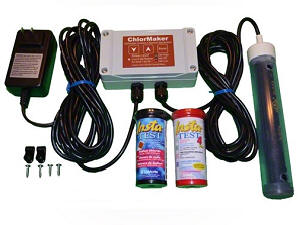 provide much information as to
whether or not the spa has an ozonator or mineral sanitizer?
The product that you are using may provide acceptable
results to a point. Eventually, a microorganism will start
growing that is resistant to this product's action. Yes, I
would try using chlorine to destroy the growth. Add enough
chlorine to boost the Free Chlorine level to 5-10 PPM and
keep it there until the growth is completely gone.
Afterwards, you can return to normal maintenance. However,
if this growth is truly resistant to the product you are
using, the problem will return with near certainty. I
suggest that you use a more conventional spa sanitizing
system. Browse through the "Ask Alan" archives for more
information on other sanitizing choices, such as
salt chlorine
generators, for spas and hot tubs. There is a
possibility that the problem is not a microorganism. It the
chlorine fails to remove the problem, have the water tested
for iron, copper, manganese and other heavy metals. I hope
that I have been helpful. Good luck. provide much information as to
whether or not the spa has an ozonator or mineral sanitizer?
The product that you are using may provide acceptable
results to a point. Eventually, a microorganism will start
growing that is resistant to this product's action. Yes, I
would try using chlorine to destroy the growth. Add enough
chlorine to boost the Free Chlorine level to 5-10 PPM and
keep it there until the growth is completely gone.
Afterwards, you can return to normal maintenance. However,
if this growth is truly resistant to the product you are
using, the problem will return with near certainty. I
suggest that you use a more conventional spa sanitizing
system. Browse through the "Ask Alan" archives for more
information on other sanitizing choices, such as
salt chlorine
generators, for spas and hot tubs. There is a
possibility that the problem is not a microorganism. It the
chlorine fails to remove the problem, have the water tested
for iron, copper, manganese and other heavy metals. I hope
that I have been helpful. Good luck.
Sincerely. Alan Schuster, 4/22/2016
► Possible
Spa Water Mold Problem?
My husband and I have a 2008 model
spa. Right before we changed the water the last time (2
weeks ago) we noticed these little wisps floating in the
water. They range from 1mm to 5mm in size, feel slimy when
touched and are pinky-orange-brown in color. Also, they
smell. They are most noticeable after the pumps have run and
then shut off. It almost looks like someone dropped a piece
of tissue paper in the water and it has dissolved into these
little bits. We have cleaned the spa and flushed the lines
twice (got lots of green algae out of the lines too), but
this problem came roaring right back after the spa was
running only two days. This stuff dirtied up a filter in
less than 36 hours. Help! Sincerely.
Rachel A., 4/18/2016
What you are describing sounds like mold and bacterial
growth. Your ozonator may not be operating properly or for
long enough periods of
time. Ozone should be detectable by odor, upon removal of
the cover. You need to verify that the ozonator is
working properly. Ozonators requires a backup sanitizer such as
chlorine, bromine or a mineral sanitizer. Are you using a
backup sanitizer? If not, I suggest that you consider using
a salt chlorine
generator. An operating ozonator will allow you
to maintain a low to normal level, by adding reducing the
amount of chlorine required, on an ongoing basis and works
well with chlorine. Try and keep the level at 1-3 PPM. Make sure that
the ozonator is operating for at least 4, 2-hour periods
spaced throughout the day. To help jump-start things, add
shock treatment to help destroy any mold or bacteria and
help establish a bromine level. I hope this information will
prove to be helpful. periods of
time. Ozone should be detectable by odor, upon removal of
the cover. You need to verify that the ozonator is
working properly. Ozonators requires a backup sanitizer such as
chlorine, bromine or a mineral sanitizer. Are you using a
backup sanitizer? If not, I suggest that you consider using
a salt chlorine
generator. An operating ozonator will allow you
to maintain a low to normal level, by adding reducing the
amount of chlorine required, on an ongoing basis and works
well with chlorine. Try and keep the level at 1-3 PPM. Make sure that
the ozonator is operating for at least 4, 2-hour periods
spaced throughout the day. To help jump-start things, add
shock treatment to help destroy any mold or bacteria and
help establish a bromine level. I hope this information will
prove to be helpful.
Sincerely. Alan Schuster, 4/19/2016
► White Mold?
I have been told that my hot tub has
white mold in it. Is this a serious health problem to the
tub users. Me and my family? I was offered a chemical for
ridding the pipes. It's pretty expensive and somewhat
drastic looking. Any recommendations? Thanks so much.
George, 6/13/2006
This type of mold problem is usually indicative of the
development of a resistant microorganism and/or inadequate
sanitation. Some more information would have been helpful.
If you are using biguanide, you should permanently switch to
another sanitizer. If you are using chlorine, I suggest that
you switch to bromine. Bromine seems to be the most
effective treatment for this problem. You can add sodium
bromide and non-chlorine shock (the 2-part bromine system)
and boost the bromine level to 5-10 PPM. Keep it elevated
until the problem is solved. After the mold is eliminated,
you can continue bromine additions with either the 2-part
system or bromine tablets. You could add a large dose of
chlorine and really get the level up (20 PPM). This will
clean out the pipes and the filter. Afterwards, drain and
clean the spa. Refill and start off fresh. The addition of
an ozonator is something that you might consider, as it will
make maintenance easier and produce higher quality water,
with more consistent results. It will reduce the chemical
consumption. You might add a mineral sanitizer, as well. The
combination of the two work well together. All you should
need is a very low level of bromine, as it will act as
confirmation that proper conditions are being maintained. I
hope that I have been helpful. Enjoy the hot tub.
Sincerely. Alan Schuster, 6/13/2006
► Possibly A
Mold Problem?
I believe I am suffering from a white
mold infestation. Here's the background. I've had my spa for
6 months, as of 3 months ago I noticed what looked like
white flakes floating in the water. I can best describe it
as what it would look like, if you put paper in the water
and broke it down into fibers. I originally thought it was
organic in nature and raised the bromine level to kill it
off. When it didn't happen, I drain it, scrubbed it and
refilled. It took 2-3 days, but the flakes returned. After
some research, I thought it might be a hardness problem. The
local water is somewhat high. Today, I'm back at thinking
the problem is organic in nature. From several sources,
professional, friends and the web, I have been told that
white mold is probably the culprit. The mold is fairly
resistant to bromine and chlorine. Sunlight is an effective
agent against it, but the mold, within the pipes, is
protected. Making the problem go away appears to be very
labor intensive and sort of hot or miss. My question is what
can you tell me about this problem/situation? I sincerely
appreciate all feedback. As for specific: I use bromine and
there is a functioning ozonator. I drain and clean, in
accordance, with manufacturer specs. We don’t use it that
much now (3-4 times a month), but it has been used heavily
in the past. It can go a month without use. After use, I
typically shock. The amount increases, if my kids use it or
we have friends over. I clean the filter every 3-4 weeks.
The current filter is 8 months old. It has never been dry.
Even if it is not used, I watch the chemicals to make sure
they are in spec. Thanks. However, test strips showed total
alkalinity to be within specs or at least abnormally high.
Today, I'm back to thinking the problem is organic in
nature.
Pete N., 5/1/2017
This mold problem, if that is what it is, is common with
biguanide and not bromine. The flakes could be calcium scale
coming off the heater,
especially if the hardness is over 400 PPM. Have the water
tested and add a calcium scale treatment, if necessary. I
suggest the adding a Mineral Sanitizer, to help add another type of
sanitizing, using metallic ions. Make sure the ozonator is working and
operates for several periods through the day. I prefer, 4
sessions of two hours each, if possible. Maintain a bromine
level of 1-3 PPM, after boosting the level to 5-10 PPM, for
24 hours. Circulate periodically throughout this time. This
combination of bromine and metallic ions should provide
adequate sanitation. The added presence of bromine will/should allow you
to use less bromine to maintain this level. Please let me
know how this works.
Sincerely. Alan Schuster, 5/1/2017
► Probably
Algae, Bacteria And More?
We were gone for the entire summer and
the spa was left with only a bromine floater. It now looks
like yuck! What do you suggest? Thanks for the help.
Ken G., Fayetteville, NC, 9/23/2008
I suggest that you start draining the water and do some
rinsing with a garden hose. Clean out the filter and
replace. Refill with fresh water and add a double or triple
dose of a quick dissolving chlorine or non-chlorine shock.
Make sure that the pH is 7.2-7.6. Keep the Free Chlorine
level high and the filter operating. Retest frequently and
add more shock, as required. Eventually, the chlorine will
destroy all of the "yuck" that developed on the walls, in
the plumbing, in the filter and in the nooks and crannies.
When things clear up, empty the spa and rinse off everything
in sight. Now, you are ready to start from scratch. For free
chlorine testing, I suggest using
LaMotte Insta-Test
Strips or a
ColorQ Digital
Water Analyzer, as they provide the right kind of
information. To better assure proper overall spa water
chemistry, visit a pool/spa store that has a very reliable,
professional lab such as a
WaterLink SpinTouch Lab,
rather than a less accurate test kit or strip reader. I hope that I have been helpful.
Good luck. fresh water and add a double or triple
dose of a quick dissolving chlorine or non-chlorine shock.
Make sure that the pH is 7.2-7.6. Keep the Free Chlorine
level high and the filter operating. Retest frequently and
add more shock, as required. Eventually, the chlorine will
destroy all of the "yuck" that developed on the walls, in
the plumbing, in the filter and in the nooks and crannies.
When things clear up, empty the spa and rinse off everything
in sight. Now, you are ready to start from scratch. For free
chlorine testing, I suggest using
LaMotte Insta-Test
Strips or a
ColorQ Digital
Water Analyzer, as they provide the right kind of
information. To better assure proper overall spa water
chemistry, visit a pool/spa store that has a very reliable,
professional lab such as a
WaterLink SpinTouch Lab,
rather than a less accurate test kit or strip reader. I hope that I have been helpful.
Good luck.
Sincerely. Alan Schuster, 9/23/2008
► White Water
Spa Mold?
Dear Alan, I've had a terrible time
getting rid of white water mold! It almost looks like
shredded tissue paper. I've super shocked the spa
(had it orange for a week in terms of the chlorine and ran
it several hours a day), drained it twice, switched over to
using Bromine so the sanitizer doesn't break down like
Chlorine after reading your website a few weeks ago, soaked
the filters in chlorine water on two occasions, etc. Done
everything I can think of to get rid of this problem- it's
still coming back in the spa? Is there no product available
for spas that specifically attacks and kills white water
mold? Will the bromine kill it off eventually? What can you
tell me about a recurring white water mold problem? I'm at
wits end with this white water mold!
Jim R., 3/2/2007
Bromine seems to be the most effective, but not for the
reason that you alluded to in your letter. It is not a case
of not breaking down. Rather, bromine just seems to more
effective under certain circumstances. You may have switched
to bromine, but if that means you are using bromine tablets,
the level is not likely to be as high as you think. The
orange color indicates that you are using OTO and that does
not measure the important germicidal forms of chlorine. You
will get better information by using a product such as the
LaMotte Insta-Test Strips. Bromine tablets are slow
dissolving and contain chlorine, which needs to be
converted, by the presence of bromide ions. Your spa, being
freshly refilled, does not have a suitable level of bromide
ions. I suggest that you add an initial dose of sodium
bromide - it is a spa product that is part of the bromine
2-part system. Many spa dealers carry the product. Adding
the sodium bromide, will create a bromide bank and all of
the bromine/chlorine sanitizers or shock will be in the form
of bromine. It s possible that the pipes have become coated
with the mold and are a continuing problem. I suggest that
you boost the Bromine level to 10 PPM and lower the pH to
7.2. Keep the water circulating and add more chlorine or
non-chlorine shock to boost the bromine level, as necessary.
This should do the trick. Once the problem is solved, resume
normal operation. You might consider adding an ozone
generator. It will make maintaining proper sanitation easier
and reduce chemical consumption. Good luck and let me know
how it turns out. means you are using bromine tablets,
the level is not likely to be as high as you think. The
orange color indicates that you are using OTO and that does
not measure the important germicidal forms of chlorine. You
will get better information by using a product such as the
LaMotte Insta-Test Strips. Bromine tablets are slow
dissolving and contain chlorine, which needs to be
converted, by the presence of bromide ions. Your spa, being
freshly refilled, does not have a suitable level of bromide
ions. I suggest that you add an initial dose of sodium
bromide - it is a spa product that is part of the bromine
2-part system. Many spa dealers carry the product. Adding
the sodium bromide, will create a bromide bank and all of
the bromine/chlorine sanitizers or shock will be in the form
of bromine. It s possible that the pipes have become coated
with the mold and are a continuing problem. I suggest that
you boost the Bromine level to 10 PPM and lower the pH to
7.2. Keep the water circulating and add more chlorine or
non-chlorine shock to boost the bromine level, as necessary.
This should do the trick. Once the problem is solved, resume
normal operation. You might consider adding an ozone
generator. It will make maintaining proper sanitation easier
and reduce chemical consumption. Good luck and let me know
how it turns out.
Sincerely. Alan Schuster, 3/2/2007
► Noah's Ark?
We moved in January to a new house. We
had to put our hot tub in the garage until summer, when we
could finish the yard and move it back outside. To our
surprise when we opened the lid we found our tub covered in
mold and a terrible smell. Even the underside of the cover
had tiny worms that looked like maggots on it. What can we
do to clean this without hurting the finish and the lines. I
can only imagine what is growing where we can't see it!
Please help we want to be able to use our hot tub again but
right the very thought disgusts me.
Laurie M., 8/11/2005
Ugh! It will clean up! Fill the hot tub up and get the
filter running. Add a gallon or liquid chlorine. Keep the
filter running and use a non-abrasive brush on the walls.
Test the water for free chlorine after a few hours. If the
level is not above 5 PPM, add more liquid chlorine or sodium
dichlor granular chlorine. Once the water has improved and
there has been a steady free chlorine level for a few hours,
drain the spa and clean the walls. Remove the filter
cartridge, hose it off and soak it in a plastic bucket with
water and a few ounces of chlorine. Refill the spa and start
by adjusting the water chemistry and sanitizer level. Hose
off the cover, scrub with a solution of chlorine (a few
ounces of liquid chlorine to a gallon) and water. Be assured
that the ability to achieve clear water that contains 1-3
PPM of free chlorine or other appropriate sanitizer will
make the unit safe to use. To help maintain ideal
conditions, with fewer chemicals, you might give some
thought to adding an ozone generator. It will provide
better quality, using less time and effort. I hope that this
information proves helpful Enjoy the hot water experience.
Sincerely. Alan Schuster, 8/11/2005
► Algae, Foam
And A Cleaning Filter Cartridge?
I have been very, very bad. And have
let my anxiety about pool care get me into a situation. I
have a fiberglass swim spa and have not been monitoring the
chlorine levels, nor circulating enough, thus the green
tinted water. I also was afraid to change my cartridge
filter. So, this is where I am now. I changed the filthy,
dog-hair, algae, ridden cartridge filter, shocked the pool
with chlorine, vacuumed the pool and brushed the pool. The
water is blue again now. I still have foam, which is
probably the algae being killed by the chlorine? and stained
steps which brushing with all my might won't remove.
Question #1: Will using muriatic acid on the old cartridge
filter clean it enough to use again, or should I buy another
new filter? Question #2: How do I get the stains off the
steps near the return when they are under water? My
telescope bristle brush is not doing it! Question #3: Is the
foam I mentioned above, a natural algae killing result? My
other levels in the pool are OK except for low pH at this
time. I'm not sure if I should add pH rise at this time or
not? I am learning the hard way! Please help!
Pat T., 4/8/2007
The foam could be the remains of the algae or from soaps
formed by body oils. Try adding an enzyme treatment to help
decompose these soaps. Antifoam products and enzymes can
help suppress the foam, while the enzymes slowly decompose
the oily byproducts. Depending on water chemistry and
circumstances, you might be better of cleaning in a soluble
of diluted liquid chlorine. Cartridges don't last forever.
You might get a new one and alternate for cleaning purposes.
If you want to make cleaning easier Visit The
Blaster Store
Page on this website. The stains are probably due to iron,
copper and other trace minerals and are rarely removed by
simply adding a metal treatment. Try this. Add 1/4 pound of
pH reducer powder to a white sock, shut off the filter and
drop onto the top step. Allow the material to "slink" down
the steps. If the stain is still there it may be necessary
to repeat the procedure using either oxalic or ascorbic
acid. Try this first. Place a few vitamin C (ascorbic acid)
tablets on a stain, shut off the filter and leave in place
for 15 minutes. If this worked it is likely that treating
with METALTRAP Stain Remover will work. Some pool dealers
carry these products. Have the spa and well water tested for
iron and copper. ADD A DOSE OF A QUALITY METAL TREATMENT,
such as Liquid METALTRAP, FOR EVERY 0.5 PPM OF IRON OR
COPPER. At the very least add two doses. I hope that this
information proves helpful and good luck. oily byproducts. Depending on water chemistry and
circumstances, you might be better of cleaning in a soluble
of diluted liquid chlorine. Cartridges don't last forever.
You might get a new one and alternate for cleaning purposes.
If you want to make cleaning easier Visit The
Blaster Store
Page on this website. The stains are probably due to iron,
copper and other trace minerals and are rarely removed by
simply adding a metal treatment. Try this. Add 1/4 pound of
pH reducer powder to a white sock, shut off the filter and
drop onto the top step. Allow the material to "slink" down
the steps. If the stain is still there it may be necessary
to repeat the procedure using either oxalic or ascorbic
acid. Try this first. Place a few vitamin C (ascorbic acid)
tablets on a stain, shut off the filter and leave in place
for 15 minutes. If this worked it is likely that treating
with METALTRAP Stain Remover will work. Some pool dealers
carry these products. Have the spa and well water tested for
iron and copper. ADD A DOSE OF A QUALITY METAL TREATMENT,
such as Liquid METALTRAP, FOR EVERY 0.5 PPM OF IRON OR
COPPER. At the very least add two doses. I hope that this
information proves helpful and good luck.
Sincerely. Alan Schuster, 4/9/2007
► Do I Need
An Algaecide?
Our pool is maintained with chemicals,
including algaecide. The spa is completely separate. It is
outdoors, but covered. Should I use an algaecide in the spa.
R. G., Evansville, IL, 5/26/2004
Spas that are covered are not usually treated with an
algaecide. Without sunlight, algae is usually not a problem
and the normal spa sanitizer should effectively prevent any
growth. Enjoy the summer.
Sincerely. Alan Schuster, 5/27/2004
► White
Floaters?
Hello, I have small white things
floating around my spa. They look like rubber or silicone
pieces and are white. What are they and how do I get rid of
them? Thanks
Jeff R., 9/29/2009
It could be a mold problem. Often, it is described as
looking like floating, shredded tissue paper. Such problems can occur, if
biguanide is used a the sanitizer. Sometimes chlorine
resistant microorganisms develop and that could be what you
are describing. If you are using chlorine, I suggest that
you switch to bromine, as it seems to be more effective in
dealing
with this problem. If the spa has not been emptied
in several months, I suggest that you shock the spa heavily
and recirculate for a few hours before draining and
cleaning. Refill, shock the spa and start on bromine. Adding
an ozonator would be another good idea, as it will make
maintaining the bromine level easier and allow it to acts as
a backup sanitizer. There is no guarantee that the problem
is mold, but that is what is sounds like. If you are using
biguanide as a spa sanitizer, I suggest that you convert to
bromine on a permanent basis, as it is almost a certainty
that the problem will return again and again. A salt
chlorine generator would be a good choice. It works well
with or without ozone and is the better way to use chlorine.
I hope that I have been helpful.
Sincerely. Alan Schuster, 9/29/2009
► Worms Or
Insect Larva?
I noticed in my hot tub tiny worms
about 5 mm long, brown with a reddish head and tail. They
were swimming/floating around these brown "nests" kind of
like dissolved tissue paper. Do you know what these are? And
what I can do to get rid of them? Thanks a lot.
Stephanie, 6/15/2007
I believe that this is an insect larva. In any event, I
suggest that you add a lethal dose of chlorine, a pound of
granular or a gallon of liquid. Recirculate for an hour or
so, drain, clean and refill. If you are using biguanide as
the sanitizer and I am guessing at this because of the
tissue-like description, you should make a permanent switch
to another sanitizer, at this time. The tissue-like material
could be a biguanide-resistant water mold. If getting away
from chlorine was the objective, you should look the
following: Salt Chlorine Generators,
Mineral Sanitizers,
UV
Sanitizers, and Ozonators. I hope that this information is
helpful, in solving this problem.
Sincerely. Alan Schuster, 6/15/2007
► Slippery
Feeling?
Occasionally, I find that spots on the
spa seating area have a slippery feel. Is this a scale
deposit, an ingredient in the chemicals (I use bromine) or
something else? Regards from Rhode Island.
Rhode Islander, 2/3/2010
Something else! Evidently, there are times when your bromine
level is too low or has been depleted by the bathers. This
allows for the development of microorganisms, creating a
slippery, slimy bacterial film (biofilm) on the underwater
surfaces, especially in the corners and areas with poor
circulation. A scale deposit would have a sandy feel and
would probably be associated with cloudy spa water. The only
slippery feeling, that might be chemical related, would be
due to extremely high pH conditions. This biofilm is the
result of inadequate sanitation, for some period of time.
You should test the water for bromine more frequently and,
if the level tests too low, add some non-chlorine shock. The
addition of the non-chlorine shock will boost the bromine
level very quickly, as opposed to the slow-dissolving
bromine tablets. Try and keep the bromine level at 3-5 PPM
and try and avoid allowing the bromine level to bottom out.
The addition of an alternative spa water sanitizer system,
such as a salt chlorine generator,
ozonator, or a
ultraviolet (UV) sanitizer, will reduce the amount of
bromine required and will help assure a more uniform
sanitizer level. I hope that the information will prove
helpful.
Sincerely. Alan Schuster, 2/3/2010
► Floating
White Stuff?
I have a one year old hot tub in which
I use Bromine tablets in the filter basket. I have an ozone
system and I am very religious about checking the levels.
However, when I turn on the jets the tub gets filled with a
floating white stuff. I have three questions I was hoping
you could answer.
1. What is it, and how to I get rid of it?
2. What will keep it from happening again?
3. What is the best level for bromine with a ozone system?
Hoping you can help. Thanks.
Jim M., 2/23/2008
In the subject line of your letter you referred to
"biofilm." Biofilm would be microorganisms growing on the
underwater surfaces, as a result of inadequate sanitation.
Not what one would expect in a spa equipped with an ozonator
and using bromine. More likely the problem
is scale
formation in the heater. Turning on the jets can cause the
white scale deposits to flake off. Have the water tested for
calcium hardness and total alkalinity. If the calcium level
is over 400 PPM, scaling would be very likely. You can try
adding a sequestering agent for calcium and lowering the pH
towards 7.2 and the TA to about 100 PPM. The
Magnetizer is an easy to
install device that helps deal with scale problems and might
be worth looking into. If the ozonator is working properly
and is in operation for enough of a period, maintaining a
1-3 PPM level of bromine should be adequate. The ozonator
will allow you to maintain this level with fewer chemicals.
I am not a big fan of adding bromine tablets to the skimmer,
as the tablets are acidic and that could cause heater
corrosion. Better to use a floating dispenser and keep the
pH at 7.2-7.8. I hope that the
information proves helpful. as a result of inadequate sanitation.
Not what one would expect in a spa equipped with an ozonator
and using bromine. More likely the problem
is scale
formation in the heater. Turning on the jets can cause the
white scale deposits to flake off. Have the water tested for
calcium hardness and total alkalinity. If the calcium level
is over 400 PPM, scaling would be very likely. You can try
adding a sequestering agent for calcium and lowering the pH
towards 7.2 and the TA to about 100 PPM. The
Magnetizer is an easy to
install device that helps deal with scale problems and might
be worth looking into. If the ozonator is working properly
and is in operation for enough of a period, maintaining a
1-3 PPM level of bromine should be adequate. The ozonator
will allow you to maintain this level with fewer chemicals.
I am not a big fan of adding bromine tablets to the skimmer,
as the tablets are acidic and that could cause heater
corrosion. Better to use a floating dispenser and keep the
pH at 7.2-7.8. I hope that the
information proves helpful.
Sincerely. Alan Schuster, 2/23/2008
► Mold In A
Spa?
I have been told that my spa has a
water mold in it. I have been using biguanide with good
results, until recently. How should I handle the problem?
Sam A., Columbia, MD, 2/2/2011
Water mold is caused by a microorganism that has,
unfortunately, become resistant to the biguanide. In order
to treat the problem, I suggest that you drain the spa and
refill with fresh water. Add some quick-dissolving chlorine
or non-chlorine shock and make sure that at least a 1-3 PPM
level of Free Chlorine persists overnight. Add more shock,
as necessary. This will destroy the water mold on the
surfaces and in the lines. Resuming maintenance on biguanide
will require that you once again, drain the spa, refill and
start from scratch or add sufficient chlorine neutralizer to
drop the chlorine level to zero. Once a biguanide-resistant
microorganism has developed there is no guarantee that it
will not return, even after successful treatment. For this
reason, I suggest that an alternative sanitizer be
considered: a salt chlorine generator, chlorine, bromine,
ozone generators,
mineral
sanitizers, ionizers or a combination. Otherwise, you just
might get the problem back, in spite of your best efforts. I
hope that I have been helpful. Good luck.
Sincerely. Alan Schuster, 2/2/2011
|
Visit The Website Stores . . . for
better informed shopping!!! |
|
|
Shipping is FREE* . . . within
the Continental U.S.
A $9.99
handling charge will apply
to Continental U.S. Orders,
under $75.00. Orders
outside of the Continental
U.S. may require some
additional charge, based on
quantity and destination.
Most products can be
shipped World-Wide. International
and orders outside of
Continental U.S. - see
comments on the ordering
pages. |
|
|
Major
Credit Cards and PayPal are accepted. |
|
▲
Return To Top Of Page
▲
Aqualab Systems, LLC does not
make any warranty or
representation, either expressed
or implied, regarding the
accuracy or completeness of the
information provided by this
website; nor does Aqualab
Systems., LLC. assume any
liability of any kind whatsoever
related to, or resulting from,
any use or reliance on this
information. The content of this
website should not be used, if
it is conflict with any
applicable federal, state or
local regulations or guidelines.
© Aqualab Systems, LLC. All
rights reserved
|
|