| |
Pool Opening Suggestions and Product Ideas
|
Getting
off on the right track can set the pace, for the season.
The
Pool and Spa Informational Website
AskAlanAQuestion.com
or
the3aq.com |
The
right way to open a pool saves time, effort and money!!!
|
Scroll
down to browse through some archived SWIMMING POOL
questions and answers. Please click the Pool
Problems Link, on top of every page, to access a complete
listing of Pool Problem subjects, an alphabetized
Website Table of Contents, Pool Equipment Information,
About Alan Biographic Material and a Pool Glossary. Use
the other links to access additional subject
information. More information about some new and unique
products, for pools and spas, can be found by visiting
The Website Store.
You'll never know what you'll find and that's always
fun. Be better prepared and avoid costly problems!
|
|
 |
Shipping is FREE* . . . within
the Continental U.S.
A $9.99
handling charge will apply
to Continental U.S. Orders,
under $75.00. Orders
outside of the Continental
U.S. may require some
additional charge, based on
quantity and destination.
Most products can be
shipped World-Wide. International
and orders outside of
Continental U.S. - see
comments on the ordering
pages. |
|
 |

Major
Credit Cards and PayPal are accepted. |
|
On-line
shopping since 2002 - Safe and Secure!!! |
|
Removing the pool cover and adding new
water!!! |
|
Over the
course of the winter, water, leaves and
debris accumulate on top of the winter
cover. Care should be taken to
remove as much of the accumulations, to avoid having debris
and water pour into the pool. Once the
cover has been removed, it is time to
raise the water level, so that the
filtration system can start. If
there's a possibility that new water
additions will contain sediments,
dissolved metals or contaminants, you
should consider using something to
pre-filter the new water. Test
your source water for iron, copper and
manganese, to determine, if dissolved
metals present a potential problem.
It is better to avoid a problem, than to
try and treat it, after the water has
been added to the pool. The
products below can remove sediments,
heavy metals and contaminants, such as sulfur. The
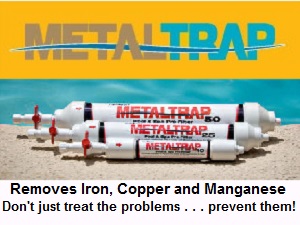
MetalTrap
Filter attaches to the garden
hose and removes dissolved iron, copper
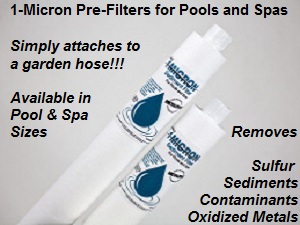
and manganese. The
MetalTrap
1-Micron Filter removes
ultra-fine contaminants, including
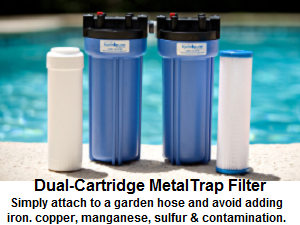
sulfur. The
MetalTrap
Dual-Cartridge Filter attaches
to a garden hose and removes dissolved
heavy metals and sediments. |
|
|
If you have a pool or spa water
testing need, we should have the
product.
►
Scroll down to read through some
Question & Answer information.
◄
|
|
Removing Leaves and Debris, from the
pool and surroundings!!! |
|
Once the
filter is running, you can use a pool
vacuum to remove debris, from inside the
pool. This will help speed up the
cleanup and reduce the amount of
chlorine or oxidizer required, to
eliminate all the organic wastes.
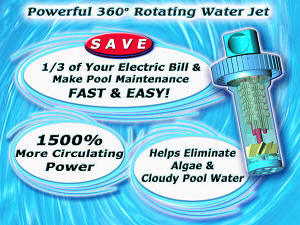
The Circulator
is a replacement return jet fitting,
that dramatically improves circulation,
by creating a spiral return flow.
Better circulation helps with cleanup
and makes sanitizers work more
effectively. An
Automatic Filter
Cartridge Cleaner will do the
cleaning better and easier.
Cleaning
up around the pool can keep dead leaves
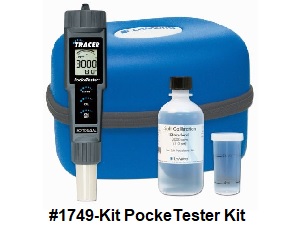
from being blown into the pool. A Tracer
PockeTester is an easy way
to test the salt level, in any pool or
spa, that uses a salt chlorine
generator. Available in a variety
of models. |
|
|
If you have a pool or spa water
testing need, we should have the
product.
►
Scroll down to read through some
Question & Answer information.
◄
|
|
Removing Stains and Metals,
from the pool or spa water!!! |
|
After the
debris has been removed, you should have
the water tested for iron, copper and
manganese. Look for the presence of
rusty, tan, blue, green, purple, brown,
gray
or black stains. These are typically
due to the presence of heavy metals,
such as iron, copper or manganese. Even
if there is no obvious staining, the
presence of heavy metals will cause
water discoloration and possible
staining, after chlorine or bromine are
added or the pH is raised. Depending
upon the severity of the problem, the
products below can help you eliminate
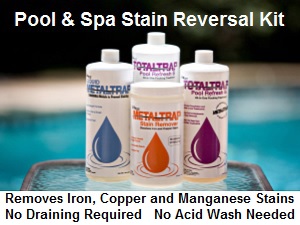
the problem. The
Stain Reversal
Kit contains everything needed
to remove the metal stains, eliminate
the heavy metals and help prevent a
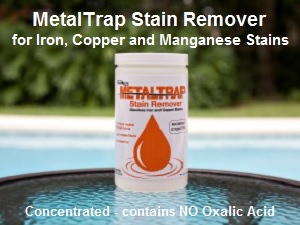
recurrence, of the problem. The
Stain Remover
removes iron copper and manganese
stains. Pool
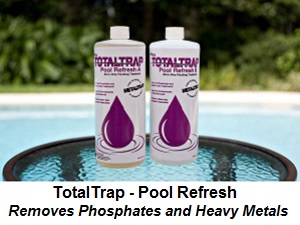
Refresh-Total Trap helps
eliminate heavy metals and phosphates,
by filtering or vacuuming them out of the
pool water. |
|
|
If you have a pool or spa water
testing need, we should have the
product.
►
Scroll down to read through some
Question & Answer information.
◄
|
|
Optimizing the water chemistry and
improving water clarity!!! |
|
With the
bulk of the debris removed, now you're
ready to add enough chlorine or shock,
to destroy all the organic waste, algae
and remaining debris. Don't drag
this part out. The longer it takes to
get a stable free chlorine level, the
more product will be required. Add
a shocking dose, every few hours and run
the filter 24/7, until conditions are
optimized. Test the water chemistry and
adjust the pH, total alkalinity, calcium
hardness and cyanuric acid, as might be
necessary. A
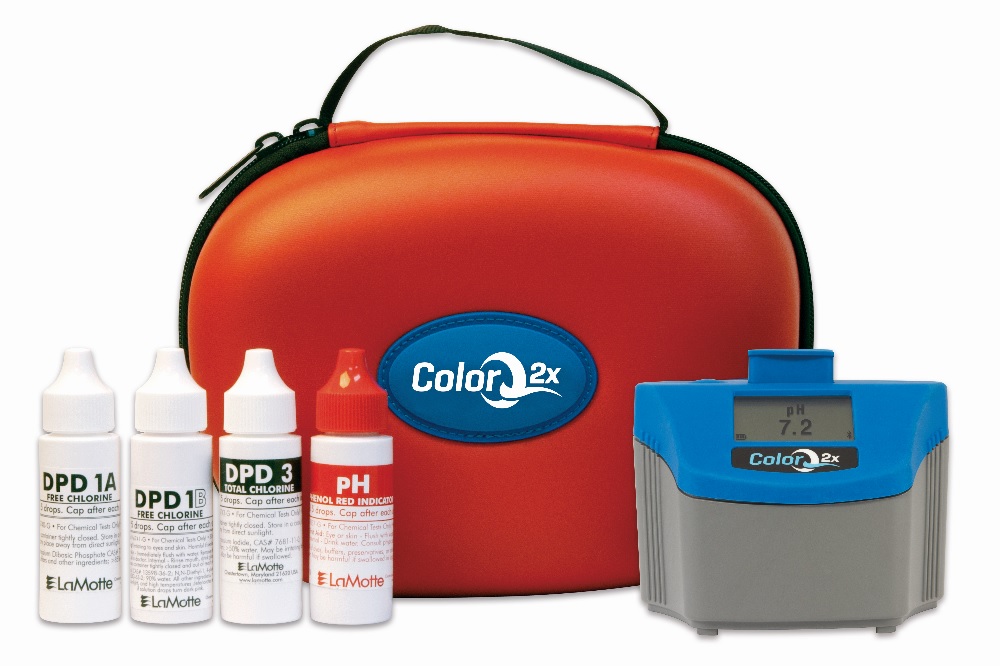
ColorQ, All-Digital Tester can
perform all of the common pool water
tests and eliminates the color-matching
and guesswork. Reliable water testing will
help get the pool swimming-ready. Better
Circulation helps make everything work
more effectively. The
Circulator is a return jet
replacement fitting, that improves
filtration, eliminates dead zones that
promote algae growth, improves sanitizer
distribution and improves heat
dispersion. A
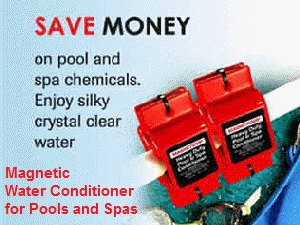
Magnetic
Water Conditioner
can help mitigate the effects of high
calcium hardness, Simply strap
around a return line. |
|
|
If you have a pool or spa water
testing need, we should have the
product.
►
Scroll down to read through some
Question & Answer information.
◄
|
|
Pool Opening Information |
Pool opening refers to the steps
necessary, to return the pool to
operating status or start up a new pool. Proper opening
techniques can save time and money and
get you in the swim sooner. The more
debris and algae, in the pool, the more
chemicals will be required. There is no
quick fix. Start with a complete water
test. The ColorQ
Testers are all-digital and
eliminate the color-matching and
guesswork. Easy to use and affordably
priced. Try to get the free chlorine
level to 5-10 PPM, as soon as possible.
This page should prove helpful: Calculating
Chemical Additions. If problems
arise, refer to the Pool
Problems Page, as a source of
problem-solving information, broken down
into various categories. Scroll down
the page and click on the linked keywords, catch
phrases or images, in the
archived answers below, to access
additional information, on that topic or
product.
 |
Join our E-Letter Mailing
List.
You'll
receive 1-3 E-Letters a
month, featuring helpful
pool and spa advice, new
product information and sale
announcements. All we
require is your e-mail
address and you can opt out
anytime you wish.
Your information will
never be shared or sold. |
|
▼ Helpful,
Problem-Solving Information,
in a question and answer
format.
▼ |
► Getting
Ready To Switch To A Salt Chlorine
Generator?
I am wanting to convert my above ground
pool from a mineral system to a salt
water system. Will I need to use the
mineral reservoir? Also is it necessary
to use the Algaecide at start up?
Thanks.
Andrea, 3/21/2018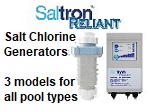
If you
continue to use the minerals, it will
provide backup sanitation, which will
allow you to get good results, even
while maintaining a lower free chlorine
level. Add enough chlorine and your
pool should clean up, even though you
don't add algaecide. The combination of
the minerals and a good free chlorine
level should be all you require. We
offer several, affordably-priced, salt
chlorine generators and one model
requires no-installation. They include
lots of advanced features and can treat
pools from 17,000 to 40,000 gallons. A
salt chlorine generator is the better
way to do chlorine. I hope that I have
provided the solution. Enjoy the
season.
Sincerely. Alan Schuster, 3/21/2018
► Opening
With A Salt Chlorinator?
This is our first time opening using the
salt system and I think we have trouble.
I have above ground 24ft. x 48in. pool.
at the end of last summer, we installed
saltwater system and (upon changing
systems our water got really green then
just as we seemed to get water
stabilized and clear, it was time to
winterize and close . Upon opening the
pool this weekend, the water is very,
very dark. we have just completed adding
the water to the needed level, and seems
we need to shock 'big time' to clear to
water. My question. Do we start up with
opening procedure, as before the
saltwater system, (shock, etc) while
adding the extra salt (because of adding
additional water) or do we shock, etc.
get the water stable and clear, then add
salt?? We live in Nashville, TN. Our
winters are becoming so mild, I think
next winter I will keep the pool open
and running to help alleviate this
situation. Please help
Sherry, Nashville, TN 3/27/2007
Do everything, the same as before, and test
the salt level and adjust to the
proper range. You will have to add
shock, as needed, to help destroy all of
the contamination. The faster, the
chlorine level is raised, the better.
Adjust the other water chemistry
parameters, as required. Once done, the Salt
Chlorine Generator should be better
able to maintain the level. Make sure
that the salt cell is clean and that all
connections are tight. I hope this
information helps.
Sincerely. Alan Schuster, 3/27/2007
► Getting
Started?
MY HUSBAND AND I
JUST PURCHASED AND ABOVE GROUND 30'
ROUND POOL. WE JUST FILLED IT WITH WATER
AND HAVE YET TO ADD ANY CHEMICALS TO IT.
CAN YOU SUGGEST HOW TO GET THE POOL
STARTED?
Lisa W., Coldwater, MS, 5/20/2018
While your question seems simple enough
and it is, it is also worthy of being on
the "top 10" list. Depending upon the
source of the water being used to fill
the pool, you can save yourself a lot of
anguish, time and money by doing a few
things before adding chemicals. Have the
water, that will be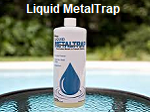 used
to fill the pool, tested for pH, total
alkalinity, calcium hardness, iron and
other heavy metals might be present. If
there are heavy metals present, it is
best to add one dose of a quality,
phosphate-free metal treatment, such as Liquid
Metal Trap, for each 0.5 PPM, as the
pool is being filled. If the tests for
heavy metals are negative, you might
want to add a dose anyway. Allow about 6
hours of filter operation before adding
other chemicals. Now you're ready to
adjust the pH, total alkalinity and
calcium hardness. Try and avoid having
chemicals, especially chlorine products,
remain in prolonged direct contact with
the liner: run the filter and stir
things up with the pool brush. If the
pool is to be maintained on chlorine,
you should add stabilizer. Try and
maintain a Free Chlorine level of 1-3
PPM, at all times, whether the pool is
being used or not. The labels are only a
guide! How much chlorine your pool will
require will depend upon location, Sun
exposure, bather usage and frequency,
water temperature, etc. It may sound
difficult, but is easier to do it right,
than to fix it after some neglect.
Having a reliable water tester can help
you avoid problems. The all-digital ColorQ
Water Analyzer will eliminate all
color matching and guesswork. I hope
that these suggestions will prove
helpful. I hope that these suggestions
will prove helpful. Enjoy the pool. used
to fill the pool, tested for pH, total
alkalinity, calcium hardness, iron and
other heavy metals might be present. If
there are heavy metals present, it is
best to add one dose of a quality,
phosphate-free metal treatment, such as Liquid
Metal Trap, for each 0.5 PPM, as the
pool is being filled. If the tests for
heavy metals are negative, you might
want to add a dose anyway. Allow about 6
hours of filter operation before adding
other chemicals. Now you're ready to
adjust the pH, total alkalinity and
calcium hardness. Try and avoid having
chemicals, especially chlorine products,
remain in prolonged direct contact with
the liner: run the filter and stir
things up with the pool brush. If the
pool is to be maintained on chlorine,
you should add stabilizer. Try and
maintain a Free Chlorine level of 1-3
PPM, at all times, whether the pool is
being used or not. The labels are only a
guide! How much chlorine your pool will
require will depend upon location, Sun
exposure, bather usage and frequency,
water temperature, etc. It may sound
difficult, but is easier to do it right,
than to fix it after some neglect.
Having a reliable water tester can help
you avoid problems. The all-digital ColorQ
Water Analyzer will eliminate all
color matching and guesswork. I hope
that these suggestions will prove
helpful. I hope that these suggestions
will prove helpful. Enjoy the pool.
Sincerely. Alan Schuster, 5/20/2018
► Messy
Opening and Safety Issues?
My husband and I
purchased a resale last December.
Although the pool was operating when we
first viewed the house, it was closed
and covered by the time we took title.
We know nothing about pools. Call us
city folks. Over the course of the
winter, the solid plastic cover over the
pool, collapsed at one end. Evidently,
this was a result of leaves and water
collecting on top. I can only imagine
what a mess is now inside the pool. The
pool is a vinyl inground type, about 20
X 40. It is spring now and we are going
to have to face the challenge. Where do
we start? The pool is fenced in, but not
separated from the house. I'm concerned
about the kids and dog. Helpful hints
will be appreciated. Thank you.
Sharon H., Milton, MA, 5/31/2013
It does sound like you're in for a lot
of work. If it were up to me, I would
call in a pool service company to open
the pool, get everything working and
start you on the road to crystal clear
water. That way, you can observe, ask
questions and, perhaps, learn about
operating the equipment. A local pool
professional can help you with matters
of water testing and chemicals. But, if
you want to do it yourself, here is
where to start. If the cover still has
water and debris on top, get a cover
pump (small submersible pump that is
attached to a garden hose and placed on
top to remove water) and pump off as
much water as possible. Try and remove
the debris with a pool leaf rake:
without causing a collapse. Pull the
cover off, trying to keep as much
debris, as possible, out of the pool.
Clean the cover, allow to dry and store
indoors until winter. Now you are
looking at a disaster of a pool, with
the water somewhat below the skimmers.
If your water is of good quality and not
from a well, you can start adding water.
If your water is from a
well, you might want to have it tested:
minerals can cause staining and are best
treated before chlorine is added. The
filter has to be hooked up: depending
upon the type it may have been removed
for the winter and stored indoors. A
local dealer or friend might be able to
help with the hookup. Once the filter is
running, you are ready to start adding
chemicals. A reliable pool water tester
is a must. I suggest the #2056
Color PRO 7, which is simple to use
and eliminates the bothersome
color-matching. I would start with 2
pounds, per 5,000 gallons of pool water,
of a shock treatment. This will begin
the decomposition of the leaves and
debris. Find out how to use your pool
vacuum and use it to start removal of
the debris on the bottom. Have the water
tested for pH, total alkalinity, calcium
hardness and chlorine stabilizer and add
chemicals as required. Test for Free
Chlorine, every few hours, and add more
shock, if the Free Chlorine level drops
below 3 PPM. The pool should start to
look better and better, but could take a
few days to really clear up. I know that
I have oversimplified things, but you
will get by with some common sense and
some pool dealer advice. During the
summer, all this work will be a fond
memory. You might want to browse through
the archives on the topics of pool
maintenance, cloudy
water, etc. There are safety
products available including Pool Alarm
Systems, for all types of pools. These
products can add a high degree of
security. You can help protect your dog
and even some uninvited critters from
drowning, because of being unable to
exit the pool. An escape ramp helps
provide an easy escape route, for pets
and animals. You might check to make
sure that the main drain is an
anti-entrapment design, as it can
prevent serious accidents. Local laws
can vary, so make sure that all safety
devices are in compliance, with all
current federal and local regulations.
Being aware is, of course, always
important! I hope that I have been of
assistance. Good luck with the pool and
enjoy the summer. a
well, you might want to have it tested:
minerals can cause staining and are best
treated before chlorine is added. The
filter has to be hooked up: depending
upon the type it may have been removed
for the winter and stored indoors. A
local dealer or friend might be able to
help with the hookup. Once the filter is
running, you are ready to start adding
chemicals. A reliable pool water tester
is a must. I suggest the #2056
Color PRO 7, which is simple to use
and eliminates the bothersome
color-matching. I would start with 2
pounds, per 5,000 gallons of pool water,
of a shock treatment. This will begin
the decomposition of the leaves and
debris. Find out how to use your pool
vacuum and use it to start removal of
the debris on the bottom. Have the water
tested for pH, total alkalinity, calcium
hardness and chlorine stabilizer and add
chemicals as required. Test for Free
Chlorine, every few hours, and add more
shock, if the Free Chlorine level drops
below 3 PPM. The pool should start to
look better and better, but could take a
few days to really clear up. I know that
I have oversimplified things, but you
will get by with some common sense and
some pool dealer advice. During the
summer, all this work will be a fond
memory. You might want to browse through
the archives on the topics of pool
maintenance, cloudy
water, etc. There are safety
products available including Pool Alarm
Systems, for all types of pools. These
products can add a high degree of
security. You can help protect your dog
and even some uninvited critters from
drowning, because of being unable to
exit the pool. An escape ramp helps
provide an easy escape route, for pets
and animals. You might check to make
sure that the main drain is an
anti-entrapment design, as it can
prevent serious accidents. Local laws
can vary, so make sure that all safety
devices are in compliance, with all
current federal and local regulations.
Being aware is, of course, always
important! I hope that I have been of
assistance. Good luck with the pool and
enjoy the summer.
Sincerely. Alan Schuster/ 5/31/2013
► Empty
Pool And Broken Pipe?
Great website!
Very informative. A question for you.
Is it possible that liner shrinkage
(from an in ground pool sitting empty
for almost two months) could introduce
enough force into the plumbing to
fracture an inlet pipe/fitting? Thanks!
Thomas K., 4/6/2011
If the pool is empty, water can collect
and could be more apt to freeze, as
compared to a filled pool. However, this
might not have anything to do with
freeze-thaw problems. If the ground
water level rose to a level, higher than
the pool floor, the pool could float up
and cause pipes to break. Depending on
how the pipes were laid out, it might
not take much to cause damage. Leaving a
pool empty, for long periods of time,
does involve risk. So, I guess the
answer is yes. Picture a rowboat almost
filled with water and barely floating.
Remove water and the boat floats higher.
A pool can be like a floating boat,
especially if heavy rains have elevated
the water table. Sorry I can't provide
something more helpful.
Sincerely. Alan Schuster, 4/6/2011
► Not
Quite Ready To Open?
I am not going to
open the pool as early as I usually do.
A friend suggested that I pull back the
cover and add a few gallons of liquid
shock, in order to help keep the water a
few weeks longer. What do you think of
that idea? The pool is a vinyl inground.
Thank you.
Rich G., Paramus, NJ, 6/2/2012
I assume that the pool is covered and
that the filter is in storage.
Therefore, there is no circulation. An
vinyl lined pool should not have
chlorine added without the benefit of
circulating water. This could result in
some bleaching of the liner. Adding
chemicals, especially chlorine, without
the filter operating, is not a good
practice. Are you willing to risk damage
to the liner? If the pool was masonry,
there would be no problem adding the
chlorine. It's your decision. The idea
has merit, as long as care is taken to
avoid damaging the liner. I hope that I
have been helpful.
Sincerely. Alan Schuster, 6/3/2012
► Jumping
The Gun To Get The Pool Opened?
Out of curiosity
(I am in Connecticut and the pool is
still covered) I did a few tests on my
pool water (gunite pool with a winter
cover that lets water through) and the
pH seemed like it had gone up a lot (the
pH number went up) over the winter – is
this normal? I did the acid demand test
and I think it took like four drops of
the reagent that is used to measure acid
demand. For one thing what is the
preferred way to bring the number down
and secondly should I wait until the
pool is opened in probably six weeks or
so? I would assume I need to wait as the
pump needs to be on, etc. I have heard
of people around here putting some
chemicals under the cover to get a head
start on the de-winterizing. Also, why
would the pH go up over the winter? From
rain and snow? Thanks for your help and
a great site.
Paul B., Connecticut, 4/4/2015
That's not how it usually works. Acid
rain and carbon dioxide should cause the
pH to drop - even in CT. Being that the
pool is gunite, it is possible that the
walls are influencing the pH. In any
event, the sample was not representative
of the pool. It won't be until the pump
is up and running. I would wait the 6
weeks and not worry about it, until the
cover is off and the filter is running.
That's when a water analysis helps tell
you what to do. Putting in chemicals,
under the cover, can lead to problems
and is not worth the risk! I hope that
this information proves helpful.
Sincerely. Alan Schuster, 4/4/2015
► Unwanted
Dearly Departed?
We just bought a
new house which contained an inground
round pool. We have absolutely no
experience with pools. It had a cover
but somehow both a chipmunk and lizard
managed to make their final resting
place at the bottom of our pool over the
winter. We removed them but now are
wondering if we should just dump the
water and start over. Please help. Thank
you.
SCOTT H., 4/12/2007
In the routine course of getting the
pool back into proper condition, after a
winter of dormancy, you will have to add
lots of chlorine: enough to boost and
maintain the free chlorine level at 1-3
PPM. Doing this will destroy all traces
of the dearly departed. There is no need
to drain the pool. This is not all that
uncommon! If you are interested in
prevent a recurrence, adding a pet
escape ramp will give these critters an
escape from the water entrapment. If is
simple to install and does not interfere
with the pool use, if you flip it onto
to deck. If the problem is just frogs
and small critters, it just might be
what you need. Good luck and enjoy the
pool.
Sincerely. Alan Schuster, 4/12/2007
► Black
Swampy Water?
Alan, thanks for
providing the website. I live in the
Detroit area and have a 24' round
aboveground pool. Upon opening this year
(after years of successful openings),
the water looks like black swamp water!
Cant see the bottom! There is a silty,
black substance on the liner surface
under the water and I'm not sure what to
do here. Should I drain it and start
over, or do I fill'er up and let
chemistry and filtration do the work? I
have had excellent results every year. I
found a few holes in my winter cover
after removing all the leaves & junk and
suspect that the dirty water migrated
into the pool. What do you think?
Sincerely.
Stephen B., Detroit, Michigan, 5/3/2008
Do not drain the pool! It could result
in liner shrinkage. The holes in the
cover allowed contamination into the
pool and that depleted any chlorine thatmight
have been present. The conditions, as
you have described them, are consistent
with algae growth and accumulated
debris. Fill the pool up and get the
filter operating. Add 2 pounds of shock
for each 5,000 gallons of pool water.
Test the water for Free Chlorine and
keep adding additional shock at the rate
of 1 pound per 5,000 gallons of water,
until a Free Chlorine level of 1-3 PPM
is established and remains after an
overnight period. Depending upon the
actual condition of the water, it may
take considerably more shock than you
might surmise. The longer you take to
establish a Free Chlorine reading, the
more chlorine will be required. Adding
an algaecide will help in eliminating
the algae. Adjust the pool water
chemistry on a timely basis. Make sure
that the pH is not above 7.6, inasmuch
as high pH values will reduce the
effectiveness of the shock treatment. To
help clear up the water, add a dose of a
quality blue clarifier. Vacuum and scoop
out as much debris as possible. Things
may seen bad, but it will clear as soon
as enough chlorine has been added. Once
clear, resume normal sanitizing and
filtration. Having the right water
tester can help solve and avoid
problems. The all-digital ColorQ
Labs eliminate all the guesswork and
the color-matching. I hope that I have
been helpful.
Sincerely. Alan Schuster, 5/4/2008
► Water
On Top Of Winter Cover?
This is my first
year having my pool, we closed the pool
fine and put a pillow in the center.
During the winter water, leaves, and ice
stacked up on top of the pool cover. I
tried getting as much as I could off but
after it froze over I wasn't very
successful. Now its spring and the ice
melted leaving a lot of water on top
which is making the pool cover drop down
and on one side the cover was pulled
close to inside the pool. I'm trying to
find a way to get all the water out
since its so deep. Do you have any
recommendations?
Pool Rookie, 4/6/2005
There are submersible cover pumps that
can be used to remove accumulated water.
Or you could take a length of hose and
create a siphon. It make take a day or
so, but it will remove the water. The
more you get off, the less likely it
will be that you get this debris in the
pool. Good luck and enjoy the season.
Sincerely. Alan Schuster, 4/6/2005
► What
About The Pump?
Alan, I just
bought a home with an above ground pool.
The previous owners told me that they
winterized the pump with some chemical
(unknown). The pump was not covered up
or brought inside. The water looks fine
and I have read all of your information
on opening pools for the summer. My
question is, what do I need to do to the
pump before turning it on? I assume
turning it on would push all of this
winterizing chemical into the pool.
Should I drain it and how? and Is this a
good technique for next year when I do
it?
Lori H., 5/18/2010
Most lucky the winterizing agent was a
pool pipeline anti-freeze product. No
matter what, if you discharge the water
into the pool, it will have little or no
effect on the overall pool water. I
prefer to remove the pump to an indoor
location, for the winter. If the filter
is not a sand filter, you might be able
to do the same with that as well.
Otherwise, draining and sealing off
against water intrusion is next best
method. Enjoy the summer.
Sincerely. Alan Schuster, 5/19/2010
► The
Pool Water Drained Away?
After looking
under the cover of our pool we found
that most of the water has drained out.
How do you go about locating where the
hole is in the liner, if that is the
case? Thanks.
Linda A., 3/1/2012
This may not be the most important step
to take, but try and prevent the cover
and all of the debris on top from
falling into the pool.  All
that would do is add to the problem.
Unfortunately, you did not provide and
specifics, as to pool type. The pool
leak could be in a main drain, return
fitting or the built-in steps. That is
if there are any of these features. It
is possible that the leak is at the
current water level. Mark the current
depth, for use as a reference point. If
the leak was very small, if may be
difficult to see a water loss on a daily
basis, because some water will be lost
due to evaporation. Fix
A Leak is a product that is used to
seal leaks, such as yours. It is added
to the pool and makes a seal, as it
leaks out, after being carried to the
leak. If the water continues to drain
out slowly, it will stop at the level of
the leak. There are concentrated dye
solutions, that can be added to a still
pool, that can help trace the flow to
the source of the leak. There are
companies that specialize in locating
pool leaks. It is not a good idea to
leave a vinyl liner pool without water
for extended periods, as such practice
can lead to liner shrinking. If the pool
is an inground, structural damage is
possible, if substantial water has
drained out. I hope that this
information will point you in the right
direction. Good luck. All
that would do is add to the problem.
Unfortunately, you did not provide and
specifics, as to pool type. The pool
leak could be in a main drain, return
fitting or the built-in steps. That is
if there are any of these features. It
is possible that the leak is at the
current water level. Mark the current
depth, for use as a reference point. If
the leak was very small, if may be
difficult to see a water loss on a daily
basis, because some water will be lost
due to evaporation. Fix
A Leak is a product that is used to
seal leaks, such as yours. It is added
to the pool and makes a seal, as it
leaks out, after being carried to the
leak. If the water continues to drain
out slowly, it will stop at the level of
the leak. There are concentrated dye
solutions, that can be added to a still
pool, that can help trace the flow to
the source of the leak. There are
companies that specialize in locating
pool leaks. It is not a good idea to
leave a vinyl liner pool without water
for extended periods, as such practice
can lead to liner shrinking. If the pool
is an inground, structural damage is
possible, if substantial water has
drained out. I hope that this
information will point you in the right
direction. Good luck.
Sincerely. Alan Schuster, 3/1/2012
► Where
To Start?
Hi Alan. Last
March (2007), we purchased an inground
fiberglass pool, with a cartridge
filter. The installation included the
opening of the pool and the first
closing. The pool company considered the
installation and start up of the pool as
our "opening", however, we were at work
the majority of the time and
unfortunately were not there to see what
was involved or to take notes or ask
questions. We were there to witness the
closing and took notes on the steps
taken. Now it is coming up on the time
to open the pool again, however, we
aren't exactly sure of what we need to
do and the pool company wants to charge
us a few hundred dollars to have them do
it. Besides removing the cover and the
fittings and plugs from the inlets, what
else would we need to do besides
shocking it, and cleaning it and adding
more water to bring the level back up?
Anti-freeze was put into the water
lines, does that have to be flushed out
or anything? Do you know of any book we
can read that gives more information?
Thanks for your help.
Karen T., 3/10/2008
A pool opening is essentially a reversal
of the pool closing. The one thing that
you should be very careful with is the
removal
 of the cover. You
don't want
to get all that debris into the pool.
Use a cover pump to remove all of the
water from the top of the cover (if it
is a solid cover) and use a skimmer net
to scoop off any debris. Once the cover
is off, start adding water, remove all
the plugs and winter fittings and
reconnect the filter and pump. Make sure
the filter cartridge is clean: using The
Blaster Filter Cartridge Cleaner will
make it easy. Assuming that a pool grade
antifreeze was used, it can be flushed
into the pool. Once filtration has been
restarted, chemicals can be added. You
will have to add enough chlorine shock
to destroy any accumulations of algae
and debris and establish an appropriate
chlorine level. The other aspects of
pool water chemistry should be tested
and adjusted, as necessary. Make sure
that the cover is cleaned and allowed to
dry off, before storing away. I hope
that this information will point you in
the right direction. Have fun and good
luck. of the cover. You
don't want
to get all that debris into the pool.
Use a cover pump to remove all of the
water from the top of the cover (if it
is a solid cover) and use a skimmer net
to scoop off any debris. Once the cover
is off, start adding water, remove all
the plugs and winter fittings and
reconnect the filter and pump. Make sure
the filter cartridge is clean: using The
Blaster Filter Cartridge Cleaner will
make it easy. Assuming that a pool grade
antifreeze was used, it can be flushed
into the pool. Once filtration has been
restarted, chemicals can be added. You
will have to add enough chlorine shock
to destroy any accumulations of algae
and debris and establish an appropriate
chlorine level. The other aspects of
pool water chemistry should be tested
and adjusted, as necessary. Make sure
that the cover is cleaned and allowed to
dry off, before storing away. I hope
that this information will point you in
the right direction. Have fun and good
luck.
Sincerely. Alan Schuster, 3/10/2008
► Antifreeze
In The Pool?
Is it imperative
to remove the antifreeze from the lines
rather than just letting it mix with the
rest of the water and then treating it
as needed for summer start up? No one
seems to know. I have a fiberglass
inground pool. If not, what is the
easiest way to clear the lines and make
ready for the season? Thanks.
John, 5/13/2006
If you are using a swimming pool
antifreeze, it is expected that the
product will get into the pool. This
type of product should present no
hazard, once in the pool. Enjoy the
summer.
Sincerely. Alan Schuster, 5/13/2006
► Unopened
For 5 Years?
Dear Alan, we
opened the pool after 5 years of not
opening it. We can not get the water to
clear. At the pool company everything
reads normal. When it is vacuumed brown
water comes out of the jets. Does that
mean there is something wrong with the
pipes or the filter? We even put in a
chemical that is supposed to take the
chemicals to the bottom but that still
hasn't help to clear the water. Help.
Thank you.
Bonny B., Phippsburg, Maine, 6/17/2008
Picture all the stuff that has been
growing in the pipes and unreachable
spots for the past 5 years. I think that
you are going to have to maintain a high
chlorine level, 5-10 PPM, and keep the
water recirculating. If the filter has
not been disassembled and cleaned, it
should be at the top of the list. Once
the chlorine has been allowed to
decompose all the accumulations of 5
years of neglect, I'm sure that progress
will be made. Good luck.
Sincerely. Alan Schuster, 6/17/2008
► Directing
The Water Flow?
I just opened my
inground pool, and the pressure is fine
and it's cleaning the pool. I have 2
skimmers on the side and 2 on the
bottom. It looks like the side skimmers
are not sucking in any water just the
bottom one. I had a pool company
winterize it, but they were booked so I
opened it my self. The water is clear,
just the side skimmers are not sucking
in any water or dirt? Why? Is it
filtrating thru the bottom 2 opening on
the floor of the pool? HELP, since all
the pool guys are booked up! Thank you.
Eddie, 5/11/2011
It sounds like a simple enough problem.
Let's hope that it is! There must be a
valve or valves that allow you to
apportion the water between the skimmers
and the bottom drains. It sounds like
all of the water is being directed to
the drains. Check the settings and
hopefully the problem will be solved. If
not, it could be indicative of a plugged
line and will require servicing. Good
luck and I hope that I have been of
assistance.
Sincerely. Alan Schuster, 5/12/2011
► When
To Open?
I live in Atlanta,
GA, and wanted to know the best time to
open our inground pool. My husband says
it is to early because there are still
blooms from the trees and bushes blowing
all over the place.
Dawn, Atlanta, GA, 4/19/2004
I don't know if I would base it on the
spring bloom. Given the cost of
electricity, I would choose to open a
pool perhaps 2-4 weeks before there was
some expectation of actually using the
pool. Otherwise, you'll incur some
needless expenses. Keep an eye on the
long term weather forecast and give
yourself enough time to get things in
order. Enjoy the season.
Sincerely. Alan Schuster, 4/19/2004
► Choice
Of Water Supply?
I am having a pool
installed basic 20X40 inground pool. I
estimate @ 35,000 gals needed. I have a
well and don't want to use it to fill
the pool. I also have a stream that
leads to a local reservoir. This time of
year it is very active and I could
easily pump water from the stream to the
pool. Will this cause me big problems in
the future? If I have the water trucked
in how do I know that the trucking
company did not get the water from the
CT river? ( I live in Conn). Please
advise?
TOM D., CT, 11/21/2006
I am not sure either is a good option. I
suggest that you sample both and have a
local pool store do some testing.
Primarily, you are looking to avoid
water with high iron content or high
hardness. You should add several doses
of a quality, phosphate-free metal
treatment, such as Liquid
METALTRAP, before the water is
added. A METALTRAP Filter unit, that you
attach to the hose, will remove lots of
the problem metals and minerals. It can
make marginal water less likely to cause
problems and save you time and money, in
the long run. I hope that this
information will be helpful.
Sincerely. Alan Schuster, 11/21/2006
► Filling
From The Pond?
Alan, this looks
like a very useful site. We are in the
process of installing a fiberglass pool.
The pool is in and they filled it (while
backfilling) with water from a pond.
There are fish in the pond so its not
polluted with chemicals, but there are
geese as well. The builder (very
reputable - in business for 40 years) is
saying that it is common to do this. I
would have preferred a tanker with fresh
water. My wife was horrified. He says
the water will clean up and be as clear
as tap water when they are through. I'm
a little uneasy. Should I be? Also, How
will I know which section of your
website this question would be answered
in? Thanks.
Del C., Fort Wayne, IN, 4/10/2007
Actually, the exact question probably is
not on the website, but I will add it.
You will receive an email reply, as I
answer far too many questions to put
them all on the website. The use of
natural water is not uncommon,
especially in rural areas. The presence
of waste from the pond's current
inhabitants is not a major issue.
Chlorine will destroy all of the organic
content and the filter should do t he
rest. Just to protect against the
presence of iron and other metals, I
would add at least two doses of a
quality, phosphate-free metal treatment,
such as Liquid
MetalTrap. Most metal treatments
contain organic phosphonic acid, which
can degrade to form phosphate and are
not effective, over a wide pH range. To
be sure, have the pond water tested for
iron and other metals. If present, add
at least a dose of each 0.5 PPM found
and another dose monthly. Inasmuch as
pond waters vary, there is no uniform
works everywhere scenario. The METALTRAP
1-Micron Pre-Filter can remove the
organic products, that are typically
found in naturally occurring water
supplies. This can help you avoid
staining, discoloration and help you get
the chemistry balanced sooner. Test the
water and adjust the pool water
parameters, as necessary, to the
recommended levels: pH, chlorine, total
alkalinity, calcium hardness, chlorine
stabilizer and heavy metals. You can do
all test tests with a ColorQ
water Analyzer, in a quick, reliable
manner and without the bother of
color-matching. Good luck with pool and
I hope this information proves helpful. he
rest. Just to protect against the
presence of iron and other metals, I
would add at least two doses of a
quality, phosphate-free metal treatment,
such as Liquid
MetalTrap. Most metal treatments
contain organic phosphonic acid, which
can degrade to form phosphate and are
not effective, over a wide pH range. To
be sure, have the pond water tested for
iron and other metals. If present, add
at least a dose of each 0.5 PPM found
and another dose monthly. Inasmuch as
pond waters vary, there is no uniform
works everywhere scenario. The METALTRAP
1-Micron Pre-Filter can remove the
organic products, that are typically
found in naturally occurring water
supplies. This can help you avoid
staining, discoloration and help you get
the chemistry balanced sooner. Test the
water and adjust the pool water
parameters, as necessary, to the
recommended levels: pH, chlorine, total
alkalinity, calcium hardness, chlorine
stabilizer and heavy metals. You can do
all test tests with a ColorQ
water Analyzer, in a quick, reliable
manner and without the bother of
color-matching. Good luck with pool and
I hope this information proves helpful.
Sincerely. Alan Schuster, 4/10/2007
► What
To Do, Until The Pump Is Repaired?
My above ground
pool was just opened, after having been
closed for the winter. The water was not
in bad shape. After trying, without
success to start up the filter, I
decided to bring the pump and motor in
for some repair. It won't be ready for
3-4 days. Can you suggest anything to do
until the equipment is ready? Thanks.
Sincerely.
John H., Pottsville, PA, 5/31/2006
Without the filter operating there is
not much that can be done. Your above
ground pool requires that some care must
be taken to avoid damaging the vinyl
liner. I would not add granular
chlorine to the pool: you don't want
product sitting on the bottom,
especially without water circulation. If
you would like to add chlorine, use
liquid chlorine. Pour it into the water
away from the walls and use a vacuum
pole or water stream from a garden hose
to help distribute and dilute the
chlorine. Use a leave rack to remove any
debris that might have fallen into the
pool, during removal of the cover. Be
patient, you have the whole summer ahead
of you. Enjoy the summer.
Sincerely. Alan Schuster, 5/31/2006
|
|
Visit The Website Stores . . . for
better informed shopping!!! |
|
|
Shipping is FREE* . . . within
the Continental U.S.
A $9.99
handling charge will apply
to Continental U.S. Orders,
under $75.00. Orders
outside of the Continental
U.S. may require some
additional charge, based on
quantity and destination.
Most products can be
shipped World-Wide. International
and orders outside of
Continental U.S. - see
comments on the ordering
pages. |
|
|
Major
Credit Cards and PayPal are accepted. |
|
▲
Return To Top Of Page
▲
Aqualab Systems, LLC does not
make any warranty or
representation, either expressed
or implied, regarding the
accuracy or completeness of the
information provided by this
website; nor does Aqualab
Systems., LLC. assume any
liability of any kind whatsoever
related to, or resulting from,
any use or reliance on this
information. The content of this
website should not be used, if
it is conflict with any
applicable federal, state or
local regulations or guidelines.
© Aqualab Systems, LLC. All
rights reserved
|
|