| |
|
Scroll
down to browse through some archived SWIMMING POOL
questions and answers. Please click the Pool
Problems Link, on top of every page, to access a complete
listing of Pool Problem subjects, an alphabetized
Website Table of Contents, Pool Equipment Information,
About Alan Biographic Material and a Pool Glossary. Use
the other links to access additional subject
information. More information about some new and unique
products, for pools and spas, can be found by visiting
The Website Store.
You'll never know what you'll find and that's always
fun. Be better prepared and avoid costly problems!
|
|
 |
Shipping is FREE* . . . within
the Continental U.S.
A $9.99
handling charge will apply
to Continental U.S. Orders,
under $75.00. Orders
outside of the Continental
U.S. may require some
additional charge, based on
quantity and destination.
Most products can be
shipped World-Wide. International
and orders outside of
Continental U.S. - see
comments on the ordering
pages. |
|
 |

Major
Credit Cards and PayPal are accepted. |
|
On-line
shopping since 2002 - Safe and Secure!!! |
|
Choosing and Maintaining The Right Pool
Finish. |
|
Masonry
or fiberglass pools
can be refinished with an epoxy pool
coating, which is less subject to
interactions, with the water chemistry.
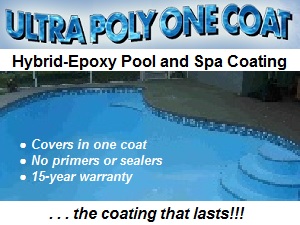
Ultra Poly One Coat,
manufactured by
Ultra
Polymers, Inc., is a
Hybrid-Epoxy Coating and is used in
pools, spas, water parks and water
features, all across the U.S. The
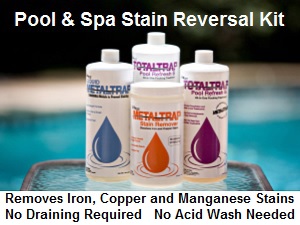
MetalTrap
Stain Reversal Kit can eliminate
the staining consequences of heavy metals, present in
the source or introduced through metal
corrosion, ionizer use or copper
algaecide use. The
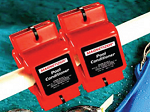
Circulator
is a return jet replacement fitting,
that improves filtration, eliminates the
dead zones that promote algae growth,
improves sanitizer distribution and
chemical dispersion. |
|
Hybrid-Epoxy Pool and Spa
Coating |
Stain Reversal Kit, for Pools
and Spas |
Circulation Boosting Return Jet
Fittings |
 |
 |
 |
|
Product
and Ordering Information |
Product and Ordering Information |
Product and Ordering Information |
If you have a pool or spa water
testing need, we should have the
product.
►
Scroll down to read through some
Question & Answer information.
◄ |
|
Corrosive
conditions can exist in a swimming pool,
when the pH is maintained too low and is
made worse, if the total alkalinity and
calcium hardness are too low, as well.
This can adversely effect the metal
parts in the pool and through which the
water flows, such as ladders, rails,
underwater light, heaters, pumps and
filters. A
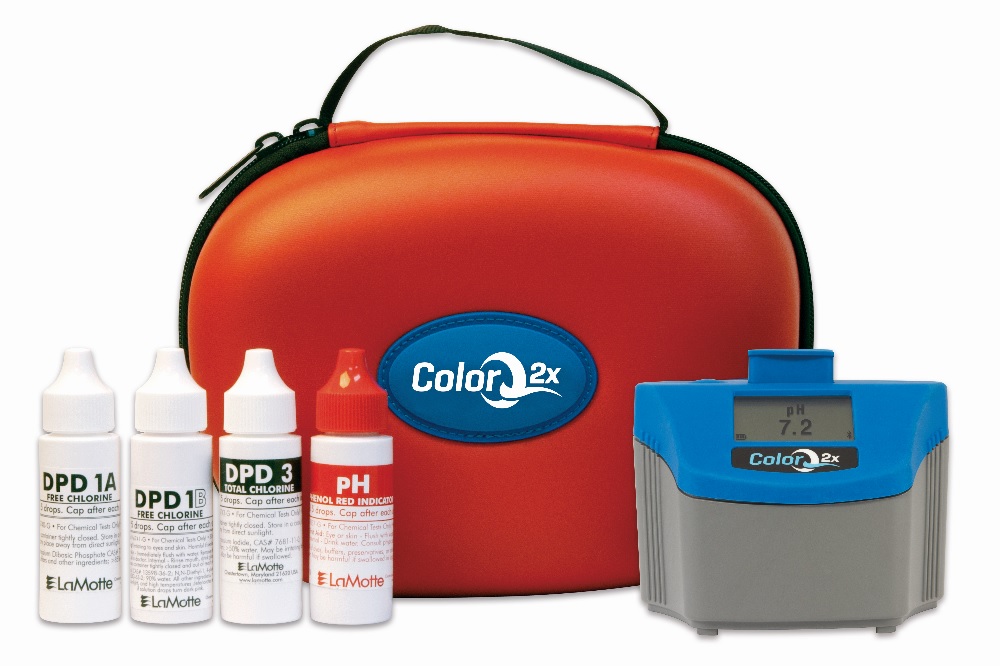
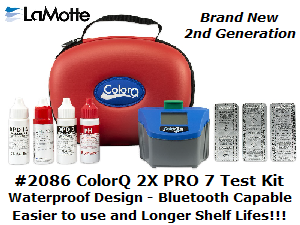
ColorQ 2X is a 2nd generation,
Bluetooth, Waterproof, all-digital tester,
that can
measure all the common test factors. There is a model, for every sanitizing
need.
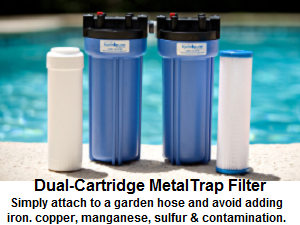
A MetalTrap Dual-Cartridge
Filter will simply attach to the garden hose,
used to add new water, and will remove heavy metals, as
water is added: removal is the best form of
treatment. The
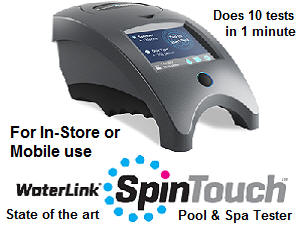
WaterLink SpinTouch Labs
are the ultimate tester, doing
up to 10 different water test
factors, in just 1 minute.
Voted product of the year. |
|
ColorQ All-Digital Water Testers |
Dual-Cartridge MetalTrap Filters |
WaterLink SpinTouch Labs |
 |
 |
 |
|
Product and Ordering Information |
Product and Ordering Information |
Product and Ordering Information |
|
If you have a pool or spa water
testing need, we should have the
product.
►
Scroll down to read through some
Question & Answer information.
◄
|
|
How to
choose the right finishing product for a pool? |
Masonry pools
can be finished with a variety products and
techniques. The finishes include: marble-dust
plaster and exposed quartz, aggregate surfaces.
Finishes, other than plaster, can be used:
paint, epoxy, fiberglass and more. There are
advantages and disadvantages, cost
considerations, suitability and
life-expectancies to consider, when deciding
which finish to choose for a new pool or a pool
resurfacing or refinishing. As an
alternative,
Ultra Poly One Coat is a hybrid-epoxy
coating, that can be applied, as a DIY project.
The products is used in pools, spas, water parks
and water features all across the country. If problems
arise, refer to the
Pool Problems
Page, as a source of problem-solving
information, broken down into various
categories. Scroll down the page and click on the linked
keywords,
catch phrases
or images, in the archived answers below, to access additional information, on that topic or product.
 |
Join our E-Letter Mailing List.
You'll receive 1-3 E-Letters a
month, featuring helpful pool
and spa advice, new product
information and sale
announcements. All we
require is your e-mail address
and you can opt out anytime you
wish.
Your information
will never be shared or sold. |
|
▼
Helpful, Problem-Solving Information, in a
question and answer format.
▼ |
►
Refinishing Is Necessary?
My Gunite/plaster pool is 22 yrs old
and has never been drained. The plaster has some stains from
leaves, chemical reactions in the water (well), and about a
3' section of tile has fallen off. I have not had anyone
come out to look at the pool. I've been told by a pool
company employee in the store that it most likely needs
re-plastering and re-tiling. If that is true, can the pool
be drained?
Kevin H., 4/2/2018
Few pool make 22 years without being refinished. Draining
always involves risks, especially if the construction is
weak or if the ground water level is unusually high, Stains alone are not grounds for
refinishing. Refinishing is a must when the plaster wears
thin over time and gets close to the underlying gunite. The
tile problem probably justifies a refinishing, in and of itself. You could retile the pool and use
Ultra Poly One Coat to
refinish the pool. It is a hybrid-epoxy coating, that is
more stain resistant and has a 15 year warranty. No acid
washing is required, preparation is easy and there are no
primers or sealer required. Any it only requires one coat.
Using well water will always present a risk of staining.
Using a MetalTrap dual-cartridge
filter to refill the pool will help remove the
stain-causing minerals. Adding some liquid MetalTrap, as the
pool is being refilled, will add some extra protection.
Using the MetalTrap filter, when adding any new water, will
help keep the unwanted metals and minerals, from being added
to the pool. I hope that this information is helpful.
unusually high, Stains alone are not grounds for
refinishing. Refinishing is a must when the plaster wears
thin over time and gets close to the underlying gunite. The
tile problem probably justifies a refinishing, in and of itself. You could retile the pool and use
Ultra Poly One Coat to
refinish the pool. It is a hybrid-epoxy coating, that is
more stain resistant and has a 15 year warranty. No acid
washing is required, preparation is easy and there are no
primers or sealer required. Any it only requires one coat.
Using well water will always present a risk of staining.
Using a MetalTrap dual-cartridge
filter to refill the pool will help remove the
stain-causing minerals. Adding some liquid MetalTrap, as the
pool is being refilled, will add some extra protection.
Using the MetalTrap filter, when adding any new water, will
help keep the unwanted metals and minerals, from being added
to the pool. I hope that this information is helpful.
Sincerely. Alan Schuster, 4/3/2018
► Refinishing With
Fiberglass, Aggregate or Paint?
I've just purchased a home that has an
inground pool (approx 20' x 40' ) in need of serious repair.
The contractors I've talked to suggest a new coping, new
tile and refinishing. The problem I'm having is deciding on
the type of surface to use. I am afraid of the pebble
finishes because of the possibility that they would become
rough over time. That seems to leave the quartz finish as
most desirable. Now, I'm being told that a fiberglass finish
is an even better choice. The information I've found on the
web is all about new fiberglass pools, not refinishing of
older pools. Is this an acceptable pool repair technology
and can you tell me its advantages over quartz? Thanks.
Richard T., 4/14/2020
My opinion.
DON'T EVEN THINK ABOUT COATINGS THAT CONTAIN FIBERGLASS!!! What follows, in bold,
is a real, unedited letter, from about an hour ago.
"My pool seems to have small fibers that cause my guests to
get very itchy after using the pool. Is there anything that
can be done to correct this? When we had the pool resurfaced
from gunite to "fiber glass" (I think that's it) we were
told it was 'guaranteed for life'....like most of those
deals.........the company is out of business. We were told
it was 5 layers of acrylic. It looks beautiful. Everyone
always says how blue and clean the pool looks.......but with
the tiny fibers causing everyone to itch.....looks aren't
everything. Any advice would be appreciated." Thank you. Ellen
S.
I wasn't sure what to tell her, short of sandblasting it all
off and replastering. I don't know, if there is a simple
solution.
I would prefer aggregate or paint. The exposed aggregate
finishes differ somewhat in appearance, but are all based on
aggregates and white Portland cement. I do not have specific
information for every product, but there are differences.
Not all aggregates are as resistant to chemical problems or
the effects of chlorine over time. I suggest that you check
into the contractor's track record and ask to see some
recent jobs.
A properly painted pool will be easier to maintain than a
plastered pool. The chemistry will be more consistent and
there will be few er places for the algae to hide. There are
lots of paints out there. Some need all sorts of
preparation. Others can't be applied, if the humidity is
above a certain level -- which probably won't happen during
the summer months. Some paints need several coats. Not
everyone takes the time to do it right and the result could
a poor job. A contractor can skimp and offer a lower price.
Not really a bargain, if the pool does not look as it
should. Ultra Poly One Coat is a high performance,
hybrid -epoxy formula that only requires a single coat. It
is very durable and long lasting. Surface preparation
consists of a cleaning with a citrate solution and then a
power washing. Humidity is not an issue and no primers or
top coats are required. Undecided? Read the first letter on
this website page: Pool Coatings and Paint. er places for the algae to hide. There are
lots of paints out there. Some need all sorts of
preparation. Others can't be applied, if the humidity is
above a certain level -- which probably won't happen during
the summer months. Some paints need several coats. Not
everyone takes the time to do it right and the result could
a poor job. A contractor can skimp and offer a lower price.
Not really a bargain, if the pool does not look as it
should. Ultra Poly One Coat is a high performance,
hybrid -epoxy formula that only requires a single coat. It
is very durable and long lasting. Surface preparation
consists of a cleaning with a citrate solution and then a
power washing. Humidity is not an issue and no primers or
top coats are required. Undecided? Read the first letter on
this website page: Pool Coatings and Paint.
Sincerely. Alan Schuster, 4/14/2020
► Choosing A Refinishing Product?
My inground Gunite pool is showing calcium. My neighbor has
the same problem, and since it's been about 5-6 years since
the last resurface, (marcite), we were thinking of going in
on a two for one deal with a contractor, if possible. The
question is this. Is there any product out there that will
finally eliminate this problem from recurring? We are
looking into a product called that is for used for making
boat hulls. A problem is that it comes in black, and black
and then black. There are rumors of a dark blue or "blue"
color finally, but never seen yet. My question is, have you
heard of a pool finish that would finally and permanently
resurface and seal a gunite pool? Thanks for your advice,
great web site.
Rich N., 1/3/2017
Finally and permanently sounds too much like forever!
Considering the possibility or staining, cracking,
weathering, abrasion and chemical action, it is probably a
matter of longer-lasting. In place of marcite you could
resurface with an exposed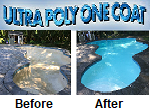 aggregate finish. You seem to be
interested in something that will avoid the periodic
maintenance associated with masonry finishes. I suggest that
you look into some of the plaster/aggregate pool finishes
that utilize aggregate particles other than marble dust.
Some products use quartz and/or ceramic aggregates. This
type of product can be long-lasting, more chemically
resistant and less prone to fading and staining. Some
products are more durable, smoother to the touch, less prone
to fading and color bleeding and able to resist abrasion.
Such products are available in a series of colors and
appearances. The cost differences, over the life of the
finish, may not amount to that much. Painting is an
often-overlooked option. Ultra-Poly One Coat is a hybrid
epoxy coating with a 15-year warranty. Its smooth surface
makes staining and algae problems less likely and makes for
easier maintenance, in terms of the water chemistry. Go with
the look you like and a contractor that is experienced. Good
luck with your choice. aggregate finish. You seem to be
interested in something that will avoid the periodic
maintenance associated with masonry finishes. I suggest that
you look into some of the plaster/aggregate pool finishes
that utilize aggregate particles other than marble dust.
Some products use quartz and/or ceramic aggregates. This
type of product can be long-lasting, more chemically
resistant and less prone to fading and staining. Some
products are more durable, smoother to the touch, less prone
to fading and color bleeding and able to resist abrasion.
Such products are available in a series of colors and
appearances. The cost differences, over the life of the
finish, may not amount to that much. Painting is an
often-overlooked option. Ultra-Poly One Coat is a hybrid
epoxy coating with a 15-year warranty. Its smooth surface
makes staining and algae problems less likely and makes for
easier maintenance, in terms of the water chemistry. Go with
the look you like and a contractor that is experienced. Good
luck with your choice.
Sincerely. Alan Schuster, 1/3/2017
► Aggregate
Surface: What Is It?
A friend bought a re-sale with a pool
that was finished with an Aggregate Finish, but doesn't know
who makes it, distributes it and whether or not it is a
paint, a plaster additive, etc. I love the look. I am about
to refinish and would like to know more about this type of
product. Thanks.
John S., North Richland, TX, 5/12/2015
The product is an alternative to conventional marble-dust
plaster. It is a masonry finish that is applied to the inner
surfaces and may be followed with an acid etching of the
surface. This etching exposes some of the aggregates:
quartz, granite, pebbles, ceramics, etc. Hence, this type of
product is called an Exposed Aggregate Finish and leaves a
textured finish. It has a different look compared to the
smooth plastered finishes. Try and see some completed jobs
and check their references. Having an experienced contractor
is important. Good Luck.
Sincerely. Alan Schuster, 5/12/2015
► Something
Smooth And Durable?
We are building a new pool in AZ and are having trouble
choosing a finish. My wife wants something very smooth on
the feet and has eliminated some of the possibilities. I
want something durable and so am considering the pebble
sheen but wonder if the extra cost is worth it. Do you have
any suggestions or places where I can get additional
information? Thanks.
Blake, Arizona, 11/9/2013
I am really not overly familiar with every product and
there's no sense in misleading you. This can be a matter of
individual taste. I suggest that you look at examples of
various and make a decision based on that and the budgetary
considerations. There are finishes that are very durable and
smooth. Painting is an often-overlooked option.
Ultra-Poly
One Coat is a hybrid epoxy coating with a 15-year warranty.
Its smooth surface makes staining and algae problems less
likely and makes for easier maintenance, in terms of the
water chemistry. Good luck with the pool.
Sincerely. Alan Schuster, 11/9/2013
► Dealing
With A Rough Surface?
My exposed aggregate pool is just
starting to show its age. The surface has become rougher,
due to acid washings, over the years. Will Ultra Poly Coat
One be able to smooth this out, without having to sand? We
have had some staining over the years and had to acid wash a
few times. I have been told that an epoxy-type of pool
coating will last a long time and will be less prone to
metal staining. Is this something to consider?
Hank G., Lakeland, FL 3/3/2009
Ultra Poly One Coat forms a relatively thick counting that
will smooth out the surface and reduce the roughness.
Surface preparation consists of cleaning with a Citrus-Based
cleaner and following with a 3500 PSI power washing. It is
also more stain-resistant than masonry surfaces. Major
defects should be repaired using patching material or
hydraulic cement. Do not use silicone products. Ultra Poly
One Coat is a long lasting, durable epoxy hybrid that is
available in 5 stock colors: custom colors are available. It
is something worth considering, as it less expensive that
replastering and has a 15-year warranty. I hope that
information will prove helpful.
Sincerely. Alan Schuster, 3/3/2009
► Painting Or
Plastering?
We have a marcite pool that is just starting to show its
age. We have had some staining over the years and had to
acid wash a few times. I have been told that an epoxy-type
of pool coating will last a long time and will be less prone
to metal staining. Is this something to consider?
Mel H., Naples, FL 1/3/2006
Painting is a serious option and does afford the benefit of
making the pool water chemistry easier to maintain and is
less prone to metal staining. The look is different and the
coated surface is smoother and less likely to harbor algae.
Ultra Poly One Coat is a long lasting, durable epoxy hybrid
that is available in several colors. It is something worth
considering. I hope that information will prove helpful.
Sincerely. Alan Schuster, 1/4/2006
► Exposed
Aggregate Vs. Plaster?
What are the advantages of using an
exposed aggregate finish over plaster, besides aesthetics?
J. H., 4/13/2017
Most exposed aggregate finishes use quartz and/or coated
aggregates in place of the crushed marble that is used in
conventional pool plaster. This creates a finish that is
less prone to staining and less involved in the pool water
chemistry. It does allow for a variety of textures and looks
that are not possible with plaster. The finished product is
rougher and less slippery to the touch. Some finishes are
smoother and more durable than conventional finishes and
might be worth investigating. I hope that I have been
helpful.
Sincerely. Alan Schuster, 4/13/2017
► Gray
Discoloration?
We had our pool re-surfaced and with
an exposed aggregate material and a couple of months later
we began to see stains. They look gray, almost like gray
clouds all over. Question, how can we take care of this pool
finish problem? Would acid wash work? Thank you!
Z. C., Tampa, FL, 6/5/2008
It sounds like a heavy metal problem. I suggest that you
have the pool water tested for iron, manganese, copper and
calcium. Before you do anything, I suggest that you look
into the warranty. You don't want to do anything that might
void the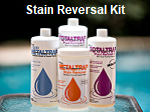 warranty. It seems probable that the water
contained iron and other metals. Dealers don't always run
these tests and metals don't always show up. Pools that turn
gray or darker after addition of chlorine or pH raising
chemicals, usually have iron and other heavy metals present.
This is especially true, whenever well water is used. I
suggest adding Liquid METALTRAP: it is phosphate free and
works over the full pool pH range and beyond. Adding this
chemical can help avoid more staining and/or discoloration.
If staining has occurred, it can be removed with
METALTRAP
Stain Remover. This concentrated product helps to
reduce and solubilize heavy metals, so that
Liquid METALTRAP
can keep them in solution in a chelated state, which is less
colored and more stable. Following up with a recirculating
treatment, using the METALTRAP Filter can permanently
eliminate the metals. All you need is a garden hose and a
small pump to do the recirculation. Once you get the water
looking right, make sure that you run all new water through
the METALTRAP FILTER. I hope that I've been helpful and that
the problem will get solved. warranty. It seems probable that the water
contained iron and other metals. Dealers don't always run
these tests and metals don't always show up. Pools that turn
gray or darker after addition of chlorine or pH raising
chemicals, usually have iron and other heavy metals present.
This is especially true, whenever well water is used. I
suggest adding Liquid METALTRAP: it is phosphate free and
works over the full pool pH range and beyond. Adding this
chemical can help avoid more staining and/or discoloration.
If staining has occurred, it can be removed with
METALTRAP
Stain Remover. This concentrated product helps to
reduce and solubilize heavy metals, so that
Liquid METALTRAP
can keep them in solution in a chelated state, which is less
colored and more stable. Following up with a recirculating
treatment, using the METALTRAP Filter can permanently
eliminate the metals. All you need is a garden hose and a
small pump to do the recirculation. Once you get the water
looking right, make sure that you run all new water through
the METALTRAP FILTER. I hope that I've been helpful and that
the problem will get solved.
Sincerely. Alan Schuster, 6/5/2008
► Getting
Started In A New Pool?
I am having a pool installed with an
exposed aggregate finish and am wondering if there is
anything special that I need to do as the pool is being
filled. The water is soft and I plan on using a saltwater
chlorinator system. I appreciate having so much information
available and being able to ask a question. Thank you.
Eric G., 7/14/2009
You should discuss chemical additions with the contractor,
as you don't want to do anything that might compromise the warranty. With soft water it is unlikely that iron or other
heavy metals are a major concern. However, it is best to
have the water tested for iron, copper and manganese. If
these metals are present, the pool should be treated before
other chemicals are added. For each 0.5 PPM of heavy metal,
add a dose of a quality metal treatment, such as
phosphate-free Liquid METALTRAP,
as soon as possible and as the water is being added. Adjust
the pH to 7.2-7.6, the total alkalinity to 80-120 PPM and
the calcium hardness to 200 PPM. Start the pool off with a
shock treatment and add the necessary amount of salt, based
on the timing suggested by the contractor. From this point
on, a salt
chlorine generator should be able to meet the pool's
chlorine requirements. Test the water frequently, as it is
important in helping to maintain the best appearance of the
pool's surface. An
all-digital,
ColorQ tester makes water testing easier: no
color-matching or guesswork. I hope that I have been helpful.
warranty. With soft water it is unlikely that iron or other
heavy metals are a major concern. However, it is best to
have the water tested for iron, copper and manganese. If
these metals are present, the pool should be treated before
other chemicals are added. For each 0.5 PPM of heavy metal,
add a dose of a quality metal treatment, such as
phosphate-free Liquid METALTRAP,
as soon as possible and as the water is being added. Adjust
the pH to 7.2-7.6, the total alkalinity to 80-120 PPM and
the calcium hardness to 200 PPM. Start the pool off with a
shock treatment and add the necessary amount of salt, based
on the timing suggested by the contractor. From this point
on, a salt
chlorine generator should be able to meet the pool's
chlorine requirements. Test the water frequently, as it is
important in helping to maintain the best appearance of the
pool's surface. An
all-digital,
ColorQ tester makes water testing easier: no
color-matching or guesswork. I hope that I have been helpful.
Sincerely. Alan Schuster, 7/14/2009
► Crack In
The Finish?
My gunite inground pool shows a crack.
The pool is finished with marcite and is 6-7 years old.
There has been a lot a rain lately and I think there was
some settling. How should this be fixed. Thanks.
Cliff H., Hobe Sound, FL 10/6/2008

If the crack is the result of erosion, it is quite possible
that it will grow in size. You might have to have a
concrete or structural stabilization device, such as the
Torque-Lock System installed, as this will help prevent the
crack from expanding. These devices work like staples and
pull the opposite sides towards one another, helping to
stabilize the repair. They are countersunk into the surface
and then covered with the same type of material that was
used to finish the pool. Good luck and I hope that this
information proves useful.
Sincerely. Alan Schuster, 10/6/2008
► Pool
Surface Cracks?
I am planning on repainting my gunite
pool next year. I have notices a few cracks and defects on
the surface. I am not losing any water, above normal, so far
a I know. I would like to repair the problem spots this year
and paint next year. I don't want to have to drain the pool
to get at theses underwater areas. Is there something that
will work under the water. Thanks for the help.

Mike H., Lakeland, FL 4/23/2007
It is a good idea to do something to prevent water getting
behind the original plaster finish.
Boxer Adhesives
manufactures a complete
line of product for making underwater repairs. One of the
products is an underwater epoxy kit. The material is white
and can be painted over when you're ready. In the meantime
it will make a water tight repair, without having to drain
the water. Just follow the simple directions. Good luck and I hope that I have been
helpful.
Sincerely. Alan Schuster, 4/23/2007
► Concerns
About Colored Finishes?
Hello again Alan. Thank you for your
quick response to my color loss dilemma. I agree with you
about the salt system as a good alternative to traditional
sanitizers. I'd much rather trade a scale problem for a
color loss one, which seems to be one of the trade offs with
salt. Newly plastered pools that are put on salt systems
seem to be constantly fighting a scaling situation,
especially during the first month of plaster cure. My
question with salt is; Is it necessary to shock from time to
time to eliminate chloramines and other organic wastes. If
so, which of the many forms of granulated oxidizers would be
most color-friendly. From what you've mentioned earlier, I
assume granulated trichlor would not be your choice.
Since strong oxidizers seem to be public enemy number one to
colored plastered surfaces, shouldn't manufacturers of color
for plaster and blenders of bagged plaster materials include
some warnings about the use of oxidizers with their
products, instead of just mentioning that their "Warranty"
does not cover color loss. How would a concerned homeowner,
builder or service tech know how to prevent a possible
detrimental oxidation level. I know that ORP levels are not
new to the industry. Is there an ORP level that at
some point becomes a problem with color in plaster?? Most
warranties or guidelines pertaining to the maintenance of
plaster products casually mention the adherence to N.S.P.I
guidelines. I think you can adhere to those basic water
balances and sanitation levels and still run in to problems
when it comes to the use of certain chemicals meant
to "shock" a pool or "enhance" the effectiveness of your
chlorine or bromine. What do you think? Revisiting chemistry
after my last college course 35 years ago isn't any easier
than it was then. Thanks again in advance for your
assistance.
Bill in Dallas, TX, 4/20/2009
Trichlor granular would be one of the worst choices.
Salt
chlorinators and scaling do not go hand in hand. Adding 2500
PPM of salt to already hard water could add to the potential
of the problem. However, keeping the pH under control should
eliminate the problem of scaling. It is no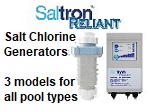 t the salt that
scales, it is the calcium compounds. The color loss problem
of certain pool finishes is more akin to a vinyl liner
problem. You want to avoid extreme high chlorine levels,
especially with low pH, as that only increases the
aggressiveness of the chlorine. Gas chlorine would be an
example of a bad choice, in my opinion. In addition, you want to avoid
direct contact between the chlorine and the finish. Trichlor
granules and calcium hypochlorite broadcast into the pool
are examples of bad choices. Lithium or sodium hypochlorite,
dichlor or non-chlorine shock are better choices. If you are
going to use chlorine, nothing gives you control over the
situation better than a salt chlorinating system. You
control chlorine production by selecting a setting and/or
varying the hours of operation. Shock treatment by
definition means boosting the chlorine level higher than
normal and this can pose risks to certain finishes. All of
the water passing through a salt chlorinator is superchlorinated and all of the chloramines are destroyed.
Under normal conditions the need to shock is greatly reduced
or eliminated. Maintaining the free chlorine level and the
pH within guidelines assures that the
ORP is normal. I hope
that I answered all of the questions. t the salt that
scales, it is the calcium compounds. The color loss problem
of certain pool finishes is more akin to a vinyl liner
problem. You want to avoid extreme high chlorine levels,
especially with low pH, as that only increases the
aggressiveness of the chlorine. Gas chlorine would be an
example of a bad choice, in my opinion. In addition, you want to avoid
direct contact between the chlorine and the finish. Trichlor
granules and calcium hypochlorite broadcast into the pool
are examples of bad choices. Lithium or sodium hypochlorite,
dichlor or non-chlorine shock are better choices. If you are
going to use chlorine, nothing gives you control over the
situation better than a salt chlorinating system. You
control chlorine production by selecting a setting and/or
varying the hours of operation. Shock treatment by
definition means boosting the chlorine level higher than
normal and this can pose risks to certain finishes. All of
the water passing through a salt chlorinator is superchlorinated and all of the chloramines are destroyed.
Under normal conditions the need to shock is greatly reduced
or eliminated. Maintaining the free chlorine level and the
pH within guidelines assures that the
ORP is normal. I hope
that I answered all of the questions.
Sincerely. Alan Schuster, 4/20/2009
► Stain
Bleeding Through The Finish?
There is an area in the hopper of my
inground pool that has a dark discoloration. I have tried
chlorine and ascorbic acid treatments and neither has
helped. My pool serviceman thinks it may be a stain caused
by a re-bar being too close to the surface. The pool is not
that old and the finish is perfect, everywhere else. Is
there something else that I can try?
Dave C., Ormand Beach, FL 2/2/2010

You have tried, what I would have suggested. Most likely the
pool tech is correct. What you can do is use an underwater
Premium Graphic Mosaic Mat and position it over the discolored area and
create an underwater landscape. These products can be used
underwater, so draining will be unnecessary. It would be an
easy and attractive solution. It will add color and an
interesting focal point, while it hides the problem. You can
choose from Dolphins, Coral Reefs, Turtles and more. When
you're ready to refinish the pool, you can consider other
options. I hope the suggestion is helpful.
Sincerely. Alan Schuster, 3/23/2010
►
Re-Fiberglassing Gone Bad?
Last year I had my in ground pool
resurfaced with fiberglass. Initially I was quite pleased as
it looked beautiful. The first time we swam in the pool,
after the resurfacing the water appeared 'milky'. In fact it
looked just like skim milk after an afternoon of swimming.
We found that if you rub your hand on the side, the finish
appears to be coming off. Several months later we found a
blister on the bottom of the pool more than 2 feet in
diameter. I have been trying to deal with the company who
did the resurfacing, but I am getting no where FAST! They
have told me things like the 'milky' water if from algae in
the pool, then they told me it was improper chemicals. THEN,
they told me it was an improper mix of chemicals. They will
take NO responsibility for the 'milky' problem. I heard that
that is caused from incorrect percentage of surfacing agent
used during the finishing gel coat. Do you know if that is
correct? They are willing to fix the blister, saying they
are a perfectly normal occurrence. HELP Alan. Do you know
what is causing these problems. I am out $8500.00 and my
pool is not right. Any help is GREATLY appreciated.
Kathi L., Santa Rosa, California, 5/11/2008
Without more specific information, I can only tell you
possible causes. There could be a filter problem, an algae
problem or a chemistry problem or more than one. Or it could
be the finish. There is no way for me to know. Start by
checking the overall pool chemistry. Blisters are not what
I would call normal. Chances are you will see where the
repair was made. I have heard lots of horror stories about
re-fiberglassing. I would have suggested Ultra Poly One
Coat: a hybrid epoxy with a 15-year warranty. It would have
been a fraction of the cost. Dead algae can pass right
thought a some filters. It is vital to boost the Free
Chlorine level to allow it to decompose the dead algae.
Adding a blue clarifier can help, but ultimately it is the
chlorine that will do the job. For free chlorine testing, I
suggest using LaMotte Insta-Test strips, as they provide the
right kind of information. High calcium hardness, over 400
PPM, can cause cloudiness especially if the pH and TA are
also high. Get the overall water chemistry under control and
see if that helps make a difference. When the chemistry is
right and the water remains cloudy, one has to consider that
there might be a filter problem. Are you able to maintain a
stable free chlorine level of 1-3 PPM? Or do you have to add
lots of chlorine? If you have a sand filter it may be
channeled and requires a cleaning and fresh sand. If you
have a sand filter, I suggest that you consider using a
zeolite: it's a sand filter replacement media, that weights
1/2 as much as sand and produces much better water quality.
Much better! Some sand filters cannot remove dead algae. Poor circulation can
be part of the problem and The
Pool Circulator can be the
solution. It is a simple to install device that makes a
dramatic difference in the water circulation. I hope that
this information proves helpful. lots of horror stories about
re-fiberglassing. I would have suggested Ultra Poly One
Coat: a hybrid epoxy with a 15-year warranty. It would have
been a fraction of the cost. Dead algae can pass right
thought a some filters. It is vital to boost the Free
Chlorine level to allow it to decompose the dead algae.
Adding a blue clarifier can help, but ultimately it is the
chlorine that will do the job. For free chlorine testing, I
suggest using LaMotte Insta-Test strips, as they provide the
right kind of information. High calcium hardness, over 400
PPM, can cause cloudiness especially if the pH and TA are
also high. Get the overall water chemistry under control and
see if that helps make a difference. When the chemistry is
right and the water remains cloudy, one has to consider that
there might be a filter problem. Are you able to maintain a
stable free chlorine level of 1-3 PPM? Or do you have to add
lots of chlorine? If you have a sand filter it may be
channeled and requires a cleaning and fresh sand. If you
have a sand filter, I suggest that you consider using a
zeolite: it's a sand filter replacement media, that weights
1/2 as much as sand and produces much better water quality.
Much better! Some sand filters cannot remove dead algae. Poor circulation can
be part of the problem and The
Pool Circulator can be the
solution. It is a simple to install device that makes a
dramatic difference in the water circulation. I hope that
this information proves helpful.
Sincerely. Alan Schuster, 5/13/2008
► Plaster
Being Eaten Away?
Last year was my season with my gunite
pool. It has a white plaster finish. When we went to close
the pool I noticed spots all over the finish. When I felt
them it was almost like the finish was being eaten away.
They were rough spots that went down into the plaster and
were not raised. I am being told different things by
different companies. Such as, it was from a chemical
imbalance, from using well water to fill it when it got low
during the dry season, to mustard algae. And as far as
fixing it, I am being told that they could add chemicals,
such as acid to the water to kill it and steel brush the
finish smooth again. Then, drain it and acid wash it. I
am concerned about both these procedures because it is a new
pool and I had a pool maintenance company maintaining it,
with chlorine products, every week. Can you please let me
know why this happened and what I should do?
Donna Lee P., 4/18/2007
This type of problem is not common and the causes are not
fully understood. Suggesting that this is mustard algae is a
diversion. The well water might cause staining, but if the
overall chemistry was corrected, it would not etch the
surface. Staining maybe! It is possible that the spots are
the result of the use and abuse of calcium chloride that
was added to the plaster mixture. There is no remedy for the
problem, other than refinishing. An excellent article
appeared, on this topic, in Service Industry News on
1/15/03. The nature of the source water and the current pool
water chemistry can both play a role in this problem.
Exactly, what is causing the change in appearance might be
determined by a complete pool water analysis. Parameters
such as pH , total alkalinity, calcium hardness and heavy
metals should be determined on the pool water. Testing the
tap/well water might also be of benefit. New pools need to
have the calcium hardness level in the 150-200 PPM range or
else the water will extract calcium from the walls. The test
results are necessary to both find the cause and prevent
further problems. This is either caused by poor chemistry,
mainly pH, TA and hardness or a poor or incorrect plaster
mixture or application or both. No one knows exactly why or
is willing to step up to the plate. It is easier to blame
something or someone else. I have no basis for pinpointing
the exact cause, but I think this pool needs to be
refinished, as it is only one-year old. You deserve better.
Sanding the surface smooth might not present a permanent
solution. Some finishes are more chemically resistant, than
many products in current use. You could also have the pool
painted. Ultra Poly One Coat is a hybrid epoxy with a 15
year warranty. It is more chemically resistant and has
little effect on the overall pool chemistry. Read the first
letter on this page:
Pool Coatings and Paints. Good luck and
I hope that I have been of some assistance.
Sincerely. Alan Schuster, 4/18/2007
► Using
Stucco?
Can I use white stucco (white cement +
silica sand) to replaster my pool instead of a pool
aggregate finish (white cement + silica sand)? What is the
difference, if any, between the two? Thanks a lot.
Maggie, 12/21/2007
The answer is NO! Stucco formulas substitute hydrated lime,
for about 30% of the white Portland. We can’t put lime into
pool plaster. Lime is Calcium Hydroxide, a soluble component
that would leach into the water and add porosity. Stucco
uses it for air entrainment and freeze thaw durability.
Stucco and Pool Plaster are different cement chemistries and
should not be interchanged. Pool finishes are made from
white Portland cement and various aggregates. The grades are
intended for use in pools. I would use something that I know
will work, considering all the work involved. I hope that I
have been helpful. Enjoy the Holidays.
Sincerely. Alan Schuster, 12/22/2007
► Undecided?
I have an 18X36 inground concrete
pool, 24,000 gallons, built in the mid-70's. There are
several problems that came up over the last three years:
a) Some stains on the bottom of the pool (most likely
tannins due to leaves at the bottom during the winter)
b) two 12" hairline cracks in the wall of the pool
c) the top pool step coating is worn and the concrete
subsurface is showing (small area, 9" by 6")
The water quality is fine.
My questions are as follows:
To eliminate the tannins, I want to try the "sock" technique
mentioned in your other postings. However, due to the
hairline cracks, the worn pool step coating and the fact
that I have to replace the main pool drain cover (broke off
last year):
1) would you suggest draining the pool this spring to solve
all of the above problems? I have to drain 1/3 of it
regardless to get to the hairline cracks, and it will be
easier to get the main drain cover on by draining the whole
pool, but will this also help at cleaning off the pool
stains (i.e. maybe power wash or a good scrubbing with a
cleaning solution instead of the sock technique)?
2) Any suggestions for the two hairline cracks and the worn
pool step coating? Based on reading the website postings, I
do not want to paint the pool, but I do not think the pool
is in bad enough shape to warrant a resurfacing yet (I
hope).
Thank you very much for your help. Regards,
Jonathan, 4/15/2004
Draining the pool could make sense. Call it one-stop repair
and fix up. As long as the pool is empty, you should give
some thought to a refinishing. It does sound like you are on
borrowed time and why pay to replace all the chemicals in
the water twice? If the stains are tannins the "sock trick"
is not needed. A shock treatment, if there is water in the
pool, or a chlorine wash, if it has been emptied, should
completely remove all of the tannins. It would be a good
idea to patch up the step, along with the hairline cracks.
The best option would be to resurface the pool, after the
repairs, that is if the budget allows. Otherwise the
aesthetics of the pool, in the repaired areas, will always
stand out. A repair pro probably could work wonders and buy
you some more time. Something to look into? Good luck and
I'm sorry that I couldn't be more helpful.
Sincerely. Alan Schuster, 4/15/2004
► Color Of
the Finish And Black Algae?
I am having an inground pool installed
and for the finish I chose the color black made from a
product made from a resin with the aggregate look. Does the
color black make it easier for black algae to form or are
all colors the same?
Kevin S. CA, 7/20/2010
I have never been asked this question about a pool finish
before. There is no reason to suspect that algae growth
problems would be related to the color of the pool finish.
Algae growth is directly related to poor pool maintenance,
inadequate pool sanitation practices, the failure to
maintain proper water chemistry or the overwhelming of the
sanitizers, by high bather demand or bather wastes. Black
algae is not particularly common and can be difficult to
remove. However, with a masonry finish pool you will always
have several treatment options, if a problem ever develops.
Enjoy the pool.
Sincerely. Alan Schuster, 7/20/2010
► Dark
Colored Bottom?
We are installing a gunite pool. We
wanted a dark-bottom pool. However they told us that the
color will fade over time, as soon as a month, and that you
can't use shock or it will bleach the color. Is this true?
I'm concerned because, if we decide to go with the dark
color, we are told that they will not warranty the color.
Can you send me some information on dark-bottom pools,
problems with them or another information that could assist
me in making a decision. Thank you for your time and help!
Sincerely.
Ryan G., 4/15/2006
The majority of the pools out there are blue or some light
color. And there are black pools as well. I can't speak for
every type of pool finish out there, but any product that
can fade, in a period as short as a month, is questionable
at best. A pool with a masonry finish is more resistant to
the elements - isn't that part of the reason that a masonry
pool is chosen over vinyl. High levels of chlorine, over a
prolonged period of time, or the direct application of
chlorine to the surface, can affect the finish. For this
reason, it is always best to add chlorine in a controllable
manner, as with a chlorine feeder or a
salt chlorinator.
This avoids having high chlorine levels or product sitting
on the bottom. I don't know which finish you are choosing
and even if I did, I would still suggest that you consider a
finish that will come with a reasonable warranty. If they
can't warranty a dark pool finish, they shouldn't be
offering it! Most likely they are using organic colorants
and they are known not to last all that long. I suggest
sticking with finishes that use only inorganic colorants and
they hold up better, over time. Good luck with your
decision.
Sincerely. Alan Schuster, 4/15/2006
► Plaster
Dust?
I just had my pool replastered.
The plaster contractor told me to brush the plaster dust
several times a day for the first week and to add no
chemicals. What exactly is this dust made of? It's white and
clouds up the pool water. Is there some other way to handle
or cure the plaster so that the dust won't form in the first
place? Thanks.
Bruce, 3/27/2004
The plaster mixture consists of white Portland cement and
ground up marble. The dusting or clouding is probably
calcium carbonate and is harmless. I'm sure that if you ask
the question, of what do about the curing pool finish, to
enough people, you'll get a variety of answers. I suggest
that you follow the contractors recommendations, as he
should know what works best with the type of finish he
applied and with your local water. To do something else
could void the warranty! Let the cloud settle and vacuum it
up. Once the chemistry is adjusted, it should slow up or
even stop and filtration should do the rest. You'll be in
the swim soon enough.
Sincerely. Alan Schuster, 3/28/2004
► Keeping It
Smooth?
Is there a suggested way to keep the
gunite smooth for a longer period of time to prevent
pitting?
Bob G., 4/21/2004
Good question! Yes, there are things that can and should be
done to protect the appearance of the pool finish.
Avoid Corrosion Water Conditions: maintain the pH at
7.2-7.6, the total alkalinity at 80-120 PPM and the calcium
Hardness at 150-200 PPM. This will help keep the walls from
being etched. If the water is soft or has a calcium hardness
below 150 PPM, you must add calcium hardness increaser to
the pool or the pool water will extract calcium from the
walls.
Avoid Direct Chlorine Contact: add chlorine is such a way as
to avoid direct contact with the pool surfaces. A built-in
chlorinator or a salt chlorinator system are well suited for
this purpose. Use liquid chlorine, lithium hypochlorite,
non-chlorine shock or dichlor, when a shock treatment is
required.
Avoid Scale Formation: high levels of calcium hardness,
usually above 400 PPM can lead to crusty-feeling scale
deposits. Once your calcium hardness level is above 200 PPM,
stop all use of calcium hypochlorite products, so as to
avoid further increases in the calcium hardness.
When the time comes to refinish the pool you might want to
look into something other than marcite. Painting is an
often-overlooked option. Ultra-Poly One Coat is a hybrid
epoxy coating with a 15-year warranty. Its smooth surface
makes staining and algae problems less likely and makes for
easier maintenance, in terms of the water chemistry.
Those are the suggestions. I hope that they prove helpful.
Sincerely. Alan Schuster, 4/21/2004
► Cause Of
Fading Finish?
Hello Alan. Enjoyed reading through
the archives of pool staining problems. Wasn't able to find
the information that has been nagging me for some time. Hope
you can shed some light on what seems to be very
controversial subject among "pool professionals." Many pools
are being plastered with pigment added; site blended batches
using white cement, marble mix and color & pre-blend
products come from the manufacturer, everything in the bag
including dry color, just add water. There are marble base
products, quartz base products, pebble base products and
even glass bead products. Who knows what else they'll think
of next, to mix with cement to make a pool surface finish.
Most manufacturers have warranties (of sorts) but none will
warrant the color to remain consistent for any length of
time. I realize that due to the harsh nature that a pool
surface can be subjected to that an unlimited warranty would
be foolish for a manufacturer, BUT no one will spell-out
what specifically causes color to fade, bleach-out, mottle
and flat disappear. Any information you could lend would be
greatly appreciated. I know there are many others that would
like an explanation of this very common dilemma and constant
source of frustration. Thanks a bunch.
Bill in Dallas, TX, 4/13/2020
You're right. For all the information on the "Pool Finishes"
page, your question was not directly answered. A pool being
maintained on chlorine is a oxidizing medium. The higher the
chlorine concentration and the lower the pH, the stronger
the potential for oxidation. Not everything underwater is
affected by oxidation. Calcium carbonate (marble dust) and
the various components of the white cement mix are already
oxidized and are unaffected by the chlorine. However, the
colorants and other additives in the mixture may be subject
to the effects of chlorine, bromine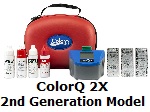 and other oxidizing
agents. Some aggregate finishes are much more resistant to
chemicals and fading problems. Harsher conditions can be
detrimental and should be avoided, in order to prolong the
look of the finish, for as along as possible. This is
something that you can control! For example, if you were to
use gas chlorine, on a weekly basis, the chlorine level
would be very high initially, in order to last for a week.
This type of situation creates strong oxidizing conditions.
On the other hand, if you could add chlorine at a very slow
and consistent rate, you would avoid the spiking up of the
oxidation potential. In this regard, nothing works better
than a salt chlorinating system: the chlorine is produced at
a controllable rate, is never added in a concentrated form
and avoids harsh elevated levels or acidic conditions. So
why you may have concerns and some unknowns about the pool
finish, you can control the water chemistry to the benefit
of the finish. Fading and "bleach-out" can be attributed to
prolonged exposure to high concentrations of oxidizers.
Mottling is probably more related to other aspects of pool
water chemistry: pH, total alkalinity and calcium hardness.
Once again, proper maintenance of the pool water chemistry
can and will make a difference. You can simplify testing and
eliminate guessing and color-matching completely. The
ColorQ 2X Testers
are all digital and easy to use. I hope that I have filled in
some of the blanks. and other oxidizing
agents. Some aggregate finishes are much more resistant to
chemicals and fading problems. Harsher conditions can be
detrimental and should be avoided, in order to prolong the
look of the finish, for as along as possible. This is
something that you can control! For example, if you were to
use gas chlorine, on a weekly basis, the chlorine level
would be very high initially, in order to last for a week.
This type of situation creates strong oxidizing conditions.
On the other hand, if you could add chlorine at a very slow
and consistent rate, you would avoid the spiking up of the
oxidation potential. In this regard, nothing works better
than a salt chlorinating system: the chlorine is produced at
a controllable rate, is never added in a concentrated form
and avoids harsh elevated levels or acidic conditions. So
why you may have concerns and some unknowns about the pool
finish, you can control the water chemistry to the benefit
of the finish. Fading and "bleach-out" can be attributed to
prolonged exposure to high concentrations of oxidizers.
Mottling is probably more related to other aspects of pool
water chemistry: pH, total alkalinity and calcium hardness.
Once again, proper maintenance of the pool water chemistry
can and will make a difference. You can simplify testing and
eliminate guessing and color-matching completely. The
ColorQ 2X Testers
are all digital and easy to use. I hope that I have filled in
some of the blanks.
Sincerely. Alan Schuster, 4/13/2020
► Frustrated
With The Chemistry?
Alan, Perhaps you can help us. We just
had our gunite pool re-plastered and we do not know how to
get it up and running. It seems that no one agrees on how
the chemicals are to be added and just how much and in what
order. Very frustrating. The pool holds 16,000 gallons. The
alkalinity seems to be the greatest concern. The plaster is
leaching calcium into the water and my husband cannot get an
answer to solve the problem. The pH of course is off, too
and we do not know how long, in hours, it takes for things
to equalize. Please help!
The McFarlands, 2/8/2020
It is common for the pool water chemistry, of a new or newly
refinished plaster pool, to fluctuate and require the
adjustment of several of the pool water parameters. The
softer the fill water - the faster the calcium will leach
from the walls. This will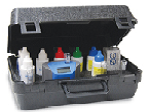 cause a rise in the pH and total
alkalinity. The way to slow the leaching effect is to raise
the calcium hardness of the water. By adding calcium to the
water, the walls will be less subject to leaching and
etching. Have the water tested for calcium hardness, pH and
total alkalinity. You want the calcium hardness to be in the
150-200 PPM range. If it is below this range, add sufficient
calcium hardness increaser to raise it into this range. Once
done, it should be easier to control the pH and TA. Raising
the TA to 80-120 PPM, will also slow down the leaching. The
pH will tend to remain closer to 7.6, than to 7.2. The
higher pH will, also, help slow down the leaching. In
summation: adjust the calcium hardness and allow a few hours
for the chemicals to disperse. Adjust the TA and allow a few
hours for the chemicals to disperse, before testing and
adjusting the pH. A local pool professional should be able
to help you with the water testing and the chemical dosages.
You'll chemical additions help on this page:
Calculating Chemical
Additions. A
ColorQ 2X Digital
Water Analyzer will provide and easier and more reliable
way to test your pool water. I hope that this information will prove helpful. cause a rise in the pH and total
alkalinity. The way to slow the leaching effect is to raise
the calcium hardness of the water. By adding calcium to the
water, the walls will be less subject to leaching and
etching. Have the water tested for calcium hardness, pH and
total alkalinity. You want the calcium hardness to be in the
150-200 PPM range. If it is below this range, add sufficient
calcium hardness increaser to raise it into this range. Once
done, it should be easier to control the pH and TA. Raising
the TA to 80-120 PPM, will also slow down the leaching. The
pH will tend to remain closer to 7.6, than to 7.2. The
higher pH will, also, help slow down the leaching. In
summation: adjust the calcium hardness and allow a few hours
for the chemicals to disperse. Adjust the TA and allow a few
hours for the chemicals to disperse, before testing and
adjusting the pH. A local pool professional should be able
to help you with the water testing and the chemical dosages.
You'll chemical additions help on this page:
Calculating Chemical
Additions. A
ColorQ 2X Digital
Water Analyzer will provide and easier and more reliable
way to test your pool water. I hope that this information will prove helpful.
Sincerely. Alan Schuster, 2/8/2020
► No Tile
Border?
Our pool contractor prefers to design
and build free form pool without the use of waterline tile.
About 3 to 4 inches of the pebble type of finish is exposed
to the air, above the water line. Several people have
suggested that over time I will have a problem with a
bathtub type of ring that will be near impossible to clean
off of the pebble (as opposed to the normal challenge of
cleaning such rings off of waterline tile). Plus my pool
friends tell me the finish is supposed to cure under water
and drying above water may result in cracks down the road.
Pool builder disagrees and claims they have built their
pools like this for years with no problems. What is your
opinion?
Dan Y., 2/21/2006
Pools do tend to get accumulations forming at the water line
and it should be easier to clean it off of a tiled area. I
would prefer a tile border! So far as cracks are concerned,
this is something that may or may not happen, as it can
depend upon the type of finish and application technique. In
this regard, you have the contractors experience to go by. I
hope that I have been of some help.
Sincerely. Alan Schuster, 1/22/2006
► Refinishing
Costs?
Two summers ago our marcite pool began
to stain and it appears pitted. The pits are yellowish in
color. It became progressively worse. Last summer we had it
drained and acid washed with no good results. The kids would
come out of the pool with tiny slivers in their toes. The
recommendation was to re-marcite the pool. We are currently
investigating the process - price, material, color options,
etc. Can you give us some recommendations, including what
price range we can expect to be in. Thanks!
Scott D., 4/15/2009
It sounds like your pool water chemistry may have gone out
of kilter adding to the pool finish problem. If that is the
case,
I hope that more attention will be paid to the topic,
in the future. Pricing can vary depending upon pool size and
condition and where the pool is located. I am really not
able to quote costs with any degree of certainty. A few
thousand dollars minimum is a good starting point. Marcite
will cost a bit less than the aggregate finishes. Fiberglass
or epoxy might cost somewhat more. Paint, such as
Ultra Poly
One Coat Hybrid Epoxy, is probably one of the less
expensive options and can yield long-lasting and attractive
results. I suggest that you decide what you would like the
pool to look like, as a stating point. The various finishes
have different looks, as well as different maintenance
requirements and costs. Do some price comparisons and the
decision is yours to make. A good water tester, such
as the all-digital
ColorQ Water
Analyzers, can help you get your pool water chemistry,
where it needs to be. It easy and simple to use and
eliminates all color-matching and guesswork. Good luck.
Sincerely. Alan Schuster, 4/16/2009
► Chlorine
Tablet Stain?
Thanks in advance for answering my
question. Last September (2005) I had a chance to rent a
home with a pool in Phoenix, Arizona. Having never
maintained a pool before, I had no knowledge of pool
maintenance. The problem is this: after reading the water ph
and other chemical levels, the little chart that came with
the kit said I should add more chlorine to the water. So I
did, with the tablets, in the water. I didn't ask and had no
reason to think this would leave brown stains on the bottom
of the pool. I also thought they would go away over time,
but have not. I moved out a few weeks ago and didn't think
much of it, but now the homeowner is asking if I dropped
chlorine tablets into the pool. I have no intention of lying
and will answer him truthfully, but wanted to offer some
advise if possible to assist in the removal of these stains.
Your website is very comprehensive and thorough, but I
didn't see anything specific to this situation. Your help
would be greatly appreciated. Kind Regards.
Michael, Phoenix, AZ, 3/27/2006
Chlorine tablets directly on a masonry pool finish can and
will cause damage. It isn't necessarily a stain, but an
alternation of the materials present. Some finishes are more
prone than others. It is probably permanent. About all I can
suggest is that you put about 1/2 pound of a pH reducer
granules in a while sock and drop onto the stain. This will
help dissolve the top layer and could even out the
appearance. Good luck.
Sincerely. Alan Schuster/ 3/27/2006
► Etched,
Pitted and Faded?
I have seen pool surfaces pitted and
etched. The pools are serviced by pool service companies
that use chlorine gas. Is this not a very bad way to
sanitize and chlorinate a pool? Is this the reason that
pools have to be re-surfaced? Why are pools being gassed?
Mitch, Dallas, Texas. 5/27/2005
Gas chlorine is wicked stuff. Adding a weeks worth of
chlorine all at once is not good for the pool surface or the
bathers, for that matter. Some companies think adding more
is even better. I guess the lure is cost. There are better
ways to sanitize a pool:
Salt chlorine generators,
ozone generators, ionization and
mineral sanitizers:
all products that maintain pools without the harshness of
gas chlorine. I hope that this helps to point you in the
direction of a better choice.
Sincerely. Alan Schuster, 5/27/2005
► To Acid
Wash Or Not To Acid Wash?
I am going to have by pool refinished
with exposed aggregate. I am trying to decide on a finish
and a contractor. Some said, I should acid wash and some say
not to. Which is it? Appreciate any input you can provide.
Ernie, AZ, 4/12/2004
Common sense tells me that you should acid wash, but I have
heard it argued both ways. Not every pool is the same and I
can't imagine that some contractors always acid wash and
others never acid wash. In the final analysis, the condition
of the pool and the type of refinishing product have to be
considered. I suggest that you select the finish and the
contractor, as this is the major part of the decision. The
contractor is the one responsible for the outcome of the job
and I would defer to his opinion. He should know what works
best with a particular product, in your local area. Good
luck with your decision and enjoy the new look.
Sincerely. Alan Schuster, 4/12/2004
► Spotted
Plaster?
Al, great site: very helpful-question
if you could help me and others- some GRANULAR CHLORINE that
apparently did not dissolve sat on different parts of the
pool bottom-(plaster pool)- where it sat, it left white
stains, that are pretty bad (spotted the pool. We drained
the pool and decided to power wash it with 2400 psi power
washer to get out some OTHER deep algae stains. It removed
some, but not all of the algae stains on the plaster of the
pool, and the chlorine stains still exist- we are refilling
as I type this, with the stains, varying colors in the
plaster as they are- when the pool is filled up again, can
we do anything to get the plaster back to where it was? Is
all lost? I told my dad that this was a chemical problem,
not a power washing problem, and there was a difference-the
pool is a decade old- but the plaster seems to be in good
condition. Will superchlorination for an extended amount of
time help when the pool is filled? Thanks.
Ben M., New Jersey, 6/12/2006
I think power washing a plaster pool finish can be a risky
practice. You could damage the surface and separate the
plaster from the underlying gunite. The white spots are
probably due to the removal of all types of discoloring
organic matter from the plaster surface. Superchlorination
is the best way to try and even out the color. You could add
some trichlor granular material. This is very slow
dissolving and will remain on the bottom for an extended
period of time. Use the brush to move the granules to areas
in need of treatment. It may turn out to be a function of
high chlorine concentration and time. Try lowering the pH to
7.2, as it will make the chlorine more active. Good luck and
I hope that it works out for you.
Sincerely. Alan Schuster, 6/12/2006
► What To Do
About Stains?
Alan- Great site- I am recommending it
to everyone I know who has had a problem. I recently began a
new job as Director of a 203,000 gallon commercial pool with
terrible brown stains all over. The pool was replastered 15
years ago, but was refilled with city water (water then
turned brown) and run for 13 years on an older cast-iron
filter. Needless to say the filter needed to be replaced due
to rust etc. and this was done in 2001. The water quality is
now excellent and chemicals are very consistent (chlorine
1.5, pH 7.5, calcium 250, alkalinity 100) but the staining
is significant. We have explored many options from acid
washing to replastering and there have been differing
opinions. Since it has never been acid washed, 3 out of 4
companies feel it could withstand the process- but one said
it won't last and needs resurfacing. With acid wash I
understand the surface may become more porous, so I had the
incoming water tested for Iron (0.192 mg/l), Copper (0.05
mg/l), and Manganese (0.025 mg/l). Since we are running a
brand new filter (free of rust) I am considering it although
my concern is the condition of the plaster. I would pay
extra to fill the pool with properly balanced water then
install a filtration system on the auto-fill to remove
metals from the water before they ever get into the pool.
Here are my questions: 1. How long should a plaster surface
last and how many times can it withstand acid wash? 2. What
type of filter would you recommend to keep metals out? 3. Is
there a better strategy for keeping metals out or for
treating my stains now (treatments)? 4. What are the
"obvious signs of damage" to look for indicating that
resurfacing is the best option? Finally, is it true that
tile is the most permanent pool surface? This is a major
project and I want to do it right. Thanks for your help I
really appreciate it.
Paul, 3/30/2007
Good questions, but I'm not sure that I can answer them.
There is lots of subjectivity here! The pool surface is 15
years old and is badly stained. If you want the appearance
to be something to be admired, you need to do something.
Tile would be great, but the cost? Acid washing etches or
dissolves the surface. It has been exposed to corrosive
forces for 15 years and could be on borrowed time. I would
opt to resurface the pool, inasmuch as acid washing might
not remove all the stains and could increase the porosity.
It is hard to say how long it could last or how many times
it can be acid washed, as a lot depends on how the pool was
plastered and how the water is maintained. When the
underlying concrete starts showing through, it is obvious
time to refinish. With the absence of visible problems, it
is your call. Your water quality is a problem and trucking
in water is a option. Treating with METALTRAP
Stain Remover and a METALTRAP Filter is
the better solution. Not only will it help remove the metals
from the water, as the pool is being filled, but you can use
it to filter all new water added to top off. Good luck and I
hope that I have been helpful. and is badly stained. If you want the appearance
to be something to be admired, you need to do something.
Tile would be great, but the cost? Acid washing etches or
dissolves the surface. It has been exposed to corrosive
forces for 15 years and could be on borrowed time. I would
opt to resurface the pool, inasmuch as acid washing might
not remove all the stains and could increase the porosity.
It is hard to say how long it could last or how many times
it can be acid washed, as a lot depends on how the pool was
plastered and how the water is maintained. When the
underlying concrete starts showing through, it is obvious
time to refinish. With the absence of visible problems, it
is your call. Your water quality is a problem and trucking
in water is a option. Treating with METALTRAP
Stain Remover and a METALTRAP Filter is
the better solution. Not only will it help remove the metals
from the water, as the pool is being filled, but you can use
it to filter all new water added to top off. Good luck and I
hope that I have been helpful.
Sincerely. Alan Schuster, 3/30/2007
► Yellow
Spots In A Marcite Pool?
I have a marcite pool that has been in
for 8 months and it has gotten yellow blotches on the bottom
and the steps. The pH, chlorine, alkalinity levels are OK. I
brush the pool each week. I was told the calcium would cause
this. I have shocked it and I have put in a gallon of
chlorine every two weeks.
Kendell W., Sarasota, FL 6/12/2009
The yellow spots could be attributed to several causes: iron
stains, algae growth and discoloration caused by fertilizer
granules. Try the following to help narrow the choices and
point to a solution. Put 1/2 pound of pH decreaser in a
white sock, shut off the filter and drop onto a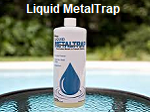 stained area
Check after 1/2 hour. If there is a noticeable improvement,
the likely cause was iron, in the water, or possibly
fertilizer granules. Repeat this elsewhere, as needed to
remove all of the stains. If the area is extensive, it may
be necessary to drop the pH of the water to 5-6. After the
stains are removed, add a quality, phosphate-free, chelating
agent, such as Liquid METALTRAP. to help prevent a
recurrence. Thereafter, add more of the product, prior to
the addition of any makeup water. Restore the pH to 7.2-7.6.
If the "sock treatment" did not work, the likelihood is that
the problem is algae or even stains from leaves. Place a 3"
chlorine tablet on a stain (NOT FOR VINYL POOLS), shut off
the filter and allow to remain in place overnight. If
improvement is seen algae or discoloration caused the stain.
You can use Polymer Algaecides, shock treatment and
well-placed trichlor tablets (NOT WITH VINYL POOLS). Broader
areas can be treated with a granular trichlor (NOT WITH
VINYL POOLS). Calcium is usually associated with scaling or
pool water cloudiness. Yellow discoloration is not a
characteristic of calcium. The discoloration is probably not
related to any defect in the marcite finish. I hope that I
have been helpful. stained area
Check after 1/2 hour. If there is a noticeable improvement,
the likely cause was iron, in the water, or possibly
fertilizer granules. Repeat this elsewhere, as needed to
remove all of the stains. If the area is extensive, it may
be necessary to drop the pH of the water to 5-6. After the
stains are removed, add a quality, phosphate-free, chelating
agent, such as Liquid METALTRAP. to help prevent a
recurrence. Thereafter, add more of the product, prior to
the addition of any makeup water. Restore the pH to 7.2-7.6.
If the "sock treatment" did not work, the likelihood is that
the problem is algae or even stains from leaves. Place a 3"
chlorine tablet on a stain (NOT FOR VINYL POOLS), shut off
the filter and allow to remain in place overnight. If
improvement is seen algae or discoloration caused the stain.
You can use Polymer Algaecides, shock treatment and
well-placed trichlor tablets (NOT WITH VINYL POOLS). Broader
areas can be treated with a granular trichlor (NOT WITH
VINYL POOLS). Calcium is usually associated with scaling or
pool water cloudiness. Yellow discoloration is not a
characteristic of calcium. The discoloration is probably not
related to any defect in the marcite finish. I hope that I
have been helpful.
Sincerely. Alan Schuster, 6/12/2009
► When To
Refinish?
At what point is it deemed necessary
to remarcite a pool? We are in the process of closing on the
sale of our home and the home inspector "recommended" that
that pool be remarcited due to a few minor areas in the pool
surface. I plan on calling a pool inspector tomorrow to come
out and inspect the pool, but I was curious at what stage
that remarciting becomes a MUST rather than a nice thing to
have done. As far as I know, there are no major problems
with the pool. Thanks for any guidance you can provide.
Lisa T., 3/29/2011
Good question! You're right in that everyone wants a perfect
pool. Unfortunately, the eyes gravitate to the
imperfections . Depending upon the nature of the water
source, the presence of trees and how well the water
chemistry is maintained, stains are something that may occur
from time to time. But, that doesn't mean that you rush out
and resurface the pool. Stains can be removed and pools can
be acid washed. However, when the plaster finish is worn so
thin that the underlying cement is close to being exposed or
there are obvious signs of damage, a refinishing is the
logical consideration. Some masonry finishes are more
chemically resistant, longer lasting and less prone to
staining. Plaster is not the only option. How about a
hybrid-epoxy pool coating with a 15-year warranty?
Ultra Poly One Coat
can restore the pool's good looks and it less prone to
staining and has less impact on the pool water chemistry.
Read the first letter on this page:
Pool Coatings and
Paints. It is difficult for me to be more specific,
without being able to see the pool. . Depending upon the nature of the water
source, the presence of trees and how well the water
chemistry is maintained, stains are something that may occur
from time to time. But, that doesn't mean that you rush out
and resurface the pool. Stains can be removed and pools can
be acid washed. However, when the plaster finish is worn so
thin that the underlying cement is close to being exposed or
there are obvious signs of damage, a refinishing is the
logical consideration. Some masonry finishes are more
chemically resistant, longer lasting and less prone to
staining. Plaster is not the only option. How about a
hybrid-epoxy pool coating with a 15-year warranty?
Ultra Poly One Coat
can restore the pool's good looks and it less prone to
staining and has less impact on the pool water chemistry.
Read the first letter on this page:
Pool Coatings and
Paints. It is difficult for me to be more specific,
without being able to see the pool.
Sincerely. Alan Schuster, 3/29/2011
► Fiberglass
Stains?
Several years ago we bought a house
with an in-ground pool which has been resurfaced with a
fiberglass liner. It was a resurface over the previous
marcite surface, not a drop-in. There was a 25 year warranty
on the surface, but the company who did the work is
apparently no longer in business. I have received
conflicting advice on brushing the walls of the pool, one
source indicates that is not a good idea because the surface
can be scratched, others say there should be no problem. The
surface itself seems very durable. If I do not brush the
walls I get a yellowish film on them which turns cloudy when
brushed off. Can you tell me what the proper maintenance for
this type surface would be? Also I am considering an
automated pool cleaner, (the pool has a vacuum return) is
one type cleaner better than others for a fiberglass
surface? Thank you for your consideration.
Mike R., 4/2/2005
You don't have a fiberglass pool. You have a gunite pool
with a fiberglass finish. The problem sounds like iron or
other metals. Have the water and tap water tested for iron
and copper. Even if not present, add a double dose of a
quality, phosphate-free metal treatment, such as
Liquid
METALTRAP. If your tap water contains metals, add a
maintenance dose monthly and prior to adding new water. You
might have to drop the pH below 6.5 to get the yellowish
deposits to dissolve. There is a lot of information in the
archives, on this topic. You should be able to brush the
finish. It all depends upon how thick the gel coat finish
was applied. Frequently, 600 grit sandpaper or automotive
compound are used on stubborn stains. Just test a spot
before doing a wider area. Robotic Pool Cleaners can be used with
fiberglass pools, require no installation and provide excellent
results. Good luck and I hope that I have been helpful.
Sincerely. Alan Schuster, 4/2/2005
► Difficult
Choice?
Hello, can you please tell me the
pro's and con's of different types of exposed aggregate
products. I am in the process of having a pool resurfaced
and have come across two products, but no one can explain
the difference. Thanks.
Jodi of Wellington, FL, 1/7/2004
Both products are described as exposed aggregate finishes.
They could be difficult to tell apart. The more important
thing is the experience and quality of the application. If
not done properly the pool finish could be streaked,
resulting in a problem. Make sure that you see some of the
actual pools, in your area, that have been refinished and
check on references. Good luck with the project.
Sincerely. Alan Schuster, 1/8/2004
Thank you for your reply, but you have
not answered my question. What is the difference in the
products? Thank you in advance.
Jodi, Wellington, FL 1/9/2004
I don't know that there are significant differences. They
are both intended for the same purpose and could be
utilizing the same colorants. The actual plaster formula
probably is different, but I do not have any access to what
amounts to a trade secret. Compare the price, look and
warranty. Good luck with your choice.
Sincerely. Alan Schuster, 1/9/2004
► Nodules
Formation?
Almost two years ago I had my pool
replastered. Slowly round nodules began to form on the
bottom, let's say about 50-60 to give you an idea. The
company said to keep brushing it, which I did. About 6
months later, when the nodules became about nickel sized, I
called the company again to come and take a look. Said it
was Calcium deposits, sanded them down and reassured me that
the problem is gone. Same thing again about 8 months later.
Then they were "busy". Now I need to call them out again.
The appearance of the plaster has always bothered me. The
old one had a uniform look to it, but the new plaster looks
more like marble, it has larger-smaller clumps of lighter
and darker material. Was the plaster improperly mixed? I
keep the chlorine between 1-2, pH between 7.2-7.6. Hardness
is under 300, although it was lower when the pool was just
filled. Any help you can give me is greatly appreciated!
Anna, Scottsdale, AZ, 1/23/2005
Nodules are related to delaminations, voids or cracks
beneath the surface, that are connected to the pool water by
pinholes or hairline cracks. The chemistry within this
subsurface feature can erupt, causing a surface nodule.
Nodules happen most often on refinished pools. The best way
to avoid the problem is to properly prepare the old surface,
so as to allow for good bonding, use the proper mixture of
materials, use proper application techniques and allow for
normally hydrating and curing. Nodules may happen one or
more times. It is related to the nature of these voids and
their contents. While sanding can be used to remove them
from the surface, the problem may reappear. Once the calcium
mineral content of the voids has been eliminated, the
problem should cease. It has not been conclusively
demonstrated that actual pool water chemistry alone can
cause or eliminate the problem. Sorry that I don't have a
quick fix for you. The uneven appearance of the pool could
be indicative of a lack of uniformity and could have been
contributory to the problem. I hope that this information
will prove helpful.
Sincerely. Alan Schuster, 1/24/2005
Thank you for your quick reply and
analysis of my problem. Since these modules have been
appearing for two years, is there any hope that the problem
will diminish or should I insist that the company replaster?
My two year warranty will expire soon. This may put you on
the spot, I apologize. Just your opinion please. Thanks
again.
Anna, 1/25/2005
I am not sure that refinishing will positively solve the
problem. The problem could run its course and then a proper
refinishing might be in order. Otherwise the underlying
problem could erupt through the new surface. I suggest that
you ask the contractor to extend the warranty. If the
warranty isn't extended, I would opt to have them refinish
the pool. That should be enough to convince them to
extend the warranty. Good luck.
Sincerely. Alan Schuster, 1/25/2005
► Exposed
Aggregate Deck Problems?
Hi. We would be most appreciative if
you can help with this problem. We have exposed aggregate
(well aggregate...not sure what the 'exposed' definition
means) surrounding our indoor pool. Our pool maintenance
people have splashed strong chlorine solutions, or even
dropped pucks (not sure) in a few areas on the deck.
Further, my son had a plastic basketball hoop on a stand at
one end of the pool; it was filled with pool water to
maintain balance. However, while it remained there, the
water beneath pooled around the bottom & ate away at the
surface coat & now the stones underneath are discoloured
and
whitish. Now, what is interesting & The Big Problem, is that
I had someone wash the end where the basketball hoop was &
then re-seal the area. Initially, the area with whitish discolouration disappeared & we were all happy. However,
within 2 or 3 weeks, the whitish discolouration re-appeared!
No one seems to know what to do! I am sure there is a
solution as this must happen frequently. Chlorine splashes
on aggregate, but I have yet to find anyone who is familiar
with this. Can you help? Many thanks in advance.
Jane B., Canada, 4/4/2010
Exposed aggregate consists of a white Portland cement and
various colored aggregates. These aggregates can simply be
colored
pieces of quartz or solid colored particles or
ceramics. In your case, it seems to be particles with a
surface coloring only. Evidently, the chlorine
and corrosion
has destroyed the colorant and left the underlying aggregate
particles colorless. Not all aggregates are susceptible to
this problem. Splashing liquid chlorine on the surface,
exposed the aggregates to a chlorine concentration about
10,000 times greater than that in the pool. This high
concentration caused the irreversible damage. A similar
scenario could have happened with the pucks. I am not sure
how popular exposed aggregate decking, made with materials
such as were used in your pool, is or if this is a common
problem only with certain aggregates. Some products are
more chemical resistant than most other types of plaster. I
really can't offer a solution to the problem, only a
suggestion about avoiding more. Have a
salt chlorine
generator added and you should not have to add chlorine to
the pool again, except under extraordinary circumstances. No
chlorine, no handling and no spills! And better water
quality with less effort! Sorry that I don't have a
solution. I hope that this information will prove helpful.
Sincerely. Alan Schuster, 4/4/2010
► Using A
Salt Chlorine Generator?
I am in the midst of having my pool
refinished with exposed aggregate. I am considering having a
salt chlorinator installed. ANY SUGGESTIONS? Thanks for your
help.
Josh from Florida, 9/13/2008
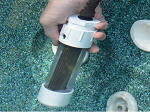
After the pool has been refilled, adjust the pH, total
alkalinity and calcium hardness level to within the optimum
range. In addition, I would add a quart of a quality mineral
treatment, such as phosphate-free
Liquid METALTRAP, as it help avoid metals stains and help keep the
electrode plates, on the
salt chlorinator, free of scale.
Salt chlorinators require about 20-25 pounds (may vary
depending upon the unit and the manufacturer) of salt per
1,000 gallons of water. Before adding the salt, check with
the contractor, as to how much time must be allowed for the
walls to cure. You don't want to risk the warranty. Good
luck with the pool work.
Sincerely. Alan Schuster, 9/13/2008
► Stains On A
Drained Gunite Pool?
Alan, we are clueless! We drained our
gunite pool planning to paint the walls due to a staining
problem. We were told that we were better off trying to
remove the stains, instead of painting. The walls and bottom
have a light green tint and there are many dark brown
circular spots. We have tried using muriatic acid and also
liquid chlorine with a deck brush. Nothing is working!
What's is our best course of action now? We've only lived in
the house a year and have never had any experience operating
a pool. HELP! Thanks for your time.
Leslie M., 5/12/2009
There are lots of painted pools, but I am no expert on this
topic. If you used liquid chlorine and the stains did not
come
off, it is safe to assume that they are not algae
stains. If you used full strength muriatic acid and the
stains did not come off, it is possible that acid washing
the pool will not provide satisfactory results. You might
try using some vitamin C tablets, on a small area. If
this works, you should be able to remove the stain, by
brushing the walls down with a solution of
MetalTrap Stain Remover.
If it looks acceptable, you might not have to paint. If nothing works, your choices might
come down to painting the pool or refinishing the pool.
Refinishing/resurfacing choices include: marcite, exposed
aggregate, pvc, epoxy, fiberglass and others.
Ultra Poly One
Coat is a hybrid-epoxy coating has should provide better
stain resistance, than masonry pool finished. Easier
chemistry too! Get some professional opinions before
deciding. Good luck. I hope that I have been of some
assistance.
Sincerely. Alan Schuster, 5/12/2009
► Clouding
Up?
I have a particle aggregate finish
that was refinished about 1 year ago in my 12,000 gallon
in-ground pool. When it was first refinished, the company
said to keep brushing the sides every day and keep the water
on the acidic side to remove the "cream" which comes out of
the new finish for about a month or two. It's been a year,
and the "cream" is still coming off. When I brush the pool,
I see a white cloud that disappears into the water. My
calcium is 500, which the pool store said is high, and may
be the cause of the white cloud, so they suggested removing
1/3 of my water and replacing it with my water-softener
water from the house. I don't know if the white stuff is due
to the high calcium, or a botched refinishing job. I also
don't know if it is better to use water-softened water or
non-soft to refill my pool. I also wanted to know if there
is an easier way to reduce the calcium other than removing
water and refilling it. Thank you.
Janet R., 4/5/2020
Unless you have been using calcium hypochlorite, the high
calcium hardness level is probably due to the maintaining of
the aci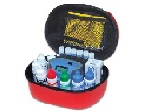 dic conditions for an extended period of time. A
level of 500 PPM can lead to sale formation and cloudy
water, especially if the TA and/or the pH are too high. It
is not possible for me to say that calcium is the cause with
certainty, as the possibility of dead algae still exists.
You can lower the calcium level by replacing about 1/3 of
the water with soft water or you could opt to add some
calcium sequestering chemicals to the pool. The latter
should work, so long as you keep the pH under 7.6 and the TA
under 80-120 PPM. You should have been long past this type
of problem. This does not mean the plaster job was
defective, although I can't rule it out. I would attempt to
create optimum pool chemistry and, if the problem persists,
your complaints will have more validity. Having the right
pool water tester can be a big help. Check out the
all-digital
ColorQ 2X Water Analyzers. Good luck. dic conditions for an extended period of time. A
level of 500 PPM can lead to sale formation and cloudy
water, especially if the TA and/or the pH are too high. It
is not possible for me to say that calcium is the cause with
certainty, as the possibility of dead algae still exists.
You can lower the calcium level by replacing about 1/3 of
the water with soft water or you could opt to add some
calcium sequestering chemicals to the pool. The latter
should work, so long as you keep the pH under 7.6 and the TA
under 80-120 PPM. You should have been long past this type
of problem. This does not mean the plaster job was
defective, although I can't rule it out. I would attempt to
create optimum pool chemistry and, if the problem persists,
your complaints will have more validity. Having the right
pool water tester can be a big help. Check out the
all-digital
ColorQ 2X Water Analyzers. Good luck.
Sincerely. Alan Schuster, 4/5/2020
► Preferences
With Salt Chlorinator?
We are in escrow and will be taking
care of our first pool. The pool needs a new finish. What is
a fair price on a gunite finish? And what finish, if there
is one, goes best with salt water sanitizer. Thanks, I'm
glad I found this site.
Marvin K., 2/27/2004
Gunite is actually the concrete material that underlies the
plaster finish. The popular masonry finishes include marcite
or exposed aggregate. The exposed aggregate finishes are
longer-lasting, more chemically resistant and, probably,
slightly more expensive. Cost varies with the geography and
the pool size. I am not up-to-date on pricing, so a real
estimate is not something that I can offer. However, you
should expect to spend a few thousand dollars, depending, of
course, on the pool size and other specifics.
Salt
chlorinating systems can be used with either type of finish.
I would check with the pool resurfacing company, as to how
the pool walls should be allowed to cure, before adding
water or chemicals. I hope that the information proves help
and good luck with the house and the pool.
Sincerely. Alan Schuster, 2/27/2004
► Check
Cracks In A Gunite Pool?
Can the absence of chemicals in a
gunite pool cause check cracks? Can a chemical imbalance
cause check cracks?
Richard M., Lake Havasu, AZ, 10/5/2006
Chemical imbalances can lead to surface etching or scale
deposits, but not necessarily check cracking. Absence of
adequate calcium hardness can lead to the dissolving of some
of the calcium-containing minerals present at the surface.
Draining of the water can lead to a drying out of the
surface and possible problems, if allow to remain in that
state over prolonged period. Inasmuch, as I'm not an expert
on this subject, you might seek a more definitive opinion.
Good luck.
Sincerely. Alan Schuster, 10/5/2006
► Paw Prints?
Alan, my dog got into my grey bottom
pool before I filled it with water. He left paw prints all
over the bottom of the pool. The pool has been filled for a
couple of days and I have tried scrubbing it with no
success. Any suggestions on this? Thank you for your time.
T., 3/11/2004
This is definitely a new one on me! You haven't given me
much in the way of details. I suggest that you contact the
contractor that built the pool and run this by him. There is
one possibility that comes to mind. You could siphon an acid
solution ( 50% muriatic acid and 50% water - add the acid to
the water and water rubber gloves and eye protection) using
a stain removal accessory (many pool stores carry such a
gadget). This will etch the area around the paw prints and,
perhaps, soften the look. BEFORE DOING THIS CHECK WITH THE
CONTRACTOR! DON'T DO ANYTHING THAT WILL JEOPARDIZE THE
WARRANTY! I hope that this will work for you. Good luck.
Sincerely. Alan Schuster, 3/11/2004
|
Visit The Website Stores . . . for
better informed shopping!!! |
|
|
Shipping is FREE* . . . within
the Continental U.S.
A $9.99
handling charge will apply
to Continental U.S. Orders,
under $75.00. Orders
outside of the Continental
U.S. may require some
additional charge, based on
quantity and destination.
Most products can be
shipped World-Wide. International
and orders outside of
Continental U.S. - see
comments on the ordering
pages. |
|
|
Major
Credit Cards and PayPal are accepted. |
|
▲
Return To Top Of Page
▲
Aqualab Systems, LLC does not
make any warranty or
representation, either expressed
or implied, regarding the
accuracy or completeness of the
information provided by this
website; nor does Aqualab
Systems., LLC. assume any
liability of any kind whatsoever
related to, or resulting from,
any use or reliance on this
information. The content of this
website should not be used, if
it is conflict with any
applicable federal, state or
local regulations or guidelines.
© Aqualab Systems, LLC. All
rights reserved
|
|