| |
|
Scroll
down to browse through some archived SWIMMING POOL
questions and answers. Please click the Pool
Problems Link, on top of every page, to access a
complete listing of Pool Problem subjects, an
alphabetized Website Table of Contents, Pool Equipment
Information, About Alan Biographic Material and a Pool
Glossary. Use the other links to access additional
subject information. More information about some new and
unique products, for pools and spas, can be found by
visiting
The Website
Store. You'll never know what you'll find and
that's always fun. Be better prepared and avoid
costly problems!
|
|
 |
Shipping is FREE* . . . within
the Continental U.S.
A $9.99
handling charge will apply
to Continental U.S. Orders,
under $75.00. Orders
outside of the Continental
U.S. may require some
additional charge, based on
quantity and destination.
Most products can be
shipped World-Wide. International
and orders outside of
Continental U.S. - see
comments on the ordering
pages. |
|
 |

Major
Credit Cards and PayPal are accepted. |
|
On-line
shopping since 2002 - Safe and Secure!!! |
|
Optimizing chemistry, improving
circulation and eliminating
phosphates!!! |
|
When the
water chemistry is out of balance, the
likelihood of algae growth increases and
the growth of sanitizer-resistant
strains, due to impaired sanitation, can
be the result. A
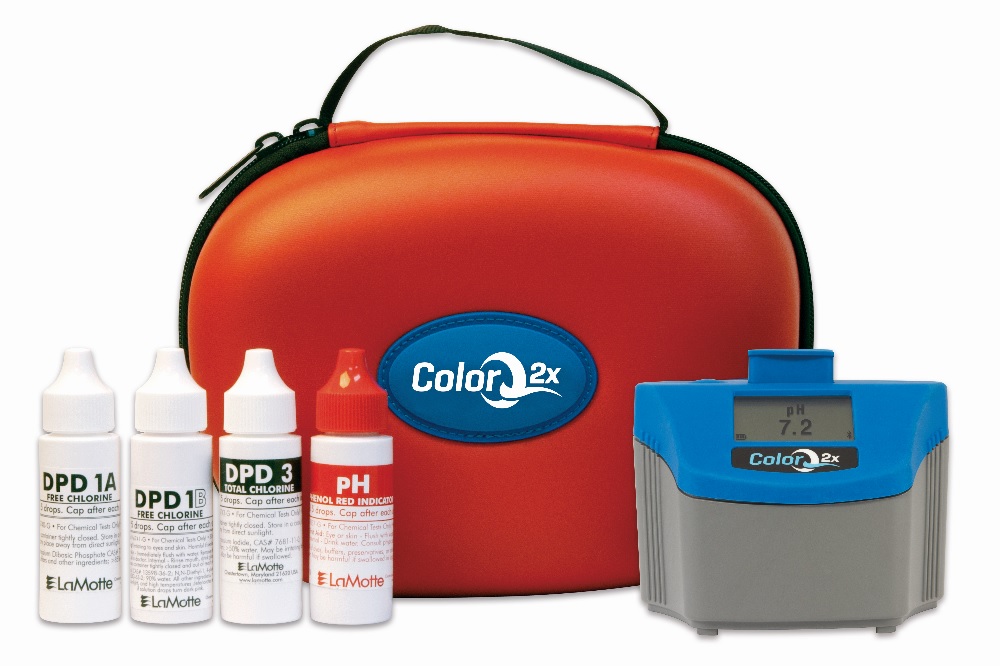
ColorQ, All-Digital Water Tester
can perform all of the common pool water
tests, eliminates the color-matching and
guesswork. There is a model, for
every pool testing need. Better
Circulation helps make everything work
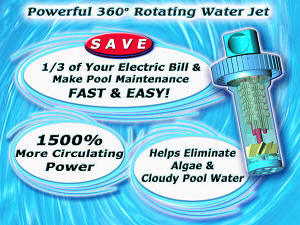
more effectively. The
Circulator is a return jet
replacement fitting, that improves
filtration and eliminates the dead zones
that promote algae growth. Phosphates and Nitrates
can increase the growth of algae and
make treatment more difficult, as both
are vital plant nutrients. Nitrate
removal is not practical, but phosphate
removal is easy enough to do.
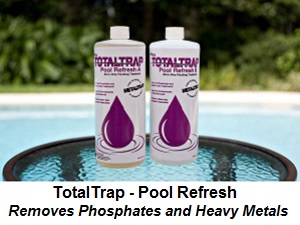
Adding Pool
Refresh Total Trap will allow
you to vacuum and filter out phosphates,
providing better algae control. |
|
|
If you have a pool or spa water
testing need, we should have the
product.
►
Scroll down to read through some
Question & Answer information.
◄
|
|
Alternative Pool Water Sanitizers |
|
When algae
is a frequent problem, it is the result
of inadequate sanitation. as well as
other factors. Maintaining proper
sanitation is a must. Adding some
backup sanitizing is important, as
chlorine level rise and fall, based on
pool usage and chemicals being added. Most pools
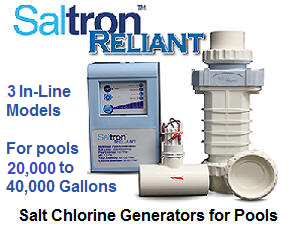
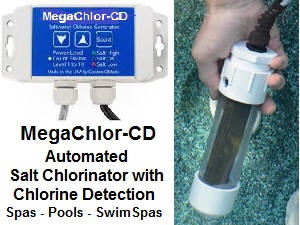
use some sort of chlorine. A
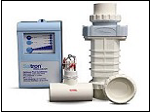
Salt
Chlorine Generator is definitely a
better way to do chlorine. Salt
chlorine generators are highly automated
and give you better control and more
consistent results, while eliminating
all chlorine handling, measuring and
storage. The salt level is about
that found in human tears. In-Line
and no-installation-required models are
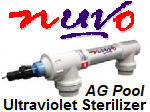
available. An
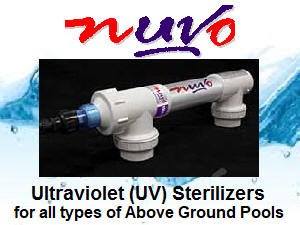
Ultraviolet Pool Sterilizer
kills 99.9% of the
microorganisms, passing through
the cell. It can kill
sanitizer-resistant pathogens
and is typically used with
chlorine or bromine. |
|
|
If you have a pool or spa water
testing need, we should have the
product.
►
Scroll down to read through some
Question & Answer information.
◄
|
|
How to treat
common swimming pool algae problems? |
It is not
always possible to identify a type of algae
without microscopic examination and this, of
course, requires a trained individual. Most
algae problems involve green water, cloudy or
hazy water, slimy walls and surfaces and a lack
of adequate pool water sanitizing. Most algae
problems respond quickly to proper treatment.
However, if current attempts to control an algae
problem are not meeting with success, the
problem should be considered to be that of a
resistant-algae condition and should be treated
in a manner similar to black algae. Water mold
and slimes can be treated in a manner similar to
that of "Pink" algae. Algae can be controlled
with various products including: swimming pool
sanitizers, algaecides, shock treatment and
phosphate eliminators. Adding some backup
sanitizing can work wonders. Consider
adding something such as a
Salt
Chlorine Generator or
Ultraviolet Sterilizer. Sometimes a combination of
products must be used together to achieve the desired
outcome.
The use of The
Circulator, as a replacement for standard
return jet fittings, can dramatically improve
circulation, better distributing sanitizer to
all areas of the pool. If problems arise, refer
to the Pool
Problems Page, as a source of
problem-solving information, broken down into
various categories. Scroll down the page
and click on the linked
keywords,
catch phrases
or images, in the archived answers below, to access additional information, on that topic or product.
Do you know what's in
your water? If you're having problems, with
sanitation or water clarity, testing allows you to better
understand the chemistry and determine the cause of the
problem. Once understood, you can select the best
treatment option. Understanding the nature of the
problem, should be step one. For information about
our full selection of testing options, visit our
Test Equipment Store.
 |
Join our E-Letter Mailing List.
You'll receive 1-3 E-Letters a
month, featuring helpful pool
and spa advice, new product
information and sale
announcements. All we
require is your e-mail address
and you can opt out anytime you
wish.
Your information
will never be shared or sold. |
|
▼
Helpful,
Problem-Solving Information, in a question and
answer format.
▼ |
► Algaecide: To Use
Or Not To Use?
I have never used an algaecide in my
new above ground pool and have had no problems to date. My
friends with pools, all seem to use phosphate eliminators, algaecides and chlorine.
Is it a good idea to use algaecide? Just wondering.
Jeff E., Lakeland, NJ, 8/1/2020
The best way to use an algaecide is to add it before you
have a problem! That way, it can help you avoid a problem.
Chlorine levels rise and fall during the course of the day,
depending upon chemical additions and bather usage. When
the sanitizer levels drops too low, algae can begin to
grow. If an algaecide is present, it just might keep the
algae under control, until an adequate sanitizer level
is restored. Both above ground and inground pools can
use algaecides. Your above ground pool does not have a
main drain and means the water circulation is not very
good across the bottom. Consider adding
The
Pool Circulator, which is a simple way to
improve pool water circulation and eliminate dead zones,
that promote algae growth. Adding a
phosphate
eliminator is an effective way to control algae, by denying
algae a vital nutrient. A simple
phosphate test
will determine, if there is a need
for this product addition. As
long as you're planning on using
chlorine, why not use it in a better
and more controllable way? A
salt chlorine generator is a
better way to do chlorine, providing
more control, fewer problems and
better results. If this
website was helpful, in answering your question, please
consider joining our E-Letter Mailing List. You'll receive E-Letters, with helpful information, new product
updates, suggestions and sale announcements. I hope that
this
recommendation works out for you.
levels rise and fall during the course of the day,
depending upon chemical additions and bather usage. When
the sanitizer levels drops too low, algae can begin to
grow. If an algaecide is present, it just might keep the
algae under control, until an adequate sanitizer level
is restored. Both above ground and inground pools can
use algaecides. Your above ground pool does not have a
main drain and means the water circulation is not very
good across the bottom. Consider adding
The
Pool Circulator, which is a simple way to
improve pool water circulation and eliminate dead zones,
that promote algae growth. Adding a
phosphate
eliminator is an effective way to control algae, by denying
algae a vital nutrient. A simple
phosphate test
will determine, if there is a need
for this product addition. As
long as you're planning on using
chlorine, why not use it in a better
and more controllable way? A
salt chlorine generator is a
better way to do chlorine, providing
more control, fewer problems and
better results. If this
website was helpful, in answering your question, please
consider joining our E-Letter Mailing List. You'll receive E-Letters, with helpful information, new product
updates, suggestions and sale announcements. I hope that
this
recommendation works out for you.
Sincerely. Alan Schuster, 8/1/2020
►
Algae or Mold?
Mold is growing in our salt water
pool. I have tested the water and my
free chlorine is 0.5 TCL is 0.7 PPM.
pH is 7.9. Alkalinity is 149
PPM. Cyanuric Acid is 10.
Calcium hardness is high.
Could you tell me what chemicals I
need to add? Thank you.
Stacie,
7/29/2018

Mold or algae, either way you need
to do the following. Raise the
free chlorine to 10 PPM and keep it
a 5-10 PPM, until the problem
is eliminated. Get the pH down to
7.2-7.6 and keep it there. Increase
the cyanuric acid to 30 PPM. Once
the problem is solved, keep the free
chlorine at 2-4 PPM and
the pH at
7.2-7.8. Improving circulation
can eliminate the dead zones that
promote algae and mold growth.
Replacing existing return jet
fittings with
The
Pool Circulator will make a
dramatic improvement.
Please visit our
website store to browse through
a large selection pool and spa water
testers, as well as many different,
useful and interesting pool and spa
products. Many are on sale now.
I hope that this information is
helpful.
Sincerely. Alan Schuster,
7/29/2018
► Slimy
Blobs?
Dear Alan. My question: One of my
accounts has a saltwater system, when I took the account the
owner only had a chemical checking company and no cleaning.
When I arrived to bid the account and look things over, I
found that he had this stuff growing on the first step and a
few other spots in the pool that looked like blob something
or other. Remember magic rocks how they grew from the bottom
of a container, well that's what this looked like but clear
and slimy. Could you tell me what it is ? And what causes it
and how to prevent it from happening again? I seem to have
it under control, still having problems with spots that are
not black algae. Kind of like stains seeping through the
plaster. Owner had a acid wash a few years ago and now
stains are appearing. Thank you so much for your advice,
your site is very interesting, I have been reading for the
last 2 hours.
Ronda V., 10/1/2017
The slimy blobs were probably algae, mold or some other
microorganism. This type of problem can develop, if the
chlorine level is not properly maintained and will first
occur in areas of poor circulation. Now that the situation
is under control, try and redirect the return flow to send
more water towards the effected areas.
Test the salt level
and make sure that it is adequate for your
salt chlorination system
and that it operates properly and for reasonable periods of
time. In addition to this problem, you may have another
concern. The dark spots could be a mineral stain and can be
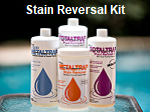
treated with a MetalTrap Stain
Reversal Kit, if due to metals. Refer to the archives
on pool staining for information on the sock trick. Another
possibility is the use and abuse of calcium chloride in the
plaster mixture. An excellent article appeared in the
January 15, 2003 issue of Service Industry News. If this is
the case, there may be no simple solution. I hope that this
information will prove helpful.
Sincerely. Alan Schuster, 10/1/2017
► All Algae
Are Not Created Equal?
A week or so ago, you helped me
identify a pool water problem that I had been fighting for
several months. You advised me that I should be killing
"mustard Algae" (not green algae that I thought was my
problem and so did several other local "experts"). Thanks to
you and your expertise, and following your instructions I
now have a clear, algae free pool. You were absolutely
correct, my problem was mustard algae and NOT green algae.
The shock treatment and the sodium bromide made a big
difference. You deserve more than just a thank you, but that
is about all I can pass along to you. Thank you!
Bill T., Sun City West, AZ, 9/22/2016
Thanks for the follow-up. Glad to hear that everything
cleared up. Yellow mustard algae can be a tough one,
especially, if you are not familiar with the problem. So
don't be too tough on the "locals." Enjoy the summer!
Sincerely, Alan Schuster, 9/23/2016
► Phosphate
Eliminators And Algaecides?
Every now and then I get a touch of a
greenish water and algae. Some algaecide and shock, is all
that it seems to take. Is there some advantage to using a
phosphate eliminator? How does it differ from algaecides?
F. T., Coral Springs, FL, 8/20/2013
Phosphate Eliminators are typically used in conjunction with
algaecide and standard swimming pool maintenance. When added
to a swimming pool, POOL REFRESH reacts with the phosphates
and drops their concentration from parts per million to
parts per billion. The presence of phosphates and nitrates
can accelerate algae growth and increase the chlorine demand. Some dealers can perform these tests and it can be
worthwhile. Phosphates are a vital nutrient for all types of
algae and their almost total removal from the water
interferes with the ability of algae to grow and thrive.
While you can't remove the nitrates in any practical way,
eliminating the phosphates can make nitrates less of a
problem, by denying algae a vital nutrient. Literally, the
algae starves to death! No algae - no problems with green
water. All this sounds great, but as long as you have people
in swimming pools, there will be phosphates added in some
quantity. For this reason the phosphate eliminator has to be
added on a periodic basis. A phosphate test can be performed
occasionally to determine the need to add additional
product. As additional assurance against algae growth, it is
a good idea to maintain the normal additions of algaecide.
The product is a worthwhile addition to the anti-algae
arsenal. The only downside is that its initial addition will
result in a precipitate that has to be removed by filtration
and/or vacuuming. Subsequent product additions are much less
of a problem because of the reduced phosphate content of the
water. BETTER CIRCULATION CAN SOLVE A HOST OF PROBLEMS.
With The Pool Circulator you can improve the circulation,
dramatically, simply by replacing the return jet fittings.
I hope that I have satisfactorily explained the product.
Enjoy the summer.
demand. Some dealers can perform these tests and it can be
worthwhile. Phosphates are a vital nutrient for all types of
algae and their almost total removal from the water
interferes with the ability of algae to grow and thrive.
While you can't remove the nitrates in any practical way,
eliminating the phosphates can make nitrates less of a
problem, by denying algae a vital nutrient. Literally, the
algae starves to death! No algae - no problems with green
water. All this sounds great, but as long as you have people
in swimming pools, there will be phosphates added in some
quantity. For this reason the phosphate eliminator has to be
added on a periodic basis. A phosphate test can be performed
occasionally to determine the need to add additional
product. As additional assurance against algae growth, it is
a good idea to maintain the normal additions of algaecide.
The product is a worthwhile addition to the anti-algae
arsenal. The only downside is that its initial addition will
result in a precipitate that has to be removed by filtration
and/or vacuuming. Subsequent product additions are much less
of a problem because of the reduced phosphate content of the
water. BETTER CIRCULATION CAN SOLVE A HOST OF PROBLEMS.
With The Pool Circulator you can improve the circulation,
dramatically, simply by replacing the return jet fittings.
I hope that I have satisfactorily explained the product.
Enjoy the summer.
Sincerely. Alan Schuster, 8/20/2013
► Biofilm?
Hi Alan, your website is very good and
I have purchased one of your books. I have a problem,
though, that I haven't encountered in any of the topics on
your site. I have a rectangular pool; 18' x 36' x 10'deep.
About 34,000 gals. A week or so ago, I noticed a small
mustard algae problem--only several patches. When I opened
the pool this year (I live 40mi. north of the New Orleans
area, and in the winter, all I do is cover it, run the pump
5hr./day, and check for balance every couple of weeks), I
didn't add any algaecide. Being the over-achiever that I am,
I figure I'm going to hit this problem hard and go out and
buy a 50% Algaecide . It's the quat-type algaecide. After
adding the recommended dose for visible algae: 14oz. per
10,000gal, I am horrified! My water turned milky ,foams when
agitated, and has a terrible odor--kind of like mildewed
plastic. I should've just shocked a couple of times, I
guess. Here's the scary part; on the walls of the skimmers,
I discovered a slimy film (and a lot of it) with the
consistency of wet modeling clay, evidently the result
of the foaming action taking place inside the skimmer. AND
IT'S NOT WATER SOLUBLE. What the heck is this stuff doing' to
my sand filter? I shocked the pool right before adding this
stuff, and shocked again a couple of days after. My pool
water was like a diamond before I put this stuff in. I'm
ready to go to the chemical people and strangle the first
person I see. Please tell me that the water is going to
clear, the smell is going to go away, and that the sand in
my filter doesn't look like bearing grease. Thanks for any
answer that you can provide.
Jimmy L., Covington, LA, 5/19/2020
You have several thing which have come together.
During the winter, a biofilm developed. This is the slimy
stuff on the underwater surfaces. It is comprised of
microorganisms that grew in the absence
of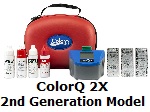 adequate chlorine
levels. Quats (I
hate them) may not kill the biofilm
and certainly won't decompose it. At
best, it attaches to the biofilm and
impedes its growth. It also causes
unsightly foam. The water was clear
before the quat algaecide was added
because the biofilm was on the walls
and not in the water. Adding the
algaecide caused the foaming and
may have caused some of the biofilm
to enter the water. All you should
need to do is add shock and boost
the FREE CHLORINE level to 5-10 PPM.
Retest often and add more chlorine,
as needed. Don't drag it out! Once
you have established a persistent
FREE CHLORINE level, the biofilm
should have been destroyed on all of
the under water surfaces, including
the filter. Keep an eye on the
filter pressure and service
accordingly. Reliable testing is
important, so I suggest using a
ColorQ
2X all-digital tester, which
eliminate all color-matching and
guesswork. During this period keep the
filter going 24/7. Once solved, resume normal pool
operation. I hope that this information proves helpful. adequate chlorine
levels. Quats (I
hate them) may not kill the biofilm
and certainly won't decompose it. At
best, it attaches to the biofilm and
impedes its growth. It also causes
unsightly foam. The water was clear
before the quat algaecide was added
because the biofilm was on the walls
and not in the water. Adding the
algaecide caused the foaming and
may have caused some of the biofilm
to enter the water. All you should
need to do is add shock and boost
the FREE CHLORINE level to 5-10 PPM.
Retest often and add more chlorine,
as needed. Don't drag it out! Once
you have established a persistent
FREE CHLORINE level, the biofilm
should have been destroyed on all of
the under water surfaces, including
the filter. Keep an eye on the
filter pressure and service
accordingly. Reliable testing is
important, so I suggest using a
ColorQ
2X all-digital tester, which
eliminate all color-matching and
guesswork. During this period keep the
filter going 24/7. Once solved, resume normal pool
operation. I hope that this information proves helpful.
Sincerely. Alan Schuster, 5/19/2020
|
How to
get better control of pool algae problems. |
|
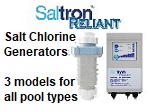
Use a Salt Chlorine Generator for more consistent
control of the chlorine level. |
|
An ultraviolet
sterilizer helps destroy microorganisms, that could
be resistant to normal levels of chlorine. |
|
Control the phosphate level, to retard the growth of
algae. |
|
The Pool Circulator improves circulation and eliminates dead zones . . . that promote algae
growth!!! |
|
Proper water chemistry helps promote sanitizer
effectiveness. |
|
 |
 |
|
|
|
|
Salt Chlorine Generators, for all types of pools, up to 20000,
25,000 or 40,000 gallons. |
Use with chlorine to helps destroy
problems, that might be resistant to normal levels of chlorine. |
Phosphate removal deprives algae, of a vital plant nutrient,
slowing its growth and avoiding blooms. |
The
Pool Circulator eliminates dead zones, improving sanitizer action.
Easy to install. |
ColorQ Digital Water Analyzers eliminate all the color-matching
and guesswork. |
|
Click on any image
for complete product and ordering information. |
► Resistant
Algae?
I have a 16,000 above ground pool and
I am getting what appears to be black or dark brownish gold
mustard algae in the ends of my pool, more prevalent in the
shallow ends of the pool. The deeper section is in the
middle and seems less likely to be affected. I have a DE
filter (running about 8 hours and the cleaner runs 3 hours)
and the problem seems to have begun when the water
temperature reached 69 degrees. I have shocked the hell out
of the pool and when I sprinkle the granular shock on the
deposits it clears up for a day and then begins reappearing.
I tried treating with black out, and then with some yellow
algae treatment. The yellow required I raise the pH to 8.0
and treat and shock and treat and shock 12 hours later and
then shock only again 12 more hours later. That is where I
am now, but I don't want to shock again as the pool smells
like a bottle of laundry bleach now. There is 4-5 ppm of
chlorine, same level of free chlorine. I am thinking after
reading your FAQ's that if I have algae growing in my pool
of chlorine. Maybe it is metal deposits precipitating out of
the water. The black stuff also is not affected at all by
brushing until I shock the hell out of the pool and then
most of it disappears for a day or so, but no longer. Any
little bit left easily brushes away, but most disperses on
its own. I am taking a sample in tomorrow to get the metal
contents tested and see if this confirms what I think I read
in your FAQ's. In the meantime, if you have any other ideas
I am interested in hearing from some knowledgeable parties.
I am getting sick and tired of buying anywhere from $40-$100
worth of chemicals that only fixes the problem in most cases
for 12 hours. The 16 year old pool experts and the little
bit older store managers don't seem to be cutting it for me
so far. Anxious in Austin TX>
John B. Austin, TX, 4/10/2010
If it turns out that you have a heavy metal problem, it
would be in addition to an algae problem. What you are
describing does not seem like the classical case of mustard
algae. The algae treatments that you have added, probably
contain an ammonium salt. This would account for the odorous
conditions that you have described. The ammonium salt reacts
with the chlorine to form chloramines, an odorous form of
combined chlorine. It has been demonstrated the high levels
of chloramines can be effective against certain types of
algae. After the algae has been destroyed, it is mandatory
to shock the pool with large amounts of chlorine in order to
destroy the chloramines. In your case, in would appear that
algae is somewhat resistant and is not responding to this
chloramine treatment. I suggest that you treat this problem
on the basis of being a resistant algae. Lower the pH to
7.0.-7.2. This will help make the chlorine more effective.
Add chlorine shock, at the rate of 2 pounds per 5,000
gallons, until a Free Chlorine level of 5-10 PPM is achieved
and persists for an overnight period. It may be necessary to
add more shock or make further pH adjustments, because of
the prior addition of the other products. The longer this
takes, the more chlorine will be required. Operate the filter continuously. Redirect the return
flow to send more water to the affected areas. The simple
installation of The Pool Circulator:
a circulation booster that can help
make algae growth less likely, by
improving the chemical distribution
and eliminating dead spots. The
addition of a polymer algaecide will
further assist in controlling the
algae. Brush the effected areas to
help the chemicals reach the algae
growths.
After the problem has been eliminated, resume normal
filtration and chlorination and restore proper pool water
chemistry. The practice of sprinkling granular chlorine,
directly on the effected areas, is not recommended and could
result in damage to the vinyl liner. I hope that this
information will prove helpful. Good luck. the chlorine to form chloramines, an odorous form of
combined chlorine. It has been demonstrated the high levels
of chloramines can be effective against certain types of
algae. After the algae has been destroyed, it is mandatory
to shock the pool with large amounts of chlorine in order to
destroy the chloramines. In your case, in would appear that
algae is somewhat resistant and is not responding to this
chloramine treatment. I suggest that you treat this problem
on the basis of being a resistant algae. Lower the pH to
7.0.-7.2. This will help make the chlorine more effective.
Add chlorine shock, at the rate of 2 pounds per 5,000
gallons, until a Free Chlorine level of 5-10 PPM is achieved
and persists for an overnight period. It may be necessary to
add more shock or make further pH adjustments, because of
the prior addition of the other products. The longer this
takes, the more chlorine will be required. Operate the filter continuously. Redirect the return
flow to send more water to the affected areas. The simple
installation of The Pool Circulator:
a circulation booster that can help
make algae growth less likely, by
improving the chemical distribution
and eliminating dead spots. The
addition of a polymer algaecide will
further assist in controlling the
algae. Brush the effected areas to
help the chemicals reach the algae
growths.
After the problem has been eliminated, resume normal
filtration and chlorination and restore proper pool water
chemistry. The practice of sprinkling granular chlorine,
directly on the effected areas, is not recommended and could
result in damage to the vinyl liner. I hope that this
information will prove helpful. Good luck.
Sincerely. Alan Schuster, 4/10/2010
► Underwater
Slime?
I had a new liner, cartridge filter,
and an ionizer installed this spring in my in ground pool.
The pool is about 22,000 gal. I have a problem with slime on
the bottom and sides of the pool. It appears clear, but it
makes the pool very slippery and unpleasant. I have tried
increasing the level of the ionizer and I have tried
decreasing it. It currently reads between 0.2 and 0.3 on the
copper ion tester. I have tried to use non chlorine shock
and it helps some, but the slime is back in 2-3 days. The
pool installer and pool stores around here are no help.
Yesterday, I did the shock again and then put in an algae
preventer liquid. Today, it still has a little of that slime
feel to it. What is wrong? How do I get rid of it? The
summer is "slipping" away and my pool is getting unusable.
Thank you for your help.
Nameless, 8/4/2005
The slime is a most likely a bacterial film. Copper is
recognized as an algaecide and not as a bactericide. I would
add chlorine and boost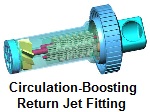 the Free Chlorine to 5-10 PPM. It
will kill and decompose the slime. Dealers that sell
ionizers may be reluctant to suggest chlorine, as that was
part of the reason to buy the ionizer. There is no reason
that you can't use chlorine to maintain a 1-2 PPM level:
both to oxidize wastes and to act as a sanitizer backup. The
presence of the ionizer will allow you to do this with less
chlorine product. The recurring nature, of the problem,
could be indicative of dead zones and poor circulation.
The
Pool Circulator is a circulation booster insert, that
dramatically eliminates dead zones and makes the water come
alive. You'll get better distribution of sanitizers and that
should help minimize algae and other related problems. This
information should help get you back in the swim. the Free Chlorine to 5-10 PPM. It
will kill and decompose the slime. Dealers that sell
ionizers may be reluctant to suggest chlorine, as that was
part of the reason to buy the ionizer. There is no reason
that you can't use chlorine to maintain a 1-2 PPM level:
both to oxidize wastes and to act as a sanitizer backup. The
presence of the ionizer will allow you to do this with less
chlorine product. The recurring nature, of the problem,
could be indicative of dead zones and poor circulation.
The
Pool Circulator is a circulation booster insert, that
dramatically eliminates dead zones and makes the water come
alive. You'll get better distribution of sanitizers and that
should help minimize algae and other related problems. This
information should help get you back in the swim.
Sincerely. Alan Schuster, 8/4/2005
► Algae
Hideout?
Hi Alan, when I had a swimming pool it
used to suffer badly from Algae build up. It did not matter
what I did I could not get rid of it until one day the pool
light blew. On removal I found a pocket of algae that was
the breeding ground. Being behind the light it was never in
the moving water and therefore did not get treated. I hope
that this knowledge might help some of the visitors to your
site who are experiencing algae problems. Regards.
Steve, 3/17/2012
There's no doubt that the colony, in the light housing, was
not helping the situation, but it is not that simple. All
pools are constantly exposed to algae at all times. Only
when the conditions are right, will algae bloom. Having
that colony just made things happen quicker, when the
sanitizer level dropped too low. Algae will grow in all the
nooks and crannies, if the conditions allow. Better
circulation eliminates the dead
zones, that promote algae growth.
Replacing standard return-jet
fittings, with
The
Circulator, can dramatically
improve circulation and sanitizer
distribution, by as much as 1500%.
Better circulation makes everything
better. Thanks for
sharing the information.
Sincerely, Alan Schuster, 3/18/2012
► Draining As
An Algae Cure?
If my pool needs to be drained because
of algae. Is it harmful to drain my vinyl lined pool? What
should I do?
Edward R., 4/7/2009
It would have been helpful to know if your pool was inground
or above ground. If it is an inground, draining exposes the
pool to the ris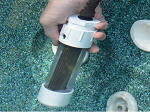 k of structural damage or collapse. In either
case, draining a vinyl lined pool runs the risk of liner
shrinkage and should be avoided, unless there is no other
option. Algae can treated without draining! Pools neglected
for years can clean up, with enough chlorine and some work.
Draining a pool with algae will not solve the problem.
Proper chemical treatment is needed. I suggest that you
remove debris and get the filter running. Add chlorine, at
the rate of 1 pound per 5,000 gallons, every few hours until
the water improves or there is a stable level of free
chlorine, of at least 1-3 PPM. Don't drag this out! Keep testing and
keep adding more chlorine, as needed. The longer it takes,
the more chlorine will be required. Adjust the pH to
7.2-7.6. Make sure that the filter is operating properly. As
the water starts to improve, add a dose of a quality blue
clarifier, to help remove fine particles and dead algae. You
might rethink how the pool is being sanitized. A
salt chlorine generator
would provide better algae control,
with less effort and an improvement
in the water quality, as well. I
hope that this information will prove helpful. k of structural damage or collapse. In either
case, draining a vinyl lined pool runs the risk of liner
shrinkage and should be avoided, unless there is no other
option. Algae can treated without draining! Pools neglected
for years can clean up, with enough chlorine and some work.
Draining a pool with algae will not solve the problem.
Proper chemical treatment is needed. I suggest that you
remove debris and get the filter running. Add chlorine, at
the rate of 1 pound per 5,000 gallons, every few hours until
the water improves or there is a stable level of free
chlorine, of at least 1-3 PPM. Don't drag this out! Keep testing and
keep adding more chlorine, as needed. The longer it takes,
the more chlorine will be required. Adjust the pH to
7.2-7.6. Make sure that the filter is operating properly. As
the water starts to improve, add a dose of a quality blue
clarifier, to help remove fine particles and dead algae. You
might rethink how the pool is being sanitized. A
salt chlorine generator
would provide better algae control,
with less effort and an improvement
in the water quality, as well. I
hope that this information will prove helpful.
Sincerely. Alan Schuster, 4/7/2009
► Recurring
Brown Spots?
Hello Alan, here's my problem. I keep
getting dark brown spots at the bottom of my 21' above
ground pool in the nooks and crannies. I've tried shocking,
algaecide, vacuuming on waste, but to no avail. I've had the
water tested for metal and iron and copper and nothing was
found. It keeps coming back no matter how many times I
vacuum. Some say it's very fine particles coming from
branches of tree above that are so fine they can't be
vacuumed. Don't know what or who to believe anymore. Any
suggestions on what to try to rid these STUBBORN brown
spots? At the end of my rope the past couple years with this
problem that no one can seem to fix. Thanks, Al.
Steve, 5/13/2008
The fact that is appears in the nooks and crannies would
lead to be believe that it is algae. Adding the fact, that
no heavy metals were found, algae is looking like the
culprit. The problem is that algae grows best in areas of
poor circulation and poor chemicalization. Adding
The Circulator is the
easiest way to improve circulation and chemical
distribution. Your letter
implies that "it keeps coming back." Have you ever gotten
rid of it? Shocking the pool is a good place to start.
Redirect the returns to send more water into the affected
areas. The presence of phosphates and nitrates can
accelerate algae growth and increase the chlorine demand.
Some dealers can perform these tests and it can be
worthwhile. You might want to consider using a phosphate
eliminator, such as POOL REFRESH. This type of product can
help avoid conditions that allow for algae growth. I would
discount the particles from the tree theory. Here's another
suggestion. Put 1/2 pound of pH decreaser powder in a white
sock , shut off the filter and drop on a spot. leave in
place for 15 minutes and move around with a vacuum pole. If
this works, the problem is metals despite the test results
and should be treated accordingly. I hope these suggestions
are of help. Browse through related areas of the archives.
Good luck.
Sincerely. Alan Schuster, 5/13/2008
► Probably
Not Algae?
We just got a new above ground pool(24
foot, 52 depth) and the day we got it installed we had half
of the pool filled with city chlorinated water and filled
the rest with the hose. The next morning we went and checked
on it and it was full of algae. We put 2 gallons of liquid
shock and one bottle of algaecide and have had the chlorine
tablets in since the tanker left. We are still having
problems getting it clean could you give us any advice to
what we should do or use. We have also vacuumed it too.
Thanx.
Kathy, 6/8/2009
It sounds like you used a "hose" with well water to fill the
balance of the pool. It is not likely that your problem is
algae: it just doesn't grow that fast! Your problem is
probably minerals present in the water from the "hose." You
need to have the pool water and the 'hose' water tested for
iron and other minerals. ASAP, I would add a double dose of
a quality mineral treatment, such as Liquid METALTRAP, which
is a true, phosphate-free chelating agent. Using a
METALTRAP
Filter, attached to a garden hose, can remove metals
from all the new water being added to the pool. Please refer
to the archives on pool staining problems for
more on this possibility. Good luck and I hope that I have
been helpful.
Sincerely. Alan Schuster, 6/9/2009
►
A Fungus Could Be Growing On the
Reverse Side Of The Liner?
One of the local pool dealers told me
that the problem I am having is not algae or a stain inside
of the pool, but is a fungus or something growing on the
outside of the pool liner. It looks like a gray shadow or
stain and scrubbing doesn't do a thing. Is this possible?
What can I do? Have you heard about this before?
M.H., Bricktown, NJ, 5/23/2006
Yes and No! It is not very common, but I have heard about it
before. Actually, a dealer once took me to inspect a pool:
it had a liner held in place with a bead and after pulling
it away, there were the black spores - right where the
discoloration was on the water side. The cause is the growth
of a microorganism, on the reverse side, that has invaded
the liner. Perhaps, by feeding on the plasticizers. Adding
chemicals to the water will not bring them in contact, with
something outside of the water (the other side of the
liner). If the liner gets bad enough and needs to be
replaced consider this point. Replacement may only bring a
return of the problem, unless the liner has been treated
with anti-microbial agents. In any event, I suggest that the
pool site be treated with weed killers and herbicides, to
add a degree of protection. Another suggestion would be to
place the new liner right over the old one. I would run all
these suggestions past someone experienced with liners and
this problem. I hope that I have help of some assistance.
Good luck.
Sincerely. Alan Schuster, 5/24/2006
|
Visit The Website Stores . . . for
better informed shopping!!! |
|
|
Shipping is FREE* . . . within
the Continental U.S.
A $9.99
handling charge will apply
to Continental U.S. Orders,
under $75.00. Orders
outside of the Continental
U.S. may require some
additional charge, based on
quantity and destination.
Most products can be
shipped World-Wide. International
and orders outside of
Continental U.S. - see
comments on the ordering
pages. |
|
|
Major
Credit Cards and PayPal are accepted. |
|
▲
Return To Top Of Page
▲
Aqualab Systems, LLC does not
make any warranty or
representation, either expressed
or implied, regarding the
accuracy or completeness of the
information provided by this
website; nor does Aqualab
Systems., LLC. assume any
liability of any kind whatsoever
related to, or resulting from,
any use or reliance on this
information. The content of this
website should not be used, if
it is conflict with any
applicable federal, state or
local regulations or guidelines.
© Aqualab Systems, LLC. All
rights reserved
|
|