|
Some
Of The Products Featured In The Website Stores
The images
below will change randomly, if this page is
refreshed or revisited. |
|
|
|
|
|
|
|
 |
Click Any Image . . . for
more product information!!! |
 |
|
 |
* FREE Shipping . . .
within the Continental U.S.
* A $9.99 handling
charge will apply to Continental U.S. orders, under
$75.00. U.S. Orders outside of the Continental (48
states) U.S. may require some additional charge,
based on quantity and destination.
** Most products can be shipped World-Wide.
International and
orders outside of Continental U.S. - see comments on
the ordering pages. |
|
|
On-line
selling since 2002 - Safe and Secure!!! |
|
|
 |
Join our E-Letter Mailing List.
You'll receive 1-3 E-Letters a
month, featuring helpful pool
and spa advice, new product
information and sale
announcements. All we
require is your e-mail address
and you can opt out anytime you
wish.
Your information
will never be shared or sold. |
The Pool and Spa Glossary contains much of the
jargon and terms used in the swimming pool and
spa/hot tub industry. The explanations should
allow you to better understand pool, spa and hot
tub care instructions, trouble-shooting guides
and the workings of your pool, spa or hot tub.
Helps you deal with water quality, water
chemistry, sanitizing and related maintenance
problems. All of the listings, in
underlined type,
are linked to a Pool or Spa Problems Page, a
Website Store, with additional information, or a
Manufacturer's Preview Page, which provides
access to additional details and a link their
corporate website.

askalanaquestion.com
. . . the free pool and spa
resource!!!
Acid: a chemical that
is used to lower the pH and/or total alkalinity. Most
commonly used are liquid muriatic acid (hydrochloric acid)
or granular pH decreaser (sodium bisulfate).
Acid Demand: the amount of acid required to lower the
pH into the 7.2-7.6 range. Usually performed as a dealer
test. if there are problems with high pH water conditions.
Acid Washing: masonry pools are periodically acid
washed, in order to remove stains, discoloration and improve
their appearance. Muriatic acid is commonly used for this
purpose. Typically, this messy task is left for a
professional. Additives that can help with the task are
available.
Aggregates: particles such as marble dust, crushed
quartz, pebbles, stones or ceramics that are used as
constituents in various pool plastering materials. The look
of the finished pool surface reflects the type of aggregate
used, as well as the application techniques.
Alarms: several types of alarm devices are used to
promote pool safety and or/backyard safety.
Pool Alarm
Systems can be used to detect intrusion into the pool and/or
immediate environs and sound a siren or signal a remote
sensor.
Algae: a single-celled plant, that can be present in
a variety of colors. Of the thousands of varieties, the most
common in pools are: blue-green, yellow mustard or black.
"Pink" algae is actually a bacteria and is usually present
as a slime. Algae can form in spots or over broad areas. Low
sanitizer levels are conducive towards algae growth.
Algaecide: a chemical that kills algae. Commonly
available in a variety of chemical types: quaternary
ammonium compounds, copper, silver or polymer (poly quat).
Chlorine and bromine, also, function as algaecides. The
different types show varying effectiveness against different
strains of algae.
Algaestat: a chemical that inhibits or retards algae
growth, but does not necessarily kill the algae.
Algal: adjective form of the word algae. Algal
growth: growth of algae.
Alkaline: the opposite of acidic. Alkaline materials
have pH levels above 7.0 (neutral). Synonymous with the word
basic.
Alkalinity, Total (TA): refer to the listing for
Total Alkalinity (TA).
Alternative Sanitizers: a group of products that
sanitize pool, spa and hot tub water, by means other than
the application of chemicals to the water. Includes such
products as: salt chlorine generators
for pools,
salt chlorine
generators for spas and swim-spas,
ultraviolet sterilizer system, for residential pools, ionizers and
ozone generators (ozonators).
Alum: a chemical (aluminum sulfate) used to clarify
water, by creating a gelatinous precipitate, that has to be
vacuumed to waste. Technique is called flocculation.
Ammonium Sulfate: the active ingredient in some types
of yellow treatments. Requires an initial shock treatment
which converts to a high level of chloramines. Under proper
conditions, very high chloramine levels can aid in control
of mustard algae. Once under control, additional shock
treatment is necessary, in order to destroy the chloramines
and establish a suitable level of free chlorine.
Anion: a negatively charged ion. A negatively charged
ion is anionic. A positively charge ion is cationic.
Anti-Entrapment Safety Drain Covers: a drain cover
designed to prevent the snaring of swimmer's long hair or
holding a swimmer underwater, due to the strong suction
creating at the drain. Products, such as this, are used to
comply with the provisions of the Virginia Graeme Bake Act
and various state laws. Laws can change and
requirement an vary, from locale to locale. Always
determine which standards apply to a particular pool, in a
specific geographic location.
Ascorbic Acid: vitamin "C." Can be used as an acidic
reducing agent in the removal of difficult metallic stains
from underwater surfaces. Oxalic acid can be used in a
similar manner.
Automation, Pool: the use of a device to
automatically control such as aspects of pool operation as:
filtering, chemical additions, sanitizer additions, heating,
cleaning, covering, pool water
level, underwater pool
lighting, area lighting, monitoring,
pool alarms, gate
alarms and pool security.
Backwash: the reversing of the flow of water through
the filter and sending it to waste. This procedure will
thoroughly flush the filter, media and components. Follow
the manufacturer's instructions! Not all filters are
routinely backwashed. Sand filters should not be backwashed
excessively: pay attention to the pressure gauge and vacuum
whenever conditions indicate the need.
Bacteria: single-celled, microorganisms. Can vary
from harmless to pathogenic and include such types as E.
Coli and pseudomonas aeruginosa. Bacterial growth is the
direct result of inadequate sanitation and is affected by
such factors as bather load, pool or spa cleanliness, water
temperature, water chemistry and filtration.
Bacterial: adjective form of the word bacteria.
Bacterial growth: growth of bacteria.
Bactericide: a chemical that kills bacteria. The most common
bactericides are: chlorine, bromine, biguanide, ozone and
silver. Most algaecides, other than copper, exhibit some
bactericidal properties.
Bacterium: singular form of the word bacteria.
Balanced Water: pool or spa water that is within the
accepted water analysis parameters for: pH, sanitizer, total
alkalinity, calcium hardness, chlorine stabilizer (chlorine
pools only) and minerals. The balancing, of the pool or spa
water, helps to eliminate water chemistry problems.
Base Demand: the amount of pH increaser needed to
raise the pH into the 7.2-7.6 range. Usually performed as a
dealer test, if there is a problem with low pH water
conditions.
Basic: the opposite of acidic. Basic materials have
pH levels above 7.0 (neutral). Synonymous with the word
alkaline.
Biguanide: the generic name for a non-chlorine,
non-bromine, sanitizer that utilizes the polymer PHMB
(polyhexamethylene biguanide). It is used to totally
eliminate the use of chlorine or bromine. A popular
non-halogen, alternative pool, spa or hot tub chemical
sanitizer. Chlorine, bromine or non-chlorine shock will
destroy the biguanide polymer. Biguanide is sold under such
trade names as, Baquacil, Baqua-Spa, Soft-Swim and Revacil.
Click here for some ordering information about
Biguanide
Test Kits.
Biofilm: a slippery coating of microorganisms that
can develop in poorly sanitized pools and spas.
Biodegrade: the natural process by which organic substances
break down or decompose into harmless basic materials:
water, carbon dioxide, nitrogen, etc.
Borates: refer to the listing for sodium tetraborate.
Breakpoint Chlorination: the amount of chlorine
required to completely oxidize all of the organic materials
and decompose all of the combined chlorine present in the
pool or spa water. An amount of chlorine, 5-10 times the
combined chlorine level, is typically required.
Broadcast: the application of dry, granular chemicals
to a swimming pool, by means of throwing or dispersing
across the surface. This allows for a "more gentle" addition
of the chemicals to the water and avoids concentration or
clumping.
Brominator: feeding devices used to introduce bromine
into pools or spas. Most automatic types can be plumbed
inline. Others are simple floating varieties. All are
intended to make the application of bromine easier and more
consistent. Do not use chlorine in place of bromine, in any
brominator.
Bromine: closely related to chlorine in chemistry. It
has become popular, especially in spas, because it has much
less odor than does chlorine. Available in solid forms for
use in specialized bromine feeders or dispensers. Also,
available as a 2-part product for use in spas and hot tubs.
Buffer: chemicals that help to stabilize the pH. In
pools and spas, sodium bicarbonate (baking soda) is
typically used to create a buffer that helps keep the pH in
the optimum range.
Bump: a method by which the filter media, in certain
types of diatomaceous earth (DE) filters, is repositioned or
"bumped," in order to restore optimum filtering conditions.
Calcium Carbonate: crystalline deposits (scale) that
can form on all under water surfaces, if the water is
excessively high in calcium hardness. High pH and high total
alkalinity can worsen the problem. Responsible for cloudy
water conditions that may result due to pool or spa water
being out of balance.
Calcium Chloride: a calcium compound that is used to
raise the calcium hardness of the water. Typically,
available in a granular form for use in pools and a liquid
form for use in spas and hot tubs. Used to raise the calcium
hardness level, of soft pool or spa water, into the 150-250
PPM range.
Calcium Hardness: a measurement of the dissolved
calcium content of the water. Can be tested by various
methods and is reported as PPM of calcium carbonate. Proper
pool or spa water balance usually requires that the calcium
hardness of soft water be raised to 150-200 PPM. Higher
levels can lead to scaling or cloudy water problems and may
require chemical treatment.
Calcium Hypochlorite: most commonly used as a daily
pool water sanitizer or shock treatment. Typically contains
65-70% available chlorine and is available as a granular
material. Not completely soluble, high in pH and increases
the calcium hardness with every application. Use in hard
water conditions may cause cloudy, hazy water or scaling
problems to develop.
Carbon Dioxide: a naturally occurring gas. Can be
used, in an automated system, to help lower and control the
pH, without the use or corrosive acids.
Cartridge Filter: a type of filter that utilizes a
porous, pleated component or bag to remove particles.
Cation: a positively charged ion. A positively charge
ion is cationic. A negatively charged ion is anionic.
CH: an abbreviation for Calcium Hardness. Refer to
that listing.
Check Cracks: fine hairline cracks that can develop
in plaster finished pools.
Chelating Agents: a class of chemical compounds that
reacts with minerals (heavy metals) such as iron, copper,
manganese and calcium and forms stable, soluble products.
This action helps prevent staining and discoloration and is
the preferred method for treating iron, copper and
manganese. When treating iron, manganese or copper, chelates
should be added at a level at least equal to, if not greater
than, the mineral being treated. Chelation is a one molecule
vs. one molecule process. Adding more chelating agent is
usually better than adding less.
MetalTrap Products include a
true. phosphate-free chelating agent, that works over the
widest pH range.
Chloramines: irritating, odorous forms of combined
chlorine, formed by the reaction of chlorine with nitrogen
containing waste products. Ineffective as a pool or spa
sanitizer. High levels of chloramines can cause the problems
of "Red Eyes" or "Stinging Eyes." Usually requires a shock
treatment to lower or destroy the combined chlorine level.
Chlorinators: feeding devices used to introduce
chlorine into pools and spas. Most automatic types can be
plumbed inline. Others are simple floating varieties. All
are intended to make the application of chlorine easier and
more consistent. DO NOT USE BROMINE IN A CHLORINATOR - USE
ONLY IN AN APPROVED BROMINE FEEDER. Only solid trichlor
products (tablets, sticks or other shapes) should be used in
a chlorinator.
Chlorinators, Salt: another term for
Salt Chlorine
Generators for Pools or
Salt Chlorine
Generators for Spas.
Chlorine, Available: a somewhat archaic term for
describing the chlorine level. Sometimes used as "Free
Available Chlorine" or "Total Available Chlorine."
Chlorine, Combined: that form of chlorine that has
reacted with nitrogen containing waste products. Chloramines
are the major constituent. The combined chlorine should be
no more than 1 PPM, ideally 0.3 PPM or less, as high levels
can cause odor and irritation problems.
Chlorine Demand: a measurement of the amount of Free
Chlorine that must be added to water, showing a zero Free
Chlorine level, in order to produce at least a minimally
positive Free Chlorine level. The test can be performed by
some dealers.
Chlorine, Free: the active, germicidal form, known
chemically as hypochlorous acid. This is the preferred form
of chlorine sanitizer used in pools and spas. Tested by DPD,
Test Strips and Syringaldazine and reported as PPM. A level
of 1-3 PPM is considered ideal. Higher levels can cause
vinyl liner fading problems and bather irritation.
Chlorine Lock: a somewhat archaic term used to
describe the presence of high levels of combined chlorine.
Combined chlorine is the difference between the Total
Chlorine reading and the Free Chlorine reading. Ideally, it
should be less that 1 PPM. High combined chlorine content
can result from the presence of nitrogen containing wastes
such as urine and sweat. Many people view any situation as
chlorine lock, where lots of Chlorine has been added and
there is little improvement in the chlorine readings. This
is not chlorine lock, but simply a case of needing to add
more because of the pool's high demand for chlorine. More
algae and debris = more chlorine required!
Chlorine, Residual: a somewhat archaic term for
describing the chlorine level showing up on a test.
Chlorine Generator, Salt: equipment that actually
manufactures chlorine by converting salt into chlorine, as
the water passes over specially-coated, titanium electrodes.
Salt
Chlorinators for Pools or
Salt Chlorinator
for Spas can provide normal
chlorination, without the need to handle chlorine. Pools
or Spas using a chlorine generator should be maintained in the same
manner as any other chlorine pool or spa. Also referred to as a
Salt Chlorinator or as a Saltwater Chlorinator.
Chlorine Neutralizer: a chemical used to quickly
lower the chlorine level of a pool, spa or hot tub.
Typically, only in the case of a serious overdosing of the
water. It is always better to add product incrementally: you
can always add more - you can't take out! Can be used with
bromine as well. Typically, sodium thiosulfate or sodium
sulfite is used in this application.
Chlorine, Stabilized: chlorinated cyanuric acids.
Available in two forms: Trichlor, approximately 90%
available chlorine and Sodium Dichlor, approximately 56%
available chlorine. Refer to those listings for more
information.
Chlorine, Total: the measurement of the total amount
of FREE CHLORINE plus the amount of COMBINED CHLORINE.
Tested by OTO as well as the materials used to test for Free
Chlorine. Reported as PPM. Test readings are always higher
than the Free Chlorine readings. The Total Chlorine level
should not be more than 1 PPM higher than the Free Chlorine
reading. Ideally, a level of 0.3 PPM would be even better.
Circulation Booster: The
Pool Circulator is a device installed in the
return fittings to help improve sanitation, chemical
distribution and heating, by improving water flow and
eliminating dead zones. The
Pool Circulator an easy way to make a positive improvement,
the pool water quality.
Clarifier: a class of
polymer based products that act on suspended, insoluble
particles and organic debris and coagulate or clump them
together, for easier and more efficient filtration. Some
particles, especially dead algae, might otherwise pass right
through some filters. Used in conjunction with proper pool
or spa water chemistry and sanitizer levels, these products
help produce sparkling, crystal clear water and help
eliminate water clarity problems.
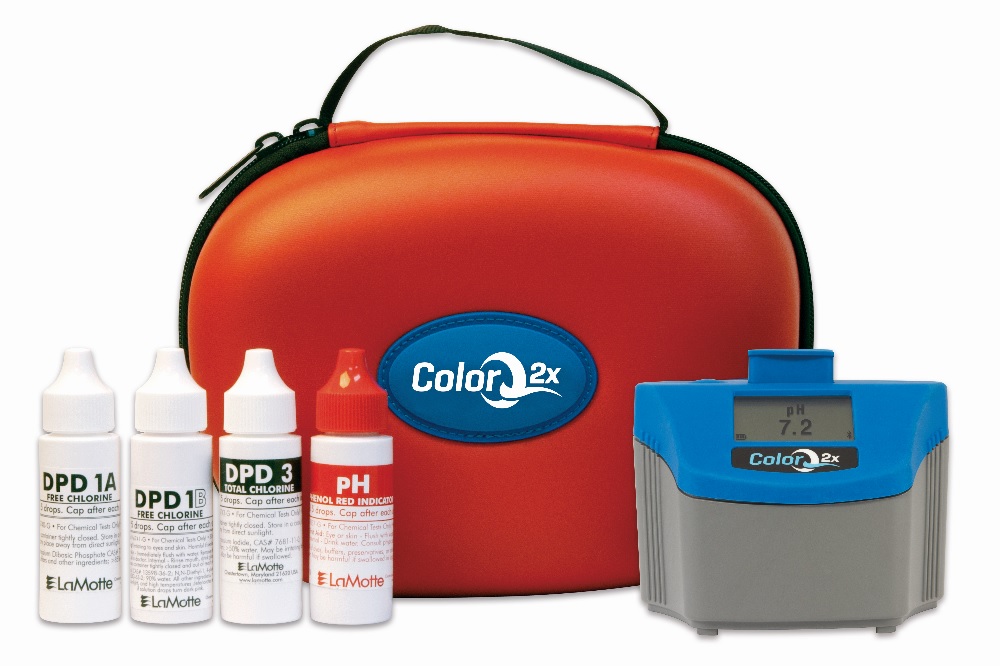
Colorimeter: a type of water analyzer that uses an
instrument with a precise light source and sensor to measure
slight differences in color. Also, referred to as a
Photometer, these instruments are amongst the most reliable
and accurate means of analyzing water. Testers are available
for all needs. Totally eliminates the need to visually match
colors, making it perfect for the color-vision impaired.
The ColorQ
line of Digital Water Analyzers includes 10 models, with
one being right for every pool or spa situation.
Cobalt Bleeding: a problem is occasionally present in
older fiberglass pools and spas and can cause a problem
resulting in dark-black spots or blotches forming on
underwater surfaces. Stain removal treatments may prove
useless or temporary. The most practical remedy is to
refinish the pool or spa.
Copper: used as an active ingredient in some
algaecides (chelated copper algaecides) and as a component
in Ionizers and Mineral Sanitizers. Copper sulfate should
not be used as a swimming pool algaecide. Usually, copper is
not found in most municipal water supplies. High
concentrations of copper, from natural sources, corrosion or
copper sulfate, can result in colored stains and/or
discolored water problems. It is best treated with a product
such as the METALTRAP Filter. Click here for some ordering
information about Copper Test Kits.
Conditioner, Chlorine: cyanuric acid (cya) is used in
outdoor swimming pools, as a chlorine stabilizing agent.
Helps protect chlorine from being destroyed by the Sun's UV
(ultraviolet) rays. Makes chlorine last longer. Also called
chlorine stabilizer.
Controllers: pool automation devices that can be used
to control aspects of water chemistry, filtration, heaters,
pool safety covers, lighting, pool cleaning and more.
Usually timer controlled and programmable.
Corona Discharge: a method for producing ozone, by
utilizing high voltage arcing to convert oxygen (O2)
into ozone (O3).
Refer to the listing for Ozone for more information.
Corrosion: a potentially damaging condition that
results from low pH (acidic) conditions. Can cause damage to
masonry surfaces and underwater metal parts. Corrosive
conditions will make chlorine more irritating and
aggressive. Proper pool or spa water chemistry or balancing
helps prevent corrosion problems.
Covers, Pool Safety: a type of
pool cover that is
installed on a track and can be rolled or unrolled, either
manually or automatically. Used for safety purposes and to
reduce water and heat loss.
Covers, Solar: a cover used to help increase or
maintain the water temperature. Typically, a plastic,
bubble-filled material that floats on the pool surface.
Cannot be used for winterizing or safety purposes.
Covers, Winter: used to cover the pool for the winter
months, after the pool has been properly prepared and
winterizing chemicals have been added. A variety of cover
types are available: mesh, laminate, solid.
Cryptosporidium: an infectious microorganism
(protozoa) that can be difficult to control, with chlorine
and other common sanitizers, and cause infectious problems
in pools and spas. Ultraviolet (UV) sanitizers are
particular effective, but must be used with other
oxidizers/sanitizers.
CYA: an abbreviation for Cyanuric Acid or Chlorine
Conditioner/Stabilizer. Refer to the Conditioner, Chlorine
listing.
Cyanobacteria: the scientific name for the most
common variety of blue-green algae found in swimming pools.
Cyanuric Acid (CYA): the active ingredient in
chlorine conditioner/stabilizer. Refer to Conditioner,
Chlorine listing.
Diatomaceous Earth (D.E.): a filter media that is
used in D.E. Filters, in order to produce highly effective
filtration. D.E. can be used as a filter aid with sand or
cartridge filters, in order to better deal with certain pool
or spa cloudy water problems or conditions.
Degassing Unit: a mixing chamber for ozone and water,
that can be used to increase the efficiency of an ozonator.
By creating small bubbles of ozone, contact time and
absorption is increased and the amount of ozone "gassing
off" is decreased.
Delamination: poorly preparing the surface of a
gunite pool, prior to applying a finishing coat, can lead to
poor adherence or delaminations of the coating. More common
in refinished pools, this can lead to calcium nodules and
other problems.
Desiccant Liner: an added measure of moisture
protection used in some brands of test strips for pools and
spa use. Much superior to the more common silica gel drying
packets.
Dichlor, Sodium: this type of stabilized chlorine is
popular as a daily pool water or spa water sanitizer.
Typically contains 56-60% available chlorine and is
available in a granular form. It is quick dissolving and is
essentially pH neutral. Can be used as a shock treatment.
Contributes cyanuric acid to the water, each time product is
added.
DPD: one of the preferred methods to test for Free
Chlorine. Variations can be used to test for the other forms
of chlorine.
Dry Acid: sodium bisulfate. A pH decreaser chemical
that is used to lower the pH and total alkalinity.
Enzymes: organic agents that hasten the natural
breakdown (digestion) or decomposition of oily wastes and
organic residues in pools and spas.
Epoxy Based Refinishing: materials that are used to
refinish and seal a masonry pool. Offers the advantage of
strength and durability and reduced interaction between the
masonry products in the walls and the pool water chemistry.
Ultra Poly One Coat is
a hybrid-epoxy coating , for pools and spas.
Escherichia Coli (E. Coli): a pathogenic, fecal
bacteria. Presence in pool or spa water at infectious levels
may be the result of inadequate sanitation, gross
contamination or poor water management.
Exposed Aggregate Finish: a type of product that is
used as the interior finish in some masonry pools.
Typically, a mixture of selected aggregates and Portland
cement. An acid etching is used to expose some of the
aggregates, creating its textured, finished look.
FAC: an abbreviation for Free Available Chlorine.
Refer to the Free Chlorine listing.
Filter Media: materials used to remove dirt and
debris from water. Common media include: diatomaceous earth,
sand and zeolites. D.E is used only with specific filters.
Sand and zeolites are used, interchangeably, in all sand
filters.
Floatation Tanks: also known as floatation chambers,
isolation tanks, sensory deprivation tanks, salt water spas
and REST chambers. Filled with a concentrated solution of
Epsom salts, the user floats in splendid isolation,
separated from the various stimuli of the surroundings.
Flocculation: the process by which insoluble, fine
particles are caused to precipitate from suspension. Alum
works by this principle. However, other more modern
polymer-type liquids or tablets accomplish the same net
result, without having to generate large amounts of
additional gelatinous precipitate.
Foam: can result in pools that have used quaternary
ammonium compound (QUATS) algaecides. This can be made
worse, if there is an air leak in the return line. In spas,
body oils can react with the natural alkalinity of the water
and form "soaps". Aeration will increase the foaming
problem. Anti-Foam products and enzyme products are useful
in controlling the problem.
Folliculitis: a rash-like bacterial infection of the
hair follicles caused by inadequate sanitation of spa or hot
tub water. Caused by the same bacteria, pseudomonas
aeruginosa, responsible for swimmer's ear and
conjunctivitis. Medical treatment should be sought in
suspected cases.
French Drain: a system intended to improve drainage
around a pool or house foundation. Usually consists of a
perforated pipe surrounded by gravel in a trench. The pipe
has to slope away from the area to allow for drainage. If
this not possible, a sump pump might be required.
Gallon (US): a unit of liquid volume, primarily used
in the U.S. One gallon (US) = 3.8 liters. (Metric
Conversions- click here)
GFI: Ground Fault Interrupter. A type of electrical
safety receptacle that prevents the possibility of
electrical shock in outdoor equipment or around water.
Usually, if not always, required by local or national codes.
Giardia: an infectious microorganism (protozoa) that
can be difficult to control, with chlorine and other common
sanitizers, and cause infectious problems in pools and spas.
Ultraviolet (UV) sanitizers are particular effective, but
must be used with other oxidizers/sanitizers.
Grains: an alternative way of stating concentration.
One grain = 17 PPM.
Gunite: a water, sand and cement mixture that is
"gunned" onto the formed shape of a pool interior under
construction. After application the walls are troweled.
Finally, a layer of a "plaster" finish is applied over the
gunite. It is this "plaster" layer, most commonly a marble
dust Marcite or an aggregate finish, that will actually
contact the water and will be visible.
Halogens: chlorine and bromine are members of the
halogen family of elements. As used, in swimming pools and
spas, chlorine and bromine are referred to as halogen
sanitizers. All other sanitizers are non-halogen.
Hard Water: the term used to describe water that is
high in calcium or magnesium. High levels, usually over 400
PPM, can lead to clarity and scaling problems, if not
treated. Source of the calcium can be natural or can be
contributed by chemicals such as calcium hypochlorite.
Heat Pumps: a type of heater that is similar to
an air conditioner operating in reverse and extracts heat
from the air. Cost effective and clean to operate, heat
pumps are suitable for summertime usage in most of the country and
wintertime operation in the southern areas only.
Heaters, Solar: a type of heater that utilizes the
Sun's energy. Solar heating systems can be plumbed into the
pool's existing filtration system and can provide FREE
energy, to raise the water temperature.
Heavy Metals: a term used to describe the presence of
metallic elements such as iron, copper, manganese, etc.
Responsible for many types of problems involving staining
and colored pool or spa water. Click here for some ordering
information about Heavy Metals Test Kits.
Click here for information about Heavy Metal Treatments.
Hopper: the deep end of an inground pool.
Hot Tub: originally designed and manufactured along
the line of a barrel, these products are an alternative to
the typical spa. Most are made of redwood or cedar and can
have an internal vinyl liner to keep the water away from the
wood. Equipped with heaters, air jets and filters, hot tubs
provide relaxing baths, arthritis relief and enjoyment.
Sizes can vary. The term "hot tub" is used, somewhat,
interchangeably with the term "spa."
Hypochlorites: a group of chlorine compounds used to
sanitize or shock pool or spa water. Includes: liquid sodium
hypochlorite, and granular calcium and lithium
hypochlorites.
Hydrogen Peroxide: H2O2,
a concentrated solution of a powerful oxidizing agent. Used
as a shock treatment for pools and spas being maintained on
biguanide and it situations where chlorine or bromine
products cannot be used. This product should not be confused
with the hydrogen peroxide solutions that are used for
household or personal uses, as this product is many times
more concentrated. Handle with appropriate caution! Click
here for some ordering information about
Peroxide Test
Strips.
Ice Compensator: a flexible, crushable component that
can be placed in the skimmers or floated on the pool
surface, as part of the winterizing procedure. Helps to
protect against possible freeze-thaw damage.
Ions: the electrically charged state that an element
assumes in true solution. In the ionic state, ions are
chemically reactive. Some ions, such as, copper, silver and
zinc, are used as sanitizers in mineral sanitizers and
ionizers.
Ionizers: equipment that sanitizes pool and spa water
by providing a low level source of copper and silver ions,
as the water passes over charged electrodes. Copper ions can
provide algaecidal control. Silver ions can provide
bactericidal control. Other types of devices (mineral
sanitizers) work by an erosion principle and utilize copper,
silver or zinc ions.
Iron: a mineral, which can occur naturally in water
and can be especially high in well water. Can lead to
problems with staining and discoloration of the pool or spa
water and underwater surfaces. Requires treatment with
chelating agents. Best to treat prior to adding chlorine or
raising the pH. Testing of the water will determine the
concentration in PPM and allow for an appropriate dosage of
chelating agents to be added. Any measurable amount of iron
is capable of causing a problem, if not treated. It is best
treated with a product such as the METALTRAP Filter. Click
here for some ordering information about
Iron Test Kits.
Kilogram: metric unit for weight. One kilogram = 2.2
pounds. (Metric Conversions- click here)
Langelier Index (Saturation Index): a system for
determining the scaling or corrosive tendencies of pool or
spa water, by testing the pH, total alkalinity, calcium
hardness and water temperature. To calculate the
Langelier Index, each parameter is assigned a
value, as per a chart.
Ideal would be a value of -0.5 to +0.5. Values outside of
the range, indicate out of balance conditions and may
require chemical treatment. More negative values indicate
corrosive conditions. Higher positive values indicate
scaling conditions.
Lanthanum: a rare earth element. Refer to the listing
for Phosphate Eliminators for more information.
Leaching: a term used to describe the movement of
slowly soluble constituents, present in masonry pool
finishes, into the pool water. Overall water chemistry
governs to what extent any leaching can occur. Normally
affects the parameters of pH, total alkalinity and calcium
hardness.
Leak Detection: the use of specialized equipment to
locate the source of a pool leak or spa leak. Usually
performed by a professional leak detection service company.
Leak Sealer: the
Fix A Leak product can be used to
seal many pool leaks, spa leaks and hot tub leaks.
Liter: metric unit of volume. One U.S. Gallon = 3.8
liters. (Metric Conversions- click here)
Lithium Hypochlorite: most commonly used as a daily
pool water sanitizer or shock treatment. Typically contains
35% available chlorine and is available as a granular
material. Completely soluble and high in pH. Tends to raise
the pH over time. Contributes no problematic residues to the
water.
Magnesium: a naturally occurring mineral that is
common in hard water. Shares a similar chemistry with that
of calcium. Tends to be more soluble than calcium,
especially at pool or spa conditions. Measured as part of
total hardness. Epsom salts are magnesium sulfate. Not
associated with any staining or discoloration problems.
Magnetizers, Pool and Spa Water: magnetic devices
that can be attached externally to the return lines. It is
reported that a pool or spa water magnetizer, also known as
a magnetic water conditioner, helps reduce and eliminate
scale formation and can have a positive impact on the
sanitizer levels and the overall water chemistry. Click here
for some more product and ordering information about
Magnetizers.
Main Drain, Anti-Vortex: safety design features have
been incorporated and regulations enacted to prevent the
entrapment of swimmers in the powerful suction of main
drains. A ramped can be placed around the anti-vortex main
drain, to help prevent pool cleaners from getting stuck in
place.
Manganese: a mineral that can occasionally occur in
well water. Even low concentrations can cause brown-black
staining and discoloration problems. High concentrations can
prompt the use of an alternative water source. Can be
treated along similar lines to iron, in pool or spa water.
Not usually found in municipal water supplies. It is best
treated with a product such as the METALTRAP Filter. Click
here for some ordering information about
Manganese Test
Kits.
Marcite: a finish for gunite pools that consists of
crushed marble and white Portland cement, that forms a water
tight layer over the underlying gunite.
Micro-filter: a filter capable of removing very fine
particles: even dead algae and bacteria. Some Robotic Pool
Cleaners feature a built-in micro-filter that works in
conjunction with the pool filter to produce higher quality
pool water.
Mineral Sanitizer: a type of device that releases
some combination of copper, silver or zinc ions into the
water at very low levels. In this ionic state, these
minerals can function in the sanitizer role and help control
algae and bacteria in pool and spa water. Mineral Sanitizers
work on the principle of erosion and do not require
electrical components. Most include some type of replaceable
cartridge, that contains the copper, silver or zinc
materials.
Mineralizer:
a type of pool sanitizer that releases metallic ions, such
as copper and zinc, to provide algae control and backup
sanitation. Most of the popular models are
solar-powered.
Minerals: naturally occurring components of water.
Include: salt, calcium, magnesium, iron, manganese, copper,
etc.
Microorganisms: include algae, bacteria, mold and
fungus. Control of microorganisms is the reason pool and spa
water require continuous sanitizing with chemicals or
methods such as chlorine, bromine, biguanide, algaecides,
ozone, ionization, ultra-violet, etc.
Mottling: a term used to describe dark blotches,
spots or stains that can appear on some plastered pools.
This problem may be caused by the "use and abuse" of calcium
chloride in the plastering mixture. Refer to Service
Industry News: issue 1/15/03. There is no solution, short of
refinishing, if this is the problem. Algae and metal stains
are other possibilities.
MPS: monopersulfate shock. Refer to the listing for
non-chlorine shock.
Multi-Port Valve: a valve with selectable positions
that is associated with the filter. Positions include:
filtering, backwashing, waste and bypass.
Muriatic Acid: the common name for hydrochloric acid.
Used to lower pH, lower total alkalinity, acid washing and
stain removal.
Nitrates: a vital nutrient for algae that can
stimulate growth and lead to higher consumption of chlorine.
The presence of nitrates in swimming pool water is
undesirable. especially at levels above 10-25 PPM. Nitrates
can find their way into swimming pool water from: well water
contaminated by agricultural runoff, decaying plant matter,
urine, sweat, fertilizers, acid rain, wind-blown matter,
bird droppings and contamination with ground runoff. While
it is possible to remove nitrates with ion-exchange resins,
it may not be a cost effective method. Replacement of all or
part of the pool water is the most common method of removal.
Click here for some ordering information about
Nitrate Test
Kits.
Nodules: a white spot or bump, consisting of calcium
carbonate, that has erupted at the surface of a plastered
pool. More common in refinished pools, it can be caused by
poor surface preparation, voids or hairline cracks. Can
occur a few times before ceasing and, generally, requires
sanding of the surface.
Non-Chlorine Shock (MPS): typically potassium
monopersulfate. Also known as monopersulfate compound and
potassium peroxymonosulfate. Replaces or assists chlorine in
destroying organic contamination and chloramines. Used as a
shock treatment, it is completely soluble, chlorine-free,
quick acting and does not create a build-up problem. Click
here for some ordering information about
MPS Test Strips.
Opening: start-up steps taken to restore the pool to
operational status.
ORP (Oxidation Reduction Potential): a measurement of
the state of the oxidizing power of pool water containing
chlorine or bromine. Requires the use of a electronic meter
and special electrodes, a minimum of 650 MV (millivolts) is
considered ideal, Pool or spa that has the recommended
levels of free chlorine or bromine and the optimum pH,
should have an acceptable ORP. As the pH falls, the ORP
rises, making reliance of this test alone a somewhat
impractical matter. It is useful as a supplement to the
standard water analysis tests. Click here for some ordering
information about
ORP PockeTesters.
OTO: ortho-tolidine. A solution used to test for
total chlorine only. Other products should be used to test
for Free Chlorine: the active germicidal form of chlorine.
Oxalic Acid: can be used as an acidic reducing agent
in the removal of difficult metallic stains from underwater
surfaces. Ascorbic acid can be used in a similar manner.
Oxidation: the chemical reaction by which organic
matter is burned or destroyed, by the action of chlorine,
bromine, ozone, hydrogen peroxide or non-chlorine shock.
Oxidation may cause minerals such as iron, manganese and
copper to form discoloring stains and precipitates, if not
treated properly.
Oxidation Reduction Potential (ORP): refer to the
listing for ORP.
Ozonator: a device for producing Ozone (O3),
by either a UV (ultraviolet) light source or by electrical
arcing (corona discharge). Also referred to as
Ozone
Generators. Used for oxidizing and sanitizing purposes in
both pools and spas. Click here for some ordering
information about Ozone Test Kits.
Ozone (O3):
typically produced by an Ozonator installed in a pool or
spa. Ozone (O3)
is a form of oxygen (O2)
and is a powerful oxidizing agent. It is used to destroy
organic waste and byproducts and help in the control of
algae and bacteria. Not a stand-alone sanitizer: needs some
supplementing with chlorine, bromine or ionization.
Parameter: limits, ranges or boundary-determining
characteristics. The common water analysis parameters
include: pH, total alkalinity, chlorine or bromine, calcium
hardness, chlorine stabilizer, iron, copper, TDS, etc. The
control and adjustment of these various parameters is
referred to as water balancing.
Pathogenic: a term used to describe infectious,
disease-causing microorganisms such as e. coli or
pseudomonas aeruginosa. These bacteria can cause infectious
conditions, if improper sanitation allows their presence to
expand beyond certain threshold populations.
pH: the pH scale goes from 0 to 14. 0 is the most
acidic. 14 is the most alkaline. 7 is neutral. The ideal
range for most pools and spas is 7.2-7.8. This is a
compromise of several factors: allows for reasonable
effectiveness of chlorine or bromine, bather comfort,
corrosion and scaling considerations and the solubility of
dissolved minerals. pH values less than ideal can lead to
corrosion problems. Values higher than ideal can lead to
cloudy water and scale formation. pH is an important
parameter and must be controlled. Chemicals are available to
lower or raise the pH. Control of total alkalinity aids in
stabilizing the pH. Click here for some ordering information
about pH PockeTesters.
Phenol Red: the material that is most commonly used
to test the pH of pool or spa water.
Phosphate Eliminators: based on the chemistry of the
rare earth element Lanthanum or other technology. Lanthanum
compounds have been found to help remove phosphates from the
water. When used, as directed, lanthanum compounds can lower
the phosphate level to just parts per billion. Some new
chemistry is also being used to precipitate the phosphates,
for removal by filtration or vacuuming. This almost total
depletion of a vital algae nutrient helps prevent or retard
algae growth, so long as the overall pool sanitizing and
chemistry are maintained.
Phosphates: a vital nutrient fort algae growth. Can
be introduced into pool water by decomposition of
vegetation, urine, body wastes, agricultural runoff and some
mineral or scale treatments. High levels can promote algae
growth. The use of a phosphate eliminator can reduce the
level to close to well below 1 PPM. Click here for some
ordering information about
Phosphate Test Kits.
Photometer: a type of water analyzer that uses an
instrument with a precise light source and sensor to measure
slight differences in color. Also, referred to as a
Colorimeter, these instruments are amongst the most reliable
and accurate means of analyzing water.
ColorQ Testers are available
for all needs. Totally eliminates the need to visually match
colors, making it perfect for the color-vision impaired.
Plaster: a type of finish that is applied over the
concrete shell of inground pools. Typically, a mixture of
marble dust and Portland cement.
Polymucosaccharide: the outermost surface or layer of
black algae and other resistant types. This
polymucosaccharide layer can act as a water repellent
barrier and shield the underlying algae from contact with
the chemically-treated water. Refer to the listing for
Wetting Agent for more information.
Pool, Above-Ground: a type of home pool that is built
on top of the ground. This type of pool can be constructed
of various materials and contains a vinyl liner to contain
the water. Pool size can vary from very small to large.
Pool, Inground, Fiberglass: a type of pool that is
built into the ground, with fiberglass as the material of
construction. Not very flexible in terms of size and shape.
Pool, Inground, Gunite: a type of pool that is built
into the ground, usually level with the surface. This type
of pool can be constructed with a concrete shell (gunned on:
hence the name gunite). The surface can be finished with a
variety of plaster or aggregate materials. Very flexible in
terms of size and shape.
Pool, Inground, Vinyl: a type of pool that is built
into the ground, usually level with the surface. This type
of pool can be constructed of a variety of structural
materials: aluminum, steel, polymer plastic and wood. This
type of pool utilizes a vinyl liner. Very flexible in terms
of size and shape.
Pool Cleaners (Vacuums), Automatic: devices, which
vacuum or remove dirt and debris from the pool bottom or
walls. Many devices can be attached directly to the skimmer
and will randomly traverse the pool. Other equipment
requires a separate pump.
Robotic Pool Cleaners operate on
low-voltage electricity, require no installation and are
programmed to clean walls, bottoms and water line areas..
Some models can be used in conjunction with ozonation.
Automatic cleaners help improve the circulation of water, on
the bottom, and are an aid in avoiding algae blooms.
Potassium Monopersulfate: a chemical name for
Non-Chlorine Shock. Refer to that listing.
Polymer Algaecide (polyquat): a type of algaecidal
ingredient that is based on a polymer (a long chained,
repeating molecule). The algaecides based on this ingredient
have become known as "poly quats" and are amongst the most
effective algae control products.
Pound: a unit of weight measurement primarily used
in the U.S. One pound = 0.454 kilograms. (Metric
Conversions- click here)
PPB: parts per billion. Used as a unit or measurement
of concentration, for most phosphate testing. 1 PPM equals
1000 PPB. pH is the only common pool parameter not expressed
as PPM.
PPM: parts per million. Used as a unit or measurement
of concentration, for most common pool water parameters and
chemicals. 1 PPM equals 1 pound per 1 million pounds of
water. pH is the only common pool parameter not expressed as
PPM. Occasionally, concentration is expressed in grains: 1
grain = 17 PPM.
Precipitation: the formation of an insoluble chemical
compound, thereby, causing it to drop out of solution.
Changes in the water analysis parameters of pH, total
alkalinity and calcium hardness can cause precipitation. Not
treating dissolved minerals such as iron, can lead to
precipitation, that can result in staining and discoloration
problems. Precipitation of calcium can lead to cloudy, hazy
pool or spa water or scale deposit problems on the
underwater surfaces.
Pseudomonas Aeruginosa: an infectious, pathogenic
bacteria. Inadequate sanitation, gross contamination or poor
water management can foster the growth of this bacterium,
causing swimmer's ear, conjunctivitis or folliculitis.
Treatment should include proper medical services.
Quartz: a commonly used ingredient in
quartz-aggregate finishes. Quartz or silicon dioxide is more
chemical resistant and durable than the more traditional
marble dust additives.
Quaternary Ammonium Compounds (quats): a type of
algaecidal ingredient, used to treat the most common
varieties of algae. Typically present as dimethyl benzyl
ammonium chloride or a variation. Can act as a wetting agent
to help improve the effectiveness of other sanitizers.
Drawback is the tendency to cause foaming problems.
Reagent: the chemist's technical term for a testing
solution.
Robotic Pool Cleaner: a type of highly featured pool
cleaner that can be programmed to suit a pool's
requirements. Robotic
Pool Cleaners contain a self-contained, washable
micro-filter bag that can remove fine particles, dead algae
and even bacteria. It is like having a second moving filter.
Ryznar Stability Index: the index is designed to
afford better protection, against corrosive effects, than
the more familiar Langelier or Saturation Index.
To calculate Ryznar Stability
Index, use this link.
Saltwater Chlorinator: another term for
Salt
Chlorinators for Pools or
Salt Chlorinator
for Spas.
Sand Filter: a tank-shaped filter that utilizes a
special grade of sand, as a filter media. Not always the
most effective: benefits from periodic use of water
clarifying products. Common mistake is backwashing too
often. The efficiency of a sand filter can be significantly
improved by using a zeolite sand filter replacement
media, in place of the filter sand.
Sanitizers:
chemicals or equipment used to kill bacteria, viruses, algae
and mold. Include: chlorine, bromine, biguanide, ozone
generators or ozonators, ionization,
Salt
Chlorinators for Pools or
Salt Chlorinator
for Spas and
ultraviolet (UV)
sterilizers.
Saturation Index: another name for the
Langelier
Index. Refer to that listing.
Scale Formation: caused when the levels of dissolved
calcium carbonate reach the maximum, based upon the actual
water chemistry. Scale (calcium carbonate precipitate) shows
up as a whitish coating on the underwater surfaces. If left
untreated, it can cause problems with filtration and pool
heating. Scale can occur, if the calcium hardness exceeds
400 PPM and the pool chemistry is not properly maintained.
Scale can be controlled by lowering the calcium hardness
level, adding Scale Control Chemicals (sequestering or
chelating agents), lowering the pH towards 7.2 and lowering
the total alkalinity towards 80 PPM. Pools, with
scale-forming potential, should avoid the further use of
products such as calcium hypochlorite: a source of calcium.
The use of a Magnetic Water Conditioner can offer help in
dealing with scale formation.
Sequestering Agent:
a class of chemical compounds that form a loose association
with dissolved minerals such as calcium or magnesium. These
chemicals help keep the minerals in solution, prevent scale
formation and, over time, redissolve scale deposits.
Sequestering is the preferred way to treat calcium problems.
Shock: refers to the application of large quantities
of chlorine (superchlorination), non-chlorine shock or
hydrogen peroxide. Typically 5-10 times the normal dose is
used, based upon actual conditions and needs. The purpose of
this large dose is to break down (breakpoint chlorination,
in the case of chlorine) the combined chlorine, organic
waste and contamination and re-establish a positive level of
Free Chlorine. Shocking must be repeated, until such time as
a stable Free Chlorine reading can be achieved, for at least
a few hours. Make sure that a Free Chlorine capable test kit
is being used, in order to know when breakpoint chlorination
has been achieved.
Silt: ultra fine particles
that settle to the bottom, during periods of inactivity. The
action of the bathers tends to lift the silt up off the
bottom, detracting from the water clarity. Vacuuming before
the pool is used can help
control the problem.
Silver: used in Ionization units and
mineral
sanitizers. Silver ions can function as a bactericide.
Skimmer: the water-level device, in the pool wall,
that aids in the removal of floating debris and serves as a
filter intake.
Slime: is usually indicative of the presence of an
algal or bacterial film and is likely due to inadequate
sanitation and/or water circulation.
Soda Ash: sodium carbonate. The chemical used to
raise the pH of water. Neutralizes acid. Not the same
chemical as sodium bicarbonate, sodium hydrogen carbonate or
baking soda.
Sodium Bicarbonate: sodium acid carbonate, sodium
hydrogen carbonate, baking soda. The chemical used to raise
the total alkalinity of the water. Creates a buffer and
helps stabilize the pH in the ideal range. Not the same
chemical as sodium carbonate or soda ash.
Sodium Bromate: a suspected hazardous chemical that
was found in trace amounts in pools that were using a salt
bromination system. This let to the recall of these units in
2002, while the subject was investigated further.
Sodium Bromide: converts into active bromine
sanitizer, when oxidized by the action of chlorine or non
chlorine, monopersulfate shock. Typically, used to treat a
variety of resistant or problematic conditions such as
"pink" algae, water mold, slimes and yellow-mustard algae.
Adding sodium bromide, to an outdoor pool, may not be the
best solution, as it will increase chlorine usage and create
the possibility of bromate formation.
Sodium Carbonate: refer to soda ash listing.
Sodium Bisulfate: available as a pH reducer, this
acidic, granular chemical is used to lower the pH and/or
total alkalinity. Neutralizes the effects of high pH
chemicals. Also known as sodium hydrogen sulfate.
Concentrated solutions are very acidic!
Sodium Dichlor: a form of stabilized chlorine. This
chlorinated cyanuric acid is completely soluble and is
essentially pH neutral. Used for routine daily sanitizing
and shocking (superchlorination) in pools and spas.
Typically, 56% available chlorine.
Sodium Hydroxide: a caustic, high pH by-product
produced by the most common types of salt chlorine
generators. Neutralized as part of the routine maintenance
of the pH, presenting no handling hazards. Also known as lye
or caustic soda.
Sodium Hypochlorite: liquid solution of chlorine.
Typically 10-15% available chlorine. High pH material.
Regular additions will require applications of acid, in
order to maintain the proper pH.
Sodium Tetraborate: is the basis of a chemical
treatment program that helps to reduce the amount of
dissolved carbon dioxide gas in the water. This reduction
makes it more difficult for algae to thrive and allows for
reduced chlorine levels, without compromising effectiveness.
Click here for some ordering information about
Borate Test
Strips.
Soft Water: is water that is low in calcium and
magnesium hardness. Such water can prove to be corrosive to
masonry surfaces and underwater metal parts. The calcium
hardness level can be raised, to the optimum range of
150-200 PPM, by the addition of appropriate amounts of a
calcium hardness increaser (calcium chloride). Vinyl pools
can be maintained at a lower level: 80-200 PPM.
Solar Blanket: a translucent floatable blanket that
is placed directly on the pool's surface. Warms the water by
reducing evaporation (a cooling process) and utilizing the
Sun's rays passing through the blanket. Usually made from an
air bubble filled plastic sheet.
Solar Heating Systems: a type of heater that utilizes
the Sun's energy.
A solar heating systems can be plumbed into the pool's
existing filtration system: providing FREE energy, to raise
the water temperature.
Spa: a popular form of aquatic recreation. Available
in a range of sizes and shapes, these products are used for
relaxing bathing, arthritis relief and fun! Portable, ready
to plug in and inground, built-in variations are available.
Units feature heated water, air jets and massage therapy.
Hot tubs are a design variation, usually of wooden
construction. The phrase "hot tub" is sometimes used
interchangeably with that of the term "spa."
Stabilizer, Chlorine: cyanuric acid. Also known as
chlorine conditioner. Refer to listing on chlorine
conditioner.
Stain Removal: various products, such as ascorbic
acid, metal removing filters and chelating agent can be used
to help remove and prevent metal staining and discoloration.
Swale: use of ground contours to direct surface
ground water drainage or flow.
Strip Reader, Water Analyzer: a type of water
analysis that use scanning technology to read the colors on
a test strip. This type of equipment is unlikely to provide
and degree of reliability beyond that of the test strips
being used. Test strips are a convenient testing method, but
do not provide the accuracy of a modern testing lab, such as
the WaterLink
SpinTouch
Lab.
Sulfur: a naturally occurring mineral, that can be
found in some poor quality well water. Produces odorous and
potentially irritating conditions. The
MetalTrap 1-Micron Pre-Filter
is a cartridge like device that simply attaches to a garden
hose. It can remove sulfur from pool water and from all new
water additions.
Superchlorination: is basically another term for
"shocking". Refer to the listing on Shock.
Syringaldazine: the chemical used in most test
strips to perform all of the Chlorine and Bromine tests.
This is the most reliable method to use, especially in the
presence of higher levels of Free Chlorine.
TA: an abbreviation for Total Alkalinity. Refer to
that listing.
TAC: an abbreviation for Total Available Chlorine.
Refer to the Total Chlorine listing.
TDS: an abbreviation for Total Dissolved Solids.
Refer to that listing.
Test Strips: relatively, modern methods of testing
pool and spa water. Typically,
Test Strips
are able to do a variety of tests including: Free Chlorine,
Total Chlorine, Bromine, pH, Total Alkalinity, Calcium
Hardness, Chlorine Stabilizer, etc. Not all strips do all
tests. A convenient, no chemicals way to test water.
Click here
for more details and selection.
Titanium: an ultra-strong, corrosion-resistant metal
that is used in electrodes for salt chlorinators and other
alternative sanitizing devices and as a copper alternative
in some, better quality, pool or spa water heat pumps and
heaters.
Total Alkalinity (TA): a measurement of the ability
of the water to resist changes in pH. Water with a TA of
80-120 PPM is sufficiently buffered, so as to resist rapid
changes in pH. This makes pH management easier. Additions of
sodium bicarbonate are used to raise the total alkalinity:
1.5 pounds will raise the TA, of 10,000 gallons, by
approximately 10 PPM. High TA can be lowered by the addition
of muriatic acid or dry acid (sodium bisulfate).
Total Dissolved Solids (TDS): a measurement of the
total PPM of all dissolved minerals and compounds. High TDS
can lead to water clarity problems, loss of sanitizer
effectiveness and other issues. Click here for some ordering
information about
TDS PockeTesters.
TriChlor: a highly concentrated stabilized chlorine.
Typically, it is approximately 90% Available Chlorine and is
sold in a variety of tablet sizes and other shapes. Acidic
in nature requiring periodic adjustment of the pH.
Recommended for pool use only. A granular material is used
to spot treat algae in masonry pools only. The types of
trichlor chlorine that are most commonly used in feeders and
floaters are the tablets and other solid shapes. No other
product can be used in a chlorinator with an enclosed space.
Turbidity: a technical term for describing the
clarity of the water. Cloudy water is turbid water.
Ultraviolet (UV):
UV
Sterilizing Systems can be,
plumbed in-line, and used to reduce the overall population
micro-organisms, as the water passes through the unit. There
is no residual effect of the UV, so backup sanitizing is
highly recommended. UV is also used in some Ozonators (refer
to the listing for Ozone), in order to convert oxygen (O2)
into ozone (O3). Because UV rays from the Sun, can destroy
chlorine or bromine, cyanuric acid conditioner/stabilizer is
used to minimize the negative effect, of sunlight, on the
chlorine concentration.
Underwater Lights: specially designed for this
purpose and meeting all of the appropriate codes. Underwater
lighting systems utilize low voltage transformers, sealed
components and the design features for use in inground or
aboveground pools.
Vacuuming: the practice of
drawing water into the filter, by using a "vacuum head" and
hose attached to a pole. Filter needs to be set on vacuum.
Follow manufacturer's instructions. Vacuuming is used to
remove debris and silt from the pool bottom.
Venturi: a means of creating a vacuum line in the
return line of a pool or spa, that is used with
ozonators,
in order to inject ozone into the water stream.
Virginia Graeme Baker Pool and Spa Safety Act: (VGB
Act) was signed into federal law on December 19, 2007, with
the support of the Association of Pool & Spa Professionals
(APSP). Please visit WWW.APSP.ORG/VGB for the latest
information. Public pools and spas that are not in
compliance by December 19, 2008, may not open for use until
compliant. The VGB Act contains three federally enforced
mandates—each effective December 19, 2008. State laws can
vary and may require that residential pools comply, with new
standards. Laws change and it is advised that current
requirements be verified.
1. All drain covers (public and residential) manufactured,
imported, distributed, or offered into commerce must comply
with the new ASME/ANSI A112.19.8 2007 standard. Proof of
compliance requires testing and certification by a
Nationally Recognized Testing Laboratory, except for “Field
Fabricated Outlets” defined under Section 2.3.1 of the ASME
standard. These specialized suction outlets may qualify for
site-specific certification by a Registered Design
Professional, as defined in Section 1.5 of the ASME
standard.
2. All public pools and spas (new and existing) must be
retrofitted with covers that meet the new ASME/ANSI
A112.19.8 2007 standard, or qualified Field Fabricated
Outlets may be certified by a Registered Design
Professional, as stipulated in the ASME standard.
3. All public pools and spas that have a single drain, other
than an unblockable drain, must employ one or more
additional options.
While I have made an effort to correctly state the facts, I
suggest that you check with your local building or zoning
department, to see if local laws or ordinances require
anything more or different, than what is required by the
Federal law. Recent legislation may have changed these
standards. Check to make sure that you and the pool are compliant.
Vinyl Liners: used inside the formed shape of a pool
and made of a heavy gauge of vinyl, pool liners are used to
contain the water within the inner surfaces of the walls and
bottom. Vinyl liners are chemically inert and are available
in a variety of colors and patterns. Stock sizes are
available, as well as custom sizes. Vinyl liners help make
the use of various materials as pool walls possible. Vinyl
hot tub liners are also used in some wooden hot tubs.
Water Chemistry: in order to minimize the possibility
of pool or spa water problems and to maximize the bathing
pleasure, it is important to maintain or balance the common
pool water parameters, within the suggested optimum ranges.
These parameters include: sanitizer level, pH, total
alkalinity, calcium hardness, chlorine stabilizer (outdoor
chlorine pools only) and the control phosphates, nitrates
and trace heavy metals. Not all of these parameters are
problematic: a lot depends upon the nature and quality of
the source water.
Water Mold: a catch-all phrase that describes the
problem of a bacterial or microorganism bloom that can cover
broad areas and can cloud the water. Can be pink or white in
appearance. Sometimes, present in a form that is describing
as resembling "floating, shredded toilet tissue." It is
usually caused by the development of a resistant strain and
is more common in pools or spas that have been maintained on
biguanide, for long periods of time. Although instances of a
mold that is resistant to chlorine does occur, it is far
less frequent and responds well to treatment with bromine.
Water Quality: refers to the state of the overall
pool or spa water conditions, regarding such factors as:
sanitation, water chemistry, water clarity, water color and
the appearance of the underwater surfaces. Water quality can
become an issue in a variety of pool or spa problems, that
detract from the goal of sparkling, crystal clear pool or
spa water.
Wetting Agent:: something that helps make water
wetter, The opposite of "beading up." Algaecides such as
dimethyl benzyl ammonium chloride and close variants are
useful in helping sanitizers, shock treatments and premium
algaecides penetrate the outer layers of some type of
resistant algae. Refer to the listing for polymucosaccharide
for additional information.
Winterizing: pool closing. A series of steps taken in
order to protect the equipment and prepare the pool for the
inactive winter period.
Zeolites: a naturally-occurring mineral that is used
as a replacement for ordinary sand filter media.
Zeolites produces higher
clarity and quality water than would be possible with
ordinary filter sand. Lasts longer than filter sand. One
pound of zeolites can replace 2 pounds of filter sand.
Zinc: used in some Ionizers and mineral sanitizers.
Zinc ions can function as a bactericide.
|
Visit The Website Stores . . . for
better informed shopping!!! |
|
|
Shipping is FREE* . . . within
the Continental U.S.
A $9.99
handling charge will apply
to Continental U.S. Orders,
under $75.00. Orders
outside of the Continental
U.S. may require some
additional charge, based on
quantity and destination.
Most products can be shipped
World-Wide. International
and orders outside of
Continental U.S. - see
comments on the ordering
pages. |
|
 |

Major
Credit Cards and PayPal are accepted. |
|
▲
Return To Top Of Page
▲
Aqualab Systems, LLC does not
make any warranty or
representation, either expressed
or implied, regarding the
accuracy or completeness of the
information provided by this
website; nor does Aqualab
Systems., LLC. assume any
liability of any kind whatsoever
related to, or resulting from,
any use or reliance on this
information. The content of this
website should not be used, if
it is conflict with any
applicable federal, state or
local regulations or guidelines.
© Aqualab Systems, LLC. All
rights reserved