|
 |
Shipping is FREE* . . . within
the Continental U.S.
A $9.99
handling charge will apply
to Continental U.S. Orders,
under $75.00. Orders
outside of the Continental
U.S. may require some
additional charge, based on
quantity and destination.
Most products can be
shipped World-Wide. International
and orders outside of
Continental U.S. - see
comments on the ordering
pages. |
|
 |

Major
Credit Cards and PayPal are accepted. |
|
On-line
shopping since 2002 - Safe and Secure!!! |
|
Avoiding Staining and Discoloration,
every time new water is added!!! |
|
Test your
source water for iron, copper and
manganese, to determine, if dissolved
metals present a potential problem. It
is better to avoid a problem, than to
try and treat it, after the water has
been added to the pool. The products
below can remove sediments, metals such
as iron, copper and manganese and
contaminates such as sulfur. The
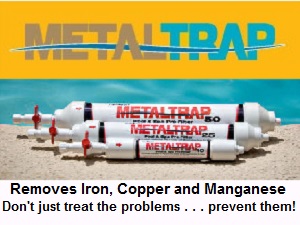
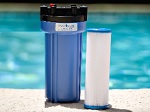
MetalTrap
Filter, available in 3 sizes, attaches to the garden
hose and removes dissolved iron, copper
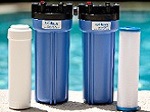
and manganese. The
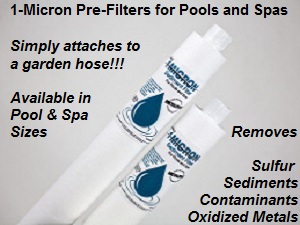
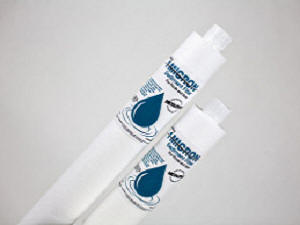
MetalTrap
1-Micron Filter removes
ultra-fine contaminants, including
sulfur. The
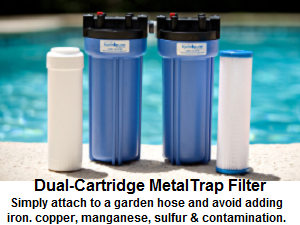
MetalTrap
Dual-Cartridge Filter, available
in 3 sizes,
attaches
to a garden hose and removes dissolved
heavy metals and sediments. One
cartridge is washable and reusable and
the other is replaceable. |
|
|
If you have a pool or spa water testing
need, we should have the product.
►
Scroll down to read through some
Question & Answer information.
◄
|
|
Removing Stains and Discoloring Metals,
from the pool water!!! |
|
Look for the presence of
blue, green, purple, gray, brown-black stains,
as these can indicate copper. The
added presence of iron or manganese can
add different discoloration
possibilities. Even
if there is no obvious staining, the
presence of heavy metals will cause
water discoloration and possible
staining, after chlorine or bromine are
added or the pH is raised. Depending
upon the severity of the problem, the
products below can help you eliminate or
avoid problems. The
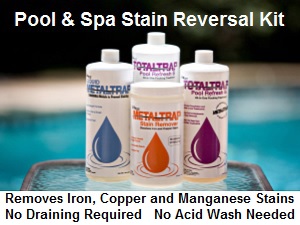
Stain Reversal
Kit contains everything needed
to remove the metal stains, eliminate
the heavy metals and help prevent a
recurrence, of the problem. The
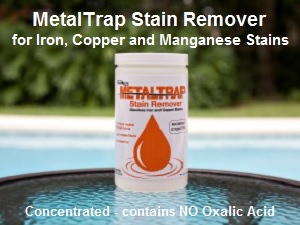
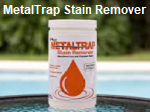
Stain Remover
removes iron copper and manganese
stains.
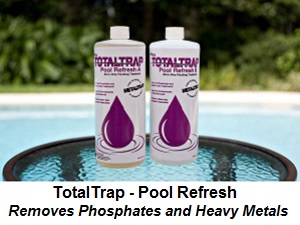
Pool
Refresh-Total Trap helps
eliminate heavy metals and phosphates,
by filtering or vacuuming them out of the
pool water. |
|
|
If you have a pool or spa water testing
need, we should have the product.
►
Scroll down to read through some
Question & Answer information.
◄
|
|
Optimizing the water chemistry and
improving pool water clarity!!! |
|
Test the water chemistry and
adjust the pH, total alkalinity, calcium
hardness and cyanuric acid, as might be
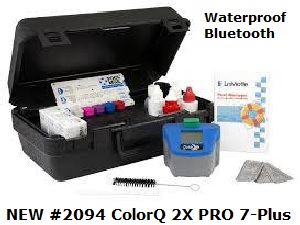
necessary. A
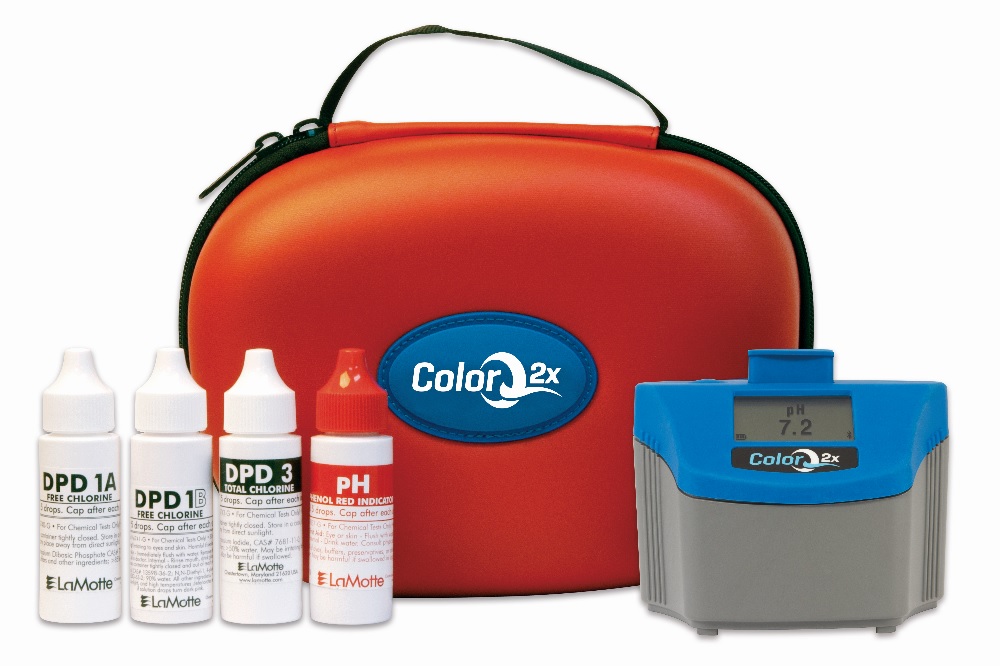
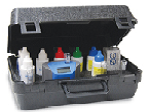
ColorQ, All-Digital Tester can
perform all of the common pool water
tests and eliminates the color-matching
and guesswork. Some tester models,
such as the #2067 ColorQ PRO 9-Plus,
perform all of the common pool water
tests, plus copper and iron. Reliable water testing will
help get the pool swimming-ready. Better
Circulation helps make everything work
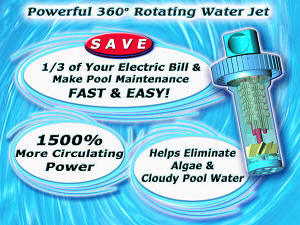
more effectively. The
Circulator is a return jet
replacement fitting, that improves
filtration, eliminates dead zones that
promote algae growth, improves sanitizer
distribution and improves chemical
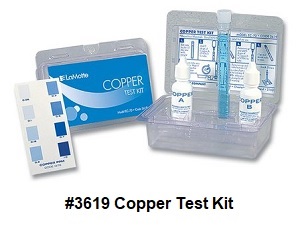
dispersion. A simple
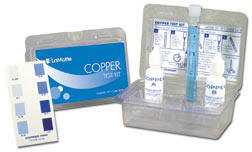
Copper Test Kit can help you
monitor the copper level and determine
the course of treatment. |
|
|
If you have a pool or spa water testing
need, we should have the product.
►
Scroll down to read through some
Question & Answer information.
◄
|
|
How to treat and avoid
copper problems in swimming pools? |
Frequently,
Copper can be found in swimming pool water. Most
commonly, it is introduced into the water in the
form of a chelated (stabilized) copper algaecide
or winterizer. Copper, in this form, usually
does not cause a pool problem, if used properly
and as directed. Copper is rarely found is
municipal water supplies. Naturally occurring
copper, is occasionally found, in well water. It
is copper from this source or from corrosion of
copper heater cores or piping that is capable of
causing blue-green or even dark colored staining
or discoloration. Copper problems can be
controlled with proper chemical treatment and
techniques. A water analysis is required to
determine the concentration of copper present
and help assure that it does not reach the
level, where staining and discoloration can
occur. An alternative method of dealing with
known heavy metal problems is to use the
METALTRAP Filter, which can physically remove
the metals, as the pool water is being added.
Copper and other heavy metal problems can
treated with Pool Refresh, used in conjunction
with other METALTRAP products. Recirculating the
pool water, through a METALTRAP Filter and a small submersible, can lower the copper ion levels, to that
manufacturers by the ionizer manufacturer. This
approach help preserve ionizer performance and reduces the
likelihood of staining and discoloration. Several
models of
ColorQ All-Digital Water Testers will allow you to
monitor the pool water quality and do a test for copper,
without any need to color-match or guess. If problems
arise, refer to the Pool
Problems Page, as a source of problem-solving
information, broken down into various categories. Scroll
down the page and click on the linked
keywords,
catch phrases
or images, in the archived answers below, to access additional information, on that topic or product.
Do you know what's in
your water? If you're having problems, with stains
and discoloration, due to the presence of metals, you should
be testing for iron and copper, to better understand the
extent and cause of the problem. This helps select the
best treatment option. Understanding the nature of
the problem, should be step one. For information
about our full selection of testing options, visit our
Test Equipment Store.
For information about treatment options, visit our
Stain Treatments Store.
|
There are many causes of stains and discolorations,
which can appear in a variety of colors.
The color can sometimes point to a cause and solution.
Water Testing
can help verify the cause of the problem. |
|
Stain
or Discoloration Color |
Cause
and Treatment |
|
Green or
Brown |
Most likely, these are organic, in nature, and are
due to algae and/or tannins, leaching from many
common varieties of tree leaves. This is more
likely to happen, if the sanitizer (oxidizer) levels
are low and/or if there is poor circulation, across
the pool floor. Superchlorination and
improving circulation,
are the best course of action. |
|
Dark Blue, Green
or Black |
Dark blue, green or
black colors or mixtures are likely caused by
copper. High calcium hardness levels tend to cause
the stains to darker, in appearance. The
source could be corrosion of the copper heat
exchanger, natural sources, over use of copper
algaecides, ionizer or mineralizers. This type
of problem requires proper chemical treatment, such
as provided by the MetalTrap
Stain Reversal Kit. If present in the
source water, a MetalTrap
Dual-Cartridge Filter can be connected to the
garden hose, used to add new water. This will
help prevent the addition of more metals, with each
new water addition. |
|
Green,
Brown,
Tea-Colored or
Rusty-Red |
Green, Brown, Tea-Colored or Rusty-Red colors are
usually indicative of an iron problem. The
most likely source is the water being used to fill
the pool. This is especially true, when well
water is used. While the use of a
MetalTrap Stain Reversal Kit
will help solve the problem, a
MetalTrap Dual-Cartridge
Filter should be attached to the garden hose, in
order to avoid future recurrences. |
|
Brown, Black or Purple |
Brown, Black or Purple
colors are usually an indication of manganese being
present. This most often occurs, when well
water is being used. A test of the source
water should confirm the presence of manganese.
While the use of a MetalTrap
Stain Reversal Kit will help solve the problem,
a MetalTrap Dual-Cartridge
Filter should be attached to the garden hose, in
order to avoid future recurrences. The
presence of copper and high levels of cyanuric can
lead to purple discoloration, due to the formation
of copper cyanurate. Lowering the CYA level
and treating for copper should help resolve the
problem. |
|
Red or
Blue |
Red or Blue Stains can be associated, with the
presence of berries or vegetation.
This is more likely to happen, if the sanitizer
(oxidizer) levels are low and/or if there is poor
circulation, across the pool floor.
Superchlorination and
improving circulation, are the best course of
action. |
 |
Join our E-Letter Mailing List.
You'll receive 1-3 E-Letters a
month, featuring helpful pool
and spa advice, new product
information and sale
announcements. All we
require is your e-mail address
and you can opt out anytime you
wish.
Your information
will never be shared or sold. |
|
▼
Helpful,
Problem-Solving Information, in a question and
answer format.
▼ |
►
Purple Discoloration Due To Copper Cyanurate?
I have been
using trichlor tablets, in a feeder, and supplementing it
with a copper algaecide. The spring, upon opening, my
water developed a purple caste and there may be some
staining, as well. I have read up, that manganese can
be associated with purple discoloration. I don't use
well water and had the water tested, for manganese, and it
is negative. Is there another possibility?
Thanks for your help. Best regards.
Austin S.,
Georgia, 4/2/2020
The
presence of high levels of cyanuric acid and copper can form
copper cyanurate, which can explain the purple color.
When you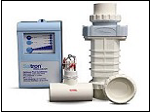 use stabilized chlorine, the cyanuric acid is always on the
rise. In fact, higher levels, over 150 PPM, can lower
the effectiveness, of chorine, and are
best treated
by partial water replacement. Instead of using
trichlor tablets, you might consider using a
salt chlorine
generator, which will eliminate the build-up of cyanuric
acid and provide better water quality and more control over
the chlorine level. If you feel that an algaecide is
beneficial, I would suggest a 60% polymer algaecide, which
contains no copper and has the added benefit of not foaming,
as do some other common algaecides. So far as the
purple discoloration and/or staining, I would treat the pool
with a MetalTrap Stain Reversal Kit.
It should eliminate the "purple" and remove the copper, as
well as any iron and phosphates. I hope that this
information will be helpful.
use stabilized chlorine, the cyanuric acid is always on the
rise. In fact, higher levels, over 150 PPM, can lower
the effectiveness, of chorine, and are
best treated
by partial water replacement. Instead of using
trichlor tablets, you might consider using a
salt chlorine
generator, which will eliminate the build-up of cyanuric
acid and provide better water quality and more control over
the chlorine level. If you feel that an algaecide is
beneficial, I would suggest a 60% polymer algaecide, which
contains no copper and has the added benefit of not foaming,
as do some other common algaecides. So far as the
purple discoloration and/or staining, I would treat the pool
with a MetalTrap Stain Reversal Kit.
It should eliminate the "purple" and remove the copper, as
well as any iron and phosphates. I hope that this
information will be helpful.
Sincerely.
Alan Schuster, 4/3/2020
►
Too Much Copper, Due To Ionization?
I have an
ionization-oxidation unit and I evidently have operated the
ionization too high, resulting in too much copper. I
know if I add standard metal treatments, it will inactivate
the copper. Is there a way to remove only the excess
copper and lower the level to 0.3 PPM. I have shut the
ionization function off, but it might take a long time to
drop, from 0.9 to under 0.3 PPM. Thank you for taking
the time to answer the question.
Frank G., Ft
Lauderdale, FL 7/1/2020
You're right amount the metal
treatment. Unless you add precisely the right amount,
you risk deactivating all of the copper. There is a
solution. Attach a MetalTrap
Filter cartridge to a garden hose and a small
submersible pump. The pump goes into the deep end and
end, with the MetalTrap
filter is placed so that the returning water enters the
skimmer. Test the copper level and retest every 8-12
hours. As water passes through the MetalTrap filter,
the copper will be removed. When it drops to 0.3 PPM
of copper, you can stop the recirculation and remove the
pump, from the pool. This way all the remaining copper
is still in the active, ionic form. I hope that this
will be helpful.
Sincerely. Alan
Schuster, 7/1/2020
►
Copper Heater Corrosion Problems Caused By Low pH?
Thank you for
your Q&A forum! What a great site! Okay, after reading your
forum, I have read pages, lol, I can't find anything on if I
need to replace a heater once it has been exposed to, to low
pH and chlorine. I just bought it less then a year ago for
$1,000. My pool is above ground splash around. 12x 22. I had
green hair followed by weird green staining on floor and
walls of pool and then a crusty green waterline. Pool store
said copper above 1 ppm, So after spending $$$$$ I drained
1/3 of water, put in a metal treatments. Did this
twice. It dropped down to under 0.5. Then it's back up to 1
ppm. Okay, so today we now know it is our heater we bought
at end of summer last year. Finally my question, Is the
heater trashed? If I make sure my ph is stable from here on
out, is it safe to use and not get copper leaching in the
water again. Did I ruin the heater? Help please.
Suzanne H., Huntington Beach, CA 4/3/2017
Most
likely, you did not destroy the heater, but damage has
occurred. Low pH, with chlorine or bromine present,
will result in copper corrosion. It amounts to a few
ounces of copper dissolved, in your case. As long as
the heater works and there are no leaks, the heater is still
wo rkable. My
guess is that you are using trichlor tablets, which are
acidic. If that is the case, you should NEVER add them
to the skimmer and, if used in a feeder, must be plumbed
last in line and separated from the heater, by a check
valve. You need to make sure the pH never drops under 7.0.
Having a total
alkalinity of at least 100-120 PPM will help
assure that the pH does not drop quickly. You need to
pay more attention, to the chemistry, on a daily basis and a
ColorQ
all-digital tester would be ideal. 1 PPM of copper
is too high. You want it under 0.3 PPM. You can
do that with a MetalTrap Filter,
some garden hose and a small submersible pump. Just
recirculate the pool water, through the MetalTrap Filter and
back into the pool. It will remove copper, as water
passes through. You should lower the level to 0.1-0.2 PPM,
to be on the safe side. A
salt chlorine generator
is an easier, better and more controllable way to use
chlorine. It avoids chemical buildups caused by
rational chlorine products, such as high cyanuric acid
levels. We offer two, no installation models and one
of them is solar-powered. Salt chlorine generators
tend to make the pH rise, so low pH will be a thing of the
past, unless you get heavy handed with acid additions.
Just remember, you can always add more - you can't take out.
I hope that this information will be helpful.
rkable. My
guess is that you are using trichlor tablets, which are
acidic. If that is the case, you should NEVER add them
to the skimmer and, if used in a feeder, must be plumbed
last in line and separated from the heater, by a check
valve. You need to make sure the pH never drops under 7.0.
Having a total
alkalinity of at least 100-120 PPM will help
assure that the pH does not drop quickly. You need to
pay more attention, to the chemistry, on a daily basis and a
ColorQ
all-digital tester would be ideal. 1 PPM of copper
is too high. You want it under 0.3 PPM. You can
do that with a MetalTrap Filter,
some garden hose and a small submersible pump. Just
recirculate the pool water, through the MetalTrap Filter and
back into the pool. It will remove copper, as water
passes through. You should lower the level to 0.1-0.2 PPM,
to be on the safe side. A
salt chlorine generator
is an easier, better and more controllable way to use
chlorine. It avoids chemical buildups caused by
rational chlorine products, such as high cyanuric acid
levels. We offer two, no installation models and one
of them is solar-powered. Salt chlorine generators
tend to make the pH rise, so low pH will be a thing of the
past, unless you get heavy handed with acid additions.
Just remember, you can always add more - you can't take out.
I hope that this information will be helpful.
Sincerely.
Alan Schuster, 4/4/2017
► Copper Pool Water
Testing?
I HAVE A QUESTION ON COPPER. WHAT DOES
COPPER DO TO YOUR WATER AND EQUIPMENT AND WHY DO YOU NEED TO
CHECK. NOT EVERYONE CHECKS FOR COPPER BUT I DID BECAUSE I
HAVE THE WATERLINK EXPRESS. MY COPPER IN MY POOL WAS AT .3
AND THEN I USED A COPPER BASED ALGAECIDE AND MY COPPER WENT
TO 0.7. I HAVE TREATED IT 3 TIMES WITH NO LUCK WITH A METAL
TREATMENT. COPPER WENT DOWN AFTER TREATING IT THE SECOND
TIME TO 0.5 AND THEN SHOT UP AGAIN. I CLEANED MY FILTER
AFTER THE SECOND DOSE. I DOSED THE THIRD TIME THIS MORNING
AND GOING TO CLEAN MY FILTER TONIGHT. I HAVE A SAND FILTER.
IS IT IMPERATIVE TO GET THE COPPER DOWN TO 0.0? THANK YOU
AND LOOKING FORWARD TO HEARING FROM YOU.
JULIE R., RICHMOND, MO, 6/2/2018
Good question. Pool owners that use ionizers,
mineral sanitizers or copper algaecides are spending money to put
copper into the pool water. The problem with copper is its
form. Ionizers and mineral sanitizers add copper ions at
very low levels: a few tenths of a PPM at most. Copper
algaecides add copper in a chelated or stabilized form:
usually at concentrations well below 1 PPM. Where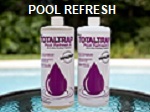 copper
does cause a problem is when it is present from copper
sulfate or corrosion at more than trace amounts. Now that I
made the case for copper being in the pool, here's the
problem. Most of the metal treatments claim to remove
copper, iron, etc. This is a misleading statement, inasmuch
as they do not actually remove copper or iron. Where did it
go? In reality, these products help control copper and iron,
by keeping it in solution in a stable, chelated form. In
many instances, the test equipment may still pick up the
copper. Adding more metal treatment will not remove the
copper and may have no impact on the test reading. However,
the copper is chelated and should not cause staining or
discoloration. In pools that are using mineral sanitizers or
ionizers, the addition of metal treatments is only done as a
last resort, because it may inactivate the copper ions. MANY
METAL TREATMENT USE ORGANIC PHOSPHONIC ACID, WHICH CAN
DEGRADE TO LEAVE YOU WITH PHOSPHATE PROBLEMS AND ARE NOT
VERY EFFECTIVE AT A pH OVER 7.8.
Pool Refresh is a two-part
product, that helps you remove copper, iron and phosphates,
by vacuuming ot filtering them out of the pool. I hope that I have explained the
problem.
copper
does cause a problem is when it is present from copper
sulfate or corrosion at more than trace amounts. Now that I
made the case for copper being in the pool, here's the
problem. Most of the metal treatments claim to remove
copper, iron, etc. This is a misleading statement, inasmuch
as they do not actually remove copper or iron. Where did it
go? In reality, these products help control copper and iron,
by keeping it in solution in a stable, chelated form. In
many instances, the test equipment may still pick up the
copper. Adding more metal treatment will not remove the
copper and may have no impact on the test reading. However,
the copper is chelated and should not cause staining or
discoloration. In pools that are using mineral sanitizers or
ionizers, the addition of metal treatments is only done as a
last resort, because it may inactivate the copper ions. MANY
METAL TREATMENT USE ORGANIC PHOSPHONIC ACID, WHICH CAN
DEGRADE TO LEAVE YOU WITH PHOSPHATE PROBLEMS AND ARE NOT
VERY EFFECTIVE AT A pH OVER 7.8.
Pool Refresh is a two-part
product, that helps you remove copper, iron and phosphates,
by vacuuming ot filtering them out of the pool. I hope that I have explained the
problem.
Sincerely. Alan Schuster, 6/2/2018
►
Copper Ionizer - Too Much Of A Good Thing?
I have been
using an ionizer and have allowed the copper level to get
too high above the recommended level. I have kept the
pH close to 7.2 and have not had any staining. How can
I lower the copper, to a safer level. I believe that
under 0.3 PPM, is preferred. Any help would be
appreciated. Thank you.
Andy B. 7/23/2014
There are two solutions. One good and one not so good.
You can add a chelating agent, such as
Liquid MetalTrap. This
would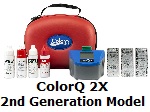 chelate or complex the copper and reduce its potential to
cause staining. However, this interferes with the
action of copper, as an algaecide, and makes it difficult to
determine how much active copper ions you actually have.
A better way is use a MetalTrap
Filter and a small submersible pump, with garden hose
connections. Simply connect the garden hose to the
pump and place in the deep end of the pool. Attach the
other end, of the garden hose, to a MetalTrap filter.
Set the MetalTrap Filter on the edge of the pool, allowing
the pumped water to flow back into the pool. As water
passes through the MetalTrap Filter, copper will be removed.
Test the
copper level before you start and shut off the ionizer.
Keep this process going and monitor the copper level, on a
daily basis. When the copper level drop to under 0.3
PPM, you can stop. If you resume use of the ionizer,
makes sure that you set it at a lower output level and keep
monitoring the level, at least once or twice a week.
This second method doesn't defeat or hamper the performance
of the ionizer, but will help restore an optimum copper
level. I hope that this information will allow you to
avoiding the down side of too much copper.
chelate or complex the copper and reduce its potential to
cause staining. However, this interferes with the
action of copper, as an algaecide, and makes it difficult to
determine how much active copper ions you actually have.
A better way is use a MetalTrap
Filter and a small submersible pump, with garden hose
connections. Simply connect the garden hose to the
pump and place in the deep end of the pool. Attach the
other end, of the garden hose, to a MetalTrap filter.
Set the MetalTrap Filter on the edge of the pool, allowing
the pumped water to flow back into the pool. As water
passes through the MetalTrap Filter, copper will be removed.
Test the
copper level before you start and shut off the ionizer.
Keep this process going and monitor the copper level, on a
daily basis. When the copper level drop to under 0.3
PPM, you can stop. If you resume use of the ionizer,
makes sure that you set it at a lower output level and keep
monitoring the level, at least once or twice a week.
This second method doesn't defeat or hamper the performance
of the ionizer, but will help restore an optimum copper
level. I hope that this information will allow you to
avoiding the down side of too much copper.
Sincerely.
Alan Schuster, 7/23/2014
►
Copper Stains And A Difference Of Opinion?
Upon
returning to Florida this winter season, I noticed my
pool had dark stains on the side walls and bottom. The
spa had even worse staining. My pool service guy, who
comes once a week to service the pool, advised me that
the stains were caused when my pool heater core
corroded, spilling water out of the core on the lawn and
needed to be replaced. He said this caused copper to
leach into the pool. The pool heater was 12 years old.
He recommended that the pool be drained and acid washed
for $500. Another pool guy said it was caused by
improper acid levels in the pool that caused the pool
heater core to leach out the copper. Who is right?
John S., Florida, 1/22/2013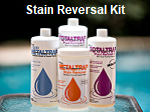
The laws of
chemistry are right. No matter how old the
heater is, copper will only be subject to
corrosion, if chlorine is present and the pH is
under 7.0.
The lower the pH, the worse the corrosion. If
chlorine is not present, no corrosion will
occur, even if the pH is down to zero. High
chlorine and pH will not corrode copper, either.
Copper will only dissolve in acidic water, if an
oxidizing agent (such as chlorine or bromine) is
present. The other "pool guy" is right and it is
indisputable! For help on dealing with copper
stains, a MetalTrap
Stain Reversal Kit should do the job and it
is a lot less expensive than an acid washing and
water replacement. I hope that I have
settled the dispute, but you'll have to solve
the problem.
Sincerely.
Alan Schuster, 1/22/2013
►
Misguided Approach Towards Sanitizing?
I have been using copper sulfate
pentahydrate in my pool at home for 11 months now. I test
everyday and maintain a copper concentration of 1ppm. I do
not use Chlorine. I do use a pH balance and flocculant. Just
recently I have had extensive blue staining around the pool
and the stainless steel ladder has become "copper plated". I
have read that this is due to galvanic deposition. I have
also noticed a strange smell to the water and have a sticky
feeling on my skin after swimming. The pool has been more
cloudy than usual as well. Any ideas on the reasons?
Thanks.
Rob, 3/1/2016
The smell
and sticky feeling are due to inadequate sanitation. Your
approach to pool sanitizing was doomed to failure. Copper is
not a complete sanitizer. It is primarily an algaecide and
is not recognized as being able to control bacterial growth.
In addition, you failed to use
an oxidizer to destroy
organic byproducts and wastes. Copper sulfate is not
recommended, for use in swimming pools, because it can lead
to staining and discoloration. The maximum recommended level
for copper, when added by ionization, mineral sanitizers or
copper algaecides is 0.3 PPM and only if the pH is kept
close to 7.2. You tried to avoid chlorine and that is not as
easy as it seems. Trying to minimize chlorine use was more
attainable. Unlike copper, chlorine is an oxidizer and a
complete sanitizer. You are between a rock and a hard place.
If you try and remove the stains, as detailed below, it has
to be done without chlorine or other oxidizers present. Once
the level is lowered or treated appropriately, you will have
to add lots of chlorine and establish a stable level of 1-3
PPM. That should address the odor and slime issues. Because
the slime may be covering stains, you may have to repeat
this procedure. This is not going to be easy or inexpensive.
There is no silver bullet. Once you solve the problem, I would give
thought to adding a
salt chlorine generator. It is the better way to add
chlorine.
Too much copper can result in staining, especially, if the
pH is high. Adding an organic phosphonic acid product can
help. However, these products
can break down over time and allow a return of the copper
problem, as well as a phosphate problems. Just adding the
product rarely removes all the stains. To deal with
heavy metals, such as iron, copper and manganese, a
MetalTrap Stain Reversal Kit,
available in our
website store, contains the complete regimen of products to
remove the stains, eliminate the metals from the water and
help assure that a recurrence does not happen. So far
as I know, no pool chemical manufacturer markets 100% copper
sulfate, as a pool algaecide, because of the inevitability
of staining, green hair and fingernails. I hope that
this information will be helpful.
Sincerely.
Alan Schuster, 3/1/2016
► Copper
Eating Plaster?
First, I want to let you know how
pleased I am with my
ColorQ PRO-11 Test Kit. I have had it
for about three years now and the ColorQ Pro-11 has provided
reliable, easy testing of my pool and spa water. The
question I have is a whether or not copper in the water
"eats" the plaster of a pool. During the recent installation
of a replacement safety cover, the installer pointed out
that I had some bluish flecks appearing in the white plaster
of my gunite pool. He said that it was a result of a buildup
of copper sulfate that was in the Granular Pool Sanitizer,
that I use, and that I should get the pool acid washed to
remove the stains before it eats my plaster. Since I just
had the pool re-plastered two years ago I really don't want
to go through an acid wash this soon unless I really do have
a problem. My research hasn't turned up anything indicating
a problem with this specific chlorine product and plaster
nor, for that matter, copper and plaster. As further
background, I removed virtually all copper plumbing from my
filtration system three year ago and my current copper
reading with the ColorQ PRO-11 is 0.4. What are your
thoughts on this?
Regards, Victor B., 9/12/2011
It would take a considerable amount of copper sulfate to get
a copper reading of 0.4 PPM. Most chlorine products with
copper sulfate, contain
low levels. Try placing some 500-mg vitamin C tablets on a
stain and allow to dissolve. If this works, I suggest
that you use a MetalTrap Stain
Reversal Kit. It contains everything you need to
remove any copper stains, eliminate the copper, from the
pool water and help prevent a recurrence. Copper
does not eat plaster! It is acidic, corrosive water
conditions, that etches plaster and, if chlorine or bromine
are present, will corrode copper plumbing or heat
exchangers. You can better preserve the plaster finish, by
keeping the pH at 7.2-7.6, the TA at 80-120 PPM and the
calcium hardness at about 200-250 PPM. I suggest not using a
product that contains copper sulfate, as 0.4 PPM is already
higher, than you want it, even if you were using an ionizer.
I hope that this information will set the record straight.
Sincerely. Alan Schuster, 9/12/2011
► Copper
Panels Causing Concern?
My daughter has been getting green
hair ever since we installed our pool 9 years ago. I
researched and found solar panels manufactured in the LA
area. They always stayed straight and did not reduce pump
pressure by using ½ copper lines encased with aluminum fins
that absorb heat into the water in the copper lines. I
thought it was great and have been very happy with it until
my daughter continued to get green hair. It appears that the
copper is getting to great levels because it always just
recirculates the same water thru the solar panels. A solar
installer says that I have to change the panels and drain
the water. That the panels are for domestic water heating
systems and can not be used for a pool. My questions are: 1.
Will putting a mineral reducer in the water solve my
daughter green hair problem? 2. Will continuing to have the
water go thru these copper pipes in the solar panels become
a problem? 3. Should I change out the panels? Thanks.
Jim, 4/1/2010
If you allowed the pH to fall into the acid ranges and were
using chlorine, the copper will dissolve. There are pools
with copper heat exchangers and copper pipes and they don't
necessarily have problems. Keep the pH up and there should
b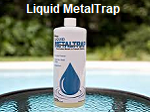 e no problem. These panels are not widely used, probably
because of the cost. Plastic is less expensive and not prone
to corrosion. If you opt to replace the panels,
some models
would be an ideal DIY solution. Have the water tested for
copper. It will be present. Add a dose of a quality metal
treatment, such as Liquid METALTRAP, for each 1.0 PPM of
copper. Add another one monthly. If the copper is more than
2 PPM, you might consider replacing some water, to get it
under 0.3 PPM. Another option would be to use a METALTRAP
Filter and a small submersible pump, to recirculate the pool
water, until the copper level drops. The treatment could
prevent further greening of the hair. Any chlorinator should
be last in line and separated by a check valve. Have your
daughter use an acidic hair condition. Apply generously, and
leave on for 15 minutes. Repeat, as necessary. Stains are
probably due to copper and are rarely removed by simply
adding a metal treatment. You might have to use a product
such a METALTRAP Stain Remover. I hope that this information
is helpful.
e no problem. These panels are not widely used, probably
because of the cost. Plastic is less expensive and not prone
to corrosion. If you opt to replace the panels,
some models
would be an ideal DIY solution. Have the water tested for
copper. It will be present. Add a dose of a quality metal
treatment, such as Liquid METALTRAP, for each 1.0 PPM of
copper. Add another one monthly. If the copper is more than
2 PPM, you might consider replacing some water, to get it
under 0.3 PPM. Another option would be to use a METALTRAP
Filter and a small submersible pump, to recirculate the pool
water, until the copper level drops. The treatment could
prevent further greening of the hair. Any chlorinator should
be last in line and separated by a check valve. Have your
daughter use an acidic hair condition. Apply generously, and
leave on for 15 minutes. Repeat, as necessary. Stains are
probably due to copper and are rarely removed by simply
adding a metal treatment. You might have to use a product
such a METALTRAP Stain Remover. I hope that this information
is helpful.
Sincerely. Alan Schuster, 4/2/2010
► A "Safe"
Copper Level?
We have the instructions for the
LaMotte code 3619 copper testing kit but it doesn't say the
colour which is a safe level can you help please.
Geraldine, 4/28/2009
If you are referring to what level of copper is "safe", that
can depend upon the source of the copper. If the source is
natural or corrosion of copper components, the content is
best at nil. Any measurable quantity should be treated. If
the source is a copper algaecide, 1 PPM is generally the
suggested upper limit. If the source is the presence of a
mineral sanitizer
or an ionizer, it should be based on the manufacturer's own
recommendation. Usually this is on the order of a few tenths
of a PPM or 0.3 PPM maximum. The copper level can be
monitored using a simple
copper test
kit or one of several
all-digital ColorQ Labs, that can
perform a complete water analysis. I hope that this
information proves to be helpful. I hope that this
information proves to be helpful.
Sincerely. Alan Schuster, 4/28/2009
► Is This A
"Toxic" Copper Level?
I was wondering how safe it is to swim
in a pool that is sanitized by ionization, in particular, if
the copper level is higher than the recommended amount. I
just got an ionizer installed in my pool and, not being
familiar with the system at all, I was not monitoring the
copper level. I had someone else do it for us. It turns out
that my copper level was at .7 to 1.0 ppm as opposed to the
recommended amount of .2 to .3 ppm. At the time, I was also
having a lot of sediments at the bottom of the pool. I would
ask the people, who would monitor the pool what that was,
they did not know. Well now, I know that the sediments may
have been excess copper, because when I would vacuum it up
it would have a blue/green color. Please let me know how
toxic, the pool may have been with such a high level of
copper. Thank you.
Huguette S., 3/25/2007
It is not a matter of toxicity - it is a matter of trying to
avoid staining. Algaecides typically can add 1 PPM of
copper. The lower setting help prevent copper staining and
discoloration, while still providing enough copper. Try
keeping the pH closer to 7.2, until the level has dropped.
Adding a onetime dose of a metal treatment, such as
phosphate-free Liquid METALTRAP, might help minimize
staining and precipitation. I hope that this information
proves helpful.
Sincerely. Alan Schuster, 3/26/2007
► Copper
Stained Tile Grout?
I recently bought a house that had a
pool. The heater coils were pretty bad and the heater has
been replaced. Unfortunately, the copper from the heater -
staining the grout . What steps can I take to remove the
copper stains so the tile grout is at least more vibrant
than it is now? Would scrubbing the tiles with a mix of
water and muriatic acid be a solution? Perhaps scrubbing
the tiles with a stain remover is the answer? I have added
stain remover to the pool and let it circulate, but this has
not provided any noticeable difference. Thank you for any
guidance. Regards.
Scott M. from Florida, 5/17/2011
Adding a stain remover to the pool water is unlikely to
produce any noticeable improvement. Try this. In a plastic
bucket, first add 2 quarts of tap water, 1 quart of a
quality mineral treatment, such as phosphate-free,
Liquid
MetalTrap, and lastly 1 quart of muriatic acid. Drop the
water level below the tiles and use this solution with one
of those sponge-backed scrubbing pads. Make use that you use
eye protection and rubber gloves. The purpose of the mineral
treatment is to prevent any copper removed from the tile
from causing a recurring problem. This mixture should
dissolve the top surface layer. Another method would be to
use a strong solution of METALTRAP Stain Remover. Unlike
oxalic acid products, it is not toxic. Good luck and I hope
that things brighten up for you.
Sincerely. Alan Schuster, 5/18/2011
► Copper
Problem Or Green Algae?
Alan, I found your website and was
hoping that you could help us. We had a green tint in our
pool water. After testing it, the pool store employee felt
that copper was the problem. The chlorine level was at zero.
Mistake on our part. The pH was too high. She directed us to
buy sequestering agent. We did and added it. A day later we
also added chemicals to reduce the pH (as directed by the
pool store). We went to another pool store (our favorite
one) to get the water retested and see what else we could
do. They found that the copper levels went up even more
after the sequestering agent was added (going from 0.4 to
0.5). They explained that when you use a sequestering agent,
you also need to use a clarifying agent. Each time I've
added the Clarifying agent, the pressure in the filter goes
WAY UP. Normal pressure was around 14, but the Clarifying
agent sends it up immediately to over 25! I end up
backwashing, which removes the clarifier from the pool. And
we start all over again with more clarifier. I've used it
multiple times, but the water color isn't changing. Now
what? Do I keep trying it but use a smaller dose since it
seems to blow out the pressure? The pH is now fine, along
with alkalinity. The chlorine level is back to where it
needs to be. Now, how do I get that copper out of the water
that seems much worse, since using the sequestering agent?
Thanks in advance for your thoughts!
Cheryl F., Mooresville, NC, 5/16/2009
We need to set the record straight. There is no difference
between a reading of 0.4 and 0.5. Both should be considered
the same value, as it is within the testing limits of the
equipment being used. None of the products will take the
copper "out" of the water. "Chelated" copper will remain in
the water, in a stable, soluble form that will help
eliminate staining and discoloration. The product you used
is not a chelating agent, it is a clarifier. It sounds like
you could have a DE filter and if that is the case, stop
using the product. It is coagulating the filter media and
causing the pressure rise. If you don't have a DE filter,
the green color and the pressure rising are due to the
presence of algae. You may have copper in the water, but it
is algae that is turning the water green. Do you have a
heater? Did you ever add copper algaecide. If the answer is
no, where did the copper come from? If the problem is algae,
as I suspect, you need to start boosting the Free Chlorine
level to a stable 1-3 PPM. Get the pH to 7.2-7.6. The best
way to deal with copper is with a chelating agent, such as
phosphate-free, Liquid METALTRAP, and not a sequestering
agent. Add a dose as soon as possible. POOL REFRESH
is a product that might present a better and easier
solution. It will convert heavy metals to a form that can
allow them to be filtered out. It is entirely possible that
the achieving of a stable free chlorine level and the
lowering of the pH will eliminate all of the problems.
Minerals are more soluble at lower pH readings and the high
pH could not have been a positive factor. I hope that this
information proves helpful.
Sincerely. Alan Schuster, 5/17/2009
► Where Has
All The Blonde Hair Gone?
My two daughters have blonde hair (the
natural type) and have developed a greenish tint in their
hair. We have had the pool for three years and this is the
first time this has happened. What can I do to stop the
problem and is there anything that can help their hair?
Please help. Thank you.
Dave A., Rocky Mount, NC, 3/12/2010
Two possibilities. The chlorine is affecting the hair and/or
some of the hair products, that might have been used. The
other, more likely possibility is copper. You can have the
pool water tested, by a local pool professional to confirm
the presence. The question of what is the sourc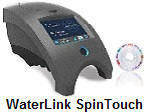 e of the
copper remains. Chelated copper algaecides are usually not
the problem, especially if used as directed. If you have a
heater and use chlorine or bromine, the presence of low pH
conditions over prolonged periods can result in some copper
corrosion in the heater. This will add copper to the water
in a problematic form. In either case, here is what I
suggest. Add a double dose, for each 1 PPM of copper, of a
quality metal treatment, such as phosphate-free
Liquid
METALTRAP. This will chelate (stabilize) the copper and
avoid further problems. So far as the hair is concerned, try
this: shampoo in the usual manner and apply a generous
amount of an acidic Leading Brand Hair Conditioner and leave
on for 15 minutes. These products have a very low pH and
should help "pull out" the discoloration. Repeat daily, as
necessary. Kids can spend a lot of time in the pool and that
can make them more susceptible, to this problem, than
adults. I hope that I have been helpful. To better assure
proper overall pool water chemistry, visit a pool store that
has a very reliable, professional lab such as a
WaterLink SpinTouch Lab, rather than a less accurate test kit or
strip reader. Enjoy the summer.
e of the
copper remains. Chelated copper algaecides are usually not
the problem, especially if used as directed. If you have a
heater and use chlorine or bromine, the presence of low pH
conditions over prolonged periods can result in some copper
corrosion in the heater. This will add copper to the water
in a problematic form. In either case, here is what I
suggest. Add a double dose, for each 1 PPM of copper, of a
quality metal treatment, such as phosphate-free
Liquid
METALTRAP. This will chelate (stabilize) the copper and
avoid further problems. So far as the hair is concerned, try
this: shampoo in the usual manner and apply a generous
amount of an acidic Leading Brand Hair Conditioner and leave
on for 15 minutes. These products have a very low pH and
should help "pull out" the discoloration. Repeat daily, as
necessary. Kids can spend a lot of time in the pool and that
can make them more susceptible, to this problem, than
adults. I hope that I have been helpful. To better assure
proper overall pool water chemistry, visit a pool store that
has a very reliable, professional lab such as a
WaterLink SpinTouch Lab, rather than a less accurate test kit or
strip reader. Enjoy the summer.
Sincerely. Alan Schuster, 3/13/2010
► Copper
Tubing For Algae Control?
I heard if you coil a piece of copper
tubing and put it in your skimmer basket it will reduce
algae growth. I put a piece in and it seems to be better,
but not exactly as good as it could be. If I use a bigger
piece will that work?
Bashful, 8/17/2005
You may have heard it, but that doesn't make it right.
Copper will not dissolve in pool water, unless there is
chlorine or bromine present and the pH is low. However, that
will risk corrosion to other metal parts, as well as the
creating harsh swimming conditions. There are products and
devices that add copper, by various methods. Copper tubing
is not one of them! If you want effective algae control,
start by keeping the free chlorine level at 1-3 PPM. If you
want to add some copper, you can use a
ionizer or a copper algaecide. I hope that this
information will prove useful.
Sincerely. Alan Schuster, 8/17/2005
► Copper
Sulfate As An Algaecide?
A friend of mine swears that copper
sulfate is a great algaecide. He says that it is cheap and
that it works. His pool does look good. What do you say?
Paul A., Danbury, CT, 8/23/2004
Your friend is partially correct. It is an effective
algaecide and it is cheap. BUT IT SHOULD NEVER BE USED IN A
SWIMMING POOL! Copper sulfate is used as an algaecide, in
the treatment of surface waters, such as reservoirs, lakes
and ponds. It should not be used in swimming pools and, so
far as I know, no
swimming pool chemical marketer or packager offers 100%
copper sulfate for sale. At the pH of a typical swimming
pool and in the presence of chlorine or other oxidizing
agents, copper (from copper sulfate, natural sources or
corrosion of heaters) can and will cause staining and
discoloration of pool surfaces and hair. The copper products
used, as swimming pool algaecides, are typically in a
chelated (stabilized) form. These specially formulated
products avoid the problems associated with copper sulfate. I hope that you will heed my advise. Enjoy the season.
Sincerely. Alan Schuster, 8/23/2004
►
Copper Level Not Going
Away?
We had an acid problem last summer and
determined that it ate away at our heat exchanger this
summer. We had copper issues all summer and used Metal Free.
We replaced the exchanger and also unhooked the heater for
the rest of summer. We can't seem to "remove" the copper
that is in the water. It stays around 2 ppm. Our local pool
store has had me try Filter Aide (many times) along with a 2
part clarifier with no success. Summer is over and we want
to close the pool, but not with the copper present. Every
time the chlorine goes up, so does the copper. We don't want
to keep it at bay. We want to REMOVE it. Any suggestions
would be appreciated. We are so very frustrated. Thank you!
Greg and Diane, 9/28/2006
Adding metal "removers" chelates or complexes the copper and
other heavy metals. It doesn't actually remove them, as that
would incur
precipitation, staining and discoloration. There is no
mention in your letter, about staining or discoloration.
If you add Pool Refresh, it will
help you filter and vacuum out, the copper and other heavy
metals. As a bonus, it will remove phosphates, as
well. I hope that I have
been helpful.
Sincerely. Alan Schuster, 9/28/2006
► Nasty
Copper Stain Problem Solved?
I recently had a nasty season-opening
copper stain on my vinyl liner that was caused (I now know)
by corrosion from my heater last season. The stain
completely covered all of the sidewalls and bottom of my
27,000 gal in-ground pool. My local pool store recommended a
stain remover product, which I used and nothing improved.
Scrubbing of the walls and floor did nothing before or after
the application of the stain remover product (which cost me
$20 per quart and I used 3 quarts). Anyway, I noticed your
site mentioned a Vitamin C tablet test, and I tried this
test on one of my sidewalls and I was amazed. I pressed a
normal sized Vitamin C tablet onto the side wall and I could
write lines immediately – the stain came right off. I
ordered the Metal Trap Stain Reversal Kit, which contained
everything needed to remove the stains and eliminate the
copper and heavy metals from the pool water. Thanks, for
having this information available on-line.
Bob J., 6/1/2017
No questions! Great letter! Glad to hear that it worked out.
Just adding a metal treatment rarely works. The problem with
Vitamin C tablets is that they contain other inert
ingredients, that may cause interaction with swimming pool
chemicals. The MetalTrap Stain
Reversal Kit, available in our
website store, contains the complete regimen of products to
remove the stains, eliminate the metals from the water and
help assure that a recurrence does not happen, after
chlorine is added. I'll give you an "A" for effort!
If you avoid the corrosively low pH, that caused the
heater corrosion, the problem should remain solved. I
am happy to hear, the website was helpful.
Sincerely. Alan Schuster, 6/1/2017
► Green Hair?
HELP ME PLEASE! MY HUSBAND AND I
PURCHASED A DOME FOR OUR ABOVE GROUND SWIMMING POOL! PROBLEM
IS OUR HAIR IS TURNING GREEN ~ IT IS UNREAL! WE HAVE OWNED
THIS POOL THREE YEARS BUT JUST PUT THIS DOME ON THIS POOL.
WHY IS THIS HAPPENING? WHAT CAN WE DO TO ELIMINATE THIS
PROBLEM? PLEASE EMAIL ME BACK. THANK YOU.
MRS. ANGELA B., 9/7/2014
The dome has nothing to do with the problem. There are
two possibilities. One is that you have a heater and have
subjected the copper coils to acidic conditions in the
presence of chlorine and/or bromine. The other possibility
is that you used a copper algaecide that may not have
been based on a chelated or stabilized formula or used the
product to excess. If you have a heater, it is the likely
source of the copper. If you have a built in
chlorinator, it should be plumbed in after the heater and
should be separated from the heater by a check valve. Have
the pool water tested for copper. The green hair is all the
confirmation I need. To stop the problem, I suggest that you
use a MetalTrap Stain Reversal Kit.
It contains everything you need to remove any copper stains,
eliminate the copper, from the pool water and help prevent a
recurrence. So far as
the hair is concerned, try this: shampoo in the usual manner
and follow with a generous application of an acidic, Leading
Brand Hair Conditioner. Leave on for 15 minutes. These
products are very acidic and will helpfully pull out the
green. Repeat again, as necessary. In the future, make sure
that the pH is always in the 7.2-7.8 range and avoid the use
of products that contain copper.. I hope that I
have been helpful.
Sincerely. Alan Schuster, 9/7/2014
► Blue
Something - Possible Copper Stain?
I have a question. We had a small
problem with mustard algae. We went to our pool supply and
brought a water sample and they sent us home with some
copper algaecide. Now our less than 1 year old pool has a
blue something all over the bottom and stairs. We went back
and they gave us a mineral remover. I don't know what to do
now. Help!
Steve, 3/7/2017
The "blue" something could be copper. If the copper
algaecide was a chelated copper formulation, it would be
unusual to cause staining, unless the pool water chemistry
was far from optimum or, in the case of masonry pools, the
pool finish had not completely cured. The product that you
added is used to help
control heavy metal staining. I doubt that it will remove
the stains just by the simple addition of the product to the
pool water. The MetalTrap
Stain Reversal Kit contains a regimen of products, that
will help remove the stains, eliminate the copper from the
pool water and help prevent a recurrence, after chlorine is
added. I would limit the use of copper algaecides and
keep the copper at 0.3 PPM maximum. You might consider
using a 60% polymer algaecide, as a means of mustard algae
control. I hope that this information
will prove helpful.
Sincerely. Alan Schuster, 3/7/2017
|
Visit The Website Stores . . . for
better informed shopping!!! |
|
|
Shipping is FREE* . . . within
the Continental U.S.
A $9.99
handling charge will apply
to Continental U.S. Orders,
under $75.00. Orders
outside of the Continental
U.S. may require some
additional charge, based on
quantity and destination.
Most products can be
shipped World-Wide. International
and orders outside of
Continental U.S. - see
comments on the ordering
pages. |
|
|
Major
Credit Cards and PayPal are accepted. |
|
▲
Return To Top Of Page
▲
Aqualab Systems, LLC does not
make any warranty or
representation, either expressed
or implied, regarding the
accuracy or completeness of the
information provided by this
website; nor does Aqualab
Systems., LLC. assume any
liability of any kind whatsoever
related to, or resulting from,
any use or reliance on this
information. The content of this
website should not be used, if
it is conflict with any
applicable federal, state or
local regulations or guidelines.
© Aqualab Systems, LLC. All
rights reserved